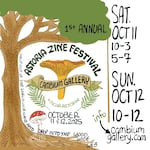
The Astoria Zine Festival flier invites participants to "drop out of the worldwide web and drop in to the wood wide web." The event takes place Oct 11-12, at the Cambium Gallery.
Courtesy Heather Douglas
Heather Douglas loves making zines, both long and short, big and small, about subjects both serious and lighthearted. The zine — its name a shortened form of magazine and pronounced “zeen” — has been around for decades, and can refer to a single sheet of paper folded into multiple panels and hand drawn, or multiple sheets of paper folded in half, similar to a chapbook.
The zine arguably saw its zenith in the late ’90s and early 2000s, before the rise of social media and the ubiquity of internet platforms that provided a million digital forms for self-expression. But for many cartoonists and zinesters, like Douglas, the physical, analog nature of the form is one to be treasured and the fact that it brings people together — offline, in real life — is one of its many appeals. That’s one reason she approached her fellow Astorian Kirista Trask with the Cambium Gallery about creating a zine festival, something she said she’d never seen before in the city.
Trask was enthusiastic and by chance had just put out her own zine about the gallery. They created the Astoria Zine Festival, which takes place at the gallery this weekend. Douglas and Trask join us, along with BB Anderson, a Portland zinester and co-organizer of the long-standing Portland Zine Symposium. They all share more about the enduring appeal of the art form and why they consider it more vital than ever.
Note: The following transcript was transcribed digitally and validated for accuracy, readability and formatting by an OPB volunteer.
Dave Miller: This is Think Out Loud on OPB. I’m Dave Miller. Before there was social media, there were zines. The hand-drawn booklets were distributed through the mail or in person and covered basically every niche topic you can imagine. Zines saw their cultural high point probably in the late 1990s and early 2000s. But many people are still finding joy in the physical analog art form and the offline communities that they can foster. That includes cartoonist and zinester Heather Douglas in Astoria. She has partnered with the gallery owner Kirista Trask to put on the first Astoria Zine Festival at Kirista’s Cambium Gallery this weekend. They both join us now along with BB Anderson, a Portland zinester and co-organizer of the long-standing Portland Zine Symposium. It’s great to have all three of you on Think Out Loud.
Kirista Trask: Thanks.
Heather Douglas: Thanks for having me here.
BB Anderson: Thanks Dave.
Miller: Heather first, many of our listeners have read zines. Some I know have made them, but I am sure that plenty of folks have never seen one. What’s your definition of a zine?
Douglas: Oh, I thought you would ask that question, because it’s sort of, it’s not implied, but it’s something that actually, when we started this concept, a lot of people have asked, like, ‘what is a zine?’ That’s usually their first question. So, I mean, typically, I think of it as the gatekeeper is removed, so there’s no publisher, you can just make a zine anywhere, any place, anytime. It can be a one-off zine or multiple copies, usually produced independently, homegrown. And it’s usually around a published passion project, so it’s usually passion over profit. And a lot of times it has a political element, sometimes things that aren’t safe to maybe publish, you can do that through kind of underground zines.
Miller: When were you first introduced to zines?
Douglas: Oh, that’s a good question. Long, long time ago before I started making zines, I picked up a punk zine, but it was about how to make a light bulb out of a potato. And I just thought that was really interesting and they had these really funny illustrations. It was actually a zine that I like found on the ground in Portland. And I just thought this is really fun, but I didn’t feel like I was cool enough to do zines. And then later I realized that zines are for everybody, so that’s kind of how I started.
Miller: Did you make a light bulb from a potato after picking it up from the ground? Did you test it out?
Douglas: I didn’t. No, I wish I had now. It would have been a good story.
Miller: Kirista, what about you? When did you first become aware or enamored of zines?
Trask: It was when I was in college. I went to University of Oregon and we participated in a conference at the time called Creating Change, and one of the workshops was about making zines. I mean, at the time I was super into Tumblr and I loved the idea that you could have an analog version that felt very similar to me. I like the idea that I could be in control and that I could just put whatever I wanted out there into the world.
Miller: Fascinating. So, but so that was if Tumblr for you came before as this – I don’t even know if it’s still around, probably it is – but a kind of visual, scrolling blog, but when you saw zines, you thought, ah, a kind of offline version of this online thing I’m already a fan of?
Trask: Yeah, I think that being a visual artist, my brain has always worked visually. So I immediately saw it as a platform to express the complexity of ideas that maybe I was working through for my artwork.
Miller: And BB, what about you? When did you start making zines?
Anderson: Oh, I think I saw… Sorry, it’s hard for me to not think about the light bulb potato zine right now. I want to find out who made that. Probably I saw zines at the Multnomah County library. I was fortunate enough to be part of a of a library system where they actually had zines on display and I didn’t actually know that they were zines at the time, but I kind of replicated them without even knowing that’s what they were. And then it actually took a few years until I finally figured out that that’s part of the, I guess the medium and like the culture around it and so.
And then I think when I actually started tabling, that sort of propelled me forward with my zine making. But I would say probably like the end of high school, right outside of high school. I spent a lot of high school reading them and then after that I spent a lot of time, I dedicated a lot of time to making them.
Miller: What were some of the themes from those first zines that you made?
Anderson: Oh, for me, I did a lot of, I think what Kirista was talking about, it was very being fascinated with a particular topic, and it was an opportunity for me to make stuff with my friends. So the early ones were actually collaborations. Sometimes I would do, I’m a visual artist, so I would do the art for it and then my friend would do the writing. Sometimes we would trade off on art and so it felt like this real collaborative effort. And then we would just go to the Kinko’s, I think before it became FedEx Kinko’s, and we would just make a ton of copies for tabling events or just to share with our friends and family.
Miller: Heather, when did you first think about creating a zine gathering in Astoria?
Douglas: Well, actually it was in tandem with a really amazing author in town, Alyssa Graybeal. She wrote a memoir called “Floppy,” and she and I had been in a writing group together and we thought, oh, let’s create the zine festival. Well, it didn’t quite come to pass. We looked at some venues and it just, there’s some barriers. And so years went by and then a couple people in the matter of a few weeks said, you should start a zine festival. And I was like, oh, I should revisit that idea.
So I thought about where would I want to have it, and I didn’t want to start with a big blank open space and I thought, where would I want to go if I was a zinester and I thought of Cambium Gallery. So I approached Kirista and she was like…
I said, ‘oh, I’m thinking maybe in a couple years, let’s plan it.’ And she’s like, ‘no, we’re doing it this fall.’ And so it was really awesome cause we just hit the ground running and I think that she’s really good at figuring out timing and there’s a kind of a zine culture already building, so it was perfect to just kind of hit that at just the right time. So yeah, that’s how we started it.
Miller: Kirista, why the urgency? So Heather said, let’s do this maybe next year, maybe the year after, and you said ‘no, let’s do it in a couple months.’ Why?
Trask: Well, at the beginning of 2025, kind of shortly after the inauguration, my business partner, Audrey, and I sat down to talk about what would be Cambium’s theme for 2025. And what we discussed was that we wanted to focus on events that cultivated creativity and connection within our real community. So a couple of those first events, we did a group show where we invited artists to submit works that explored themes of political resistance. And I was surprised to find that a number of the submissions were actually zines.
And that sparked a relationship with a local teacher, Noah Hawkes, who teaches introduction to zine workshops. And so Cambium held one of those. And honestly, Heather and I scheduled this appointment. She didn’t tell me what she wanted to talk to me about, and it was kismet. Cambium released our first zine the day Heather and I met. So when she said ‘zine festival’, I thought, politically and culturally, that the time is now. The time is now to show people kind of new alternative ways to connect.
Miller: What was your first… the Cambium Zine again, Cambium is the art gallery that you run in Astoria. What was your gallery’s first zine about?
Trask: It was about the concept of Cambium as Astoria’s living room. So we included a QR code to a playlist – the Cambium Living Room playlist – where we asked our regular customers what was the banger of the summer, and we put it into a playlist. We included recipes, how to make different flavored coffee syrups, and we included a lot of writings on what we think a living room is, what our customers think a living room is, some drawing prompts and just an invitation if you’re having a hard time and you’re not finding community that Cambium is a place that is always open to you.
Miller: What does a living room mean to you?
Trask: That is a good question. Kind of this place where it’s a third space, it’s outside of the home, is what we think of as the living room, but it’s where you come to talk to other people and to meet other people and to be together. It’s not a coffee shop that you’re gonna go and sit at a single table and work on your computer. It’s way too loud. It’s way too robust. We’re having real conversations. People are going to sit with you. It doesn’t exist in this very sterile environment. It felt like a place you invited people into.
Miller: BB, am I right that you attended your first Portland Zine Symposium back in 2007?
Anderson: That’s right, yeah. It’s, interestingly, it was at Smith Memorial Student Union at Portland State University, which is where we’re going to be having it this year. And between then and now, there’s been a number of venue changes, but we ended up going back to that venue, so it feels very much like home for me. It feels there’s something very familiar and very comfortable about being there on campus, hanging out with other zinesters.
But yeah, it was totally, I felt that same sort of movement in that direction of just, I guess being a little like wanting to make something and get it out as soon as possible. And so when my friends, someone who I had worked on a zine with, my good friend Emily, had heard about the Portland Zine Symposium, she was like, we should just get a table, and that was all there was to it. And I felt very out of my element, but it also felt so nice to be behind the table. I think it kind of removed this barrier almost. When you’re there as an attendee and you feel overwhelmed about the person that you’re meeting with and actually putting yourself in those shoes makes it more, it doesn’t seem as scary, I think, to be the person tabling.
Miller: And I guess part of the ethos here is that anybody could be behind the table, right? You don’t need to be a National Book Award winner or some PhD. Anybody can make a zine. Anybody can put it out in the world.
Anderson: Yeah, I think when you have those barriers removed – and this is something that is very appealing as a young person because I feel like you encounter throughout your young life, you encounter so many people who are telling you that you can’t do something or that there’s reasons why you can’t do something – and so for it to be that accessible, not having those barriers is awesome. It means that you can sort of put the dreams that you have for your projects or for your, just your work out and for other people to see and it doesn’t seem like there’s anything that’s sort of keeping you down from doing that.
Miller: I want to turn to some of the recent zines that you all have made. Heather, as a person born and raised in Astoria, one of your series now is about changes to your beloved city. Can you tell us about this series?
Douglas: Yeah, I started a series called Old Astoria, and there’s just a lot of places that no longer exist: restaurants, places to hang out, buildings, names of buildings. So I wanted to sort of preserve that, so I created a series of zines – just comic zines – just documenting some of the old places that used to, that nobody remembers. I mean a few people do remember, but there’s just an example like the Colombian Cafe. That was a real mainstay in Astoria for years and it’s no longer there, so I made a little zine. Also…
Miller: You even mentioned the dishes that people would get, the dishes, I guess people can no longer get, the omelets.
Douglas: Yeah, that was Pier 11, where I had my first bussing job. I was a busser in high school. And so they had a big wooden bar, dragon, I can’t remember the name of it, but there was a big wooden dragon on the bar. And anyways, there’s a lot of stuff like that that people are like, what? What are you talking about? But Astoria has changed a whole lot in the last 20 years.
Miller: Kirista, can you tell us about some of the zines that Astorians have made over the last year or so that you’re excited to have a broader audience get their eyes on or get their hands on?
Trask: Yeah, one of the things about having a publicly available space is when you decide to do something like a zine festival and you start to tell your community, they start to bring zines to you. Some of my favorite zines that we’ve seen so far in relation to the upcoming zine festival is that a local regular customer of ours, Tim Kennedy, who is a woodworker and builder and designer, brought in a single edition zine that has like seven copies about prostate cancer, and about his prostate and his experience of going through treatment, which, at the time wasn’t something he had told a ton of people, and he used zines as his inspiration to express this experience.
It was a really nice full circle moment because he was inspired by the zines of local zinester Noah Hawkes, who is teaching one of our workshops, to use this format, to document his experience this way.
We also received a zine as a guest, as a gift two weeks ago from a local kid about our dog, and that one…
Miller: About your dog?
Trask: About our dog, we lost our dog a couple of weeks ago and honestly this, Ollie’s first response was to draw us a zine about our dog Snacks. I feel like what, culturally, what are we experiencing that an elementary age child’s first response is to make a zine? I think…
Miller: What did it mean to you to get that zine?
Trask: It’s the most beautiful thing I’ve ever seen, and that truly, like is the only description. Ollie knows our dog because we’re neighbors, and to have something that is really heartbreaking to go through immortalized in a very beautiful way, it was a connection point that you just can’t experience any other way.
Miller: BB, that does make me wonder. I mean, and what we’re hearing there is we’re talking about, she’s talking about an elementary school kid. I’m curious what you hear from teens or maybe young adults, but people who have just been throughout their short-ish lives marinated in digital culture. And here we’re talking about the exact opposite. We’re talking about photocopying and folding and stapling, using typewriters maybe or just using a pen and ink, but so offline, so analog. I’m curious what you hear about young people about the physical act of making art in this way?
Anderson: Yeah, I think that there’s no mistake that there’s like a correlation between those two things, and I think it’s very intentional just with the younger generation of creators spending so much time online and on their phones and sort of working in these online spaces, that to actually have something physical and tangible that they can work on kind of as like a self-soothing is like a therapeutic exercise. I think zines really fulfill a role like an art therapy tool and I think I am seeing more and more younger creators, including kids. And it makes me even think of times when I had just folded computer paper in half and stapled it together and then drew on it and that was essentially a zine. So, without even knowing it, I guess I was making zines too.
I think like this physical component is so central and intrinsic to zine making and zine culture. Working in analog ways is very important and pretty foundational, I’d say. And I think there’s more people learning about making zines and actually learning about zines in educational spaces. So instructors, teachers, professors who grew up or who learned to make zines in like the late ‘90s, early 2000s are now teaching it, so you actually have kids, teenagers, young people who are learning from the generation before them about what zines are, how important they are and that they can do it themselves.
Miller: Kirista, we have just about 45 seconds left, but would you be interested in making a zine to give back to your young neighbor whose work really touched you?
Trask: You know I had started what isn’t a zine, but a pullout accordion book about my young neighbor. I’m just documenting experiences of what it’s like to live in conjunction. At some point that is going to be complete and will be returned. It’s been slower than my normal zines though, because I think there’s a lot more intention with the creation of it.
Miller: Kirista, BB, and Heather, thanks so much.
Douglas: Thank you.
Trask: Thank you.
Anderson: Thanks, Dave.
Miller: Kirista Trask and Heather Douglas are the co-founders of the first ever Astoria Zine Festival. It’s happening this weekend in Astoria. BB Anderson is a zinester, designer, multimedia artist, and an organizer for the Portland Zine Symposium since 2018.
“Think Out Loud®” broadcasts live at noon every day and rebroadcasts at 8 p.m.
If you’d like to comment on any of the topics in this show or suggest a topic of your own, please get in touch with us on Facebook, send an email to thinkoutloud@opb.org, or you can leave a voicemail for us at 503-293-1983.