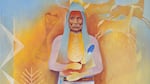
Iméec’inpun (The Prophet), 2001, by Nakia Williamson-Cloud (detail)
Courtesy Nakia Williamson-Cloud/Oregon Origins Project
Before colonization and the decimation of Indigenous people, Nez Perce, or Nimíipuu, lands encompassed 17 million acres that would become parts of Oregon, Washington, Idaho and Montana. The Nez Perce Indian Reservation currently consists of 750,000 acres in North-Central Idaho.
The Oregon Origins Project aims to bring the traditions, art and storytelling of Oregon’s first peoples to a nonnative audience, and to provide additional space for tribal members, or culture bearers, to gather with each other for their own benefit.
This Saturday, Oct. 18, the Project presents its seventh series, called “Earth + Heart, Being and Becoming Nimíipuu” at 6 p.m. at the Reed College Performing Arts Building.
We learn more in conversation with Nez Perce/Nimíipuu tribal members Nakia Williamson-Cloud and Phil Cash Cash, along with Matthew Packwood, the executive director of the Oregon Origins Project.
Note: The following transcript was transcribed digitally and validated for accuracy, readability and formatting by an OPB volunteer.
Dave Miller: This is Think Out Loud on OPB. I’m Dave Miller. Before European colonization and the decimation of Indigenous peoples that followed, Nez Perce or Nimíipuu lands encompassed something like 17 million acres throughout the Northwest. The Nez Perce Indian Reservation currently consists of less than a million acres just in north central Idaho. But vibrant Nez Perce art, culture, and language is not geographically contained. Nez Perce art makers and culture bearers will gather in Portland this coming Saturday for a live event put on by the Oregon Origins Project. The nonprofit was created three years ago to bring the traditions, art, and storytelling of Oregon’s first peoples to non-native audiences and to provide additional spaces for tribal members or culture bearers to gather with each other for their own benefit.
This Saturday’s event starts at 6 p.m. at the Reed College Performing Arts building. It’s called wéetes waχ tim’íne or Earth and Heart, Being and Becoming Nimíipuu. Matthew Packwood is the Executive Director of the Oregon Origins Project. He joins us now along with two of the artists and storytellers who are going to be taking part in this Saturday’s event. Nakia Williamson-Cloud is the Director of the Nez Perce Tribe’s Cultural Resources Program. Phil Cash Cash is a visual artist, writer, and linguist and a co-founder of Crow’s Shadow Institute for the Arts. Great to have all three of you on the show.
Phil Cash Cash: Yes, good morning and good day to everyone.
Miller: Matthew Packwood, what is the Oregon Origins Project?
Matthew Packwood: Thanks, Dave. Thanks for having us. Oregon Origins Project, our fundamental mission is to celebrate the ancient origins of what we call Oregon through creative expression. And we do that in a couple of ways. Our fall events are a platform for Indigenous artists and culture bearers to share their living traditions and their creative work. And our spring events are an open call to all artists of all backgrounds to explore this place we call Oregon and the places we love through music, theater, dance, et cetera.
Miller: What did you think was missing from Oregon’s arts and culture program? There are a lot of nonprofits, a lot of arts organizations. Why create a new one?
Packwood: My orientation is as a composer and the performing arts, musically oriented. And for me, this idea of this rich place that surrounds us is something that we live with every day that Oregonians are renowned for loving. I wanted to see more of that brought to the fore, not just through the performing arts, but also through Indigenous culture. Really what we’re trying to do here is bring together community to celebrate these places that we love and to deepen our awareness of their really ancient and profound history and culture.
Miller: If I’m not mistaken, the event this coming Saturday is the seventh one of its kind that you’ve put on. Can you give a sense for the events you’ve already done?
Packwood: They kind of run the gamut. I’ll try to be brief but we’ve had a number of culture bearers from tribes across the state from as far east as the Umatilla Walla Walla down to the south coast with the Chetco and the Hanis Coos. Those events have been our fall events. And in the spring we’ve had new commissions of works by playwright Sara Jean Accuardi. We have a new dance work coming up in Bend this summer by push/FOLD who are this Portland-based dance company, and they’re creating a work inspired by a volcano out there. So we really are digging deep metaphorically and literally with this idea of place and our relationship to the land through art and culture.
Miller: Nikia, what made you accept Matthew’s invitation to take part in this Saturday’s event?
Nakia Williamson-Cloud: For me personally, it was really important to have this opportunity to express many of these things that are so very elemental to our way of life, our way of understanding our existence. So I thought it was a very good opportunity to educate. In this time that we live in, there’s a lot of lack of knowledge about other ways of knowing, other ways of being. And the fact that our way of life is grounded in this very landscape that we all share is really important to express visually, through the act of storytelling, through our language. Because everything that we are, as Nimíipuu, is dependent on this relationship with these lands and with these rivers that are a part of this broad place we call the Pacific Northwest and even beyond.
Miller: Is there a connection between the goals of the Oregon Origins Project that we’re just hearing from Matthew and what you do in your day job as director of the Nez Perce tribe’s Cultural Resources Program?
Williamson-Cloud: Oh, most definitely. What we do is all land-based. It’s all based on what happens on the landscape and how it impacts the life and culture, and not only the history, but also the future of our people as we’re taught to make decisions in a way that is looking generations ahead, not just a five-year planning period or a 20-year planning period. These things are in perpetuity that we have been able to extend the life of our people and the life of all beings on this land. And so it’s very fundamental to our existence as Nez Perce people, the existence of all life around us, which includes all of you and all of our listeners that are here this morning.
Miller: Phil, what about you? Why did you say yes to this request?
Cash Cash: Similar to what Nakia just said, the opportunity exists for the expression and meaning of our experience as Indigenous people, still ongoing, still very profound and every opportunity is always a renewed interest to share with the broader mainstream and Oregon community what it means to be an Indigenous person.
Miller: I did my best to say in the Nez Perce language, the Nimipuutímt language the name of this event. Can you, Phil, give us a sense for what the name actually means to you?
Cash Cash: Yeah, the discussions we had with Nakia and Darla and with Matthew, we were trying to come up with the theme for the orientation we all had on our relationship to our life as Nimíipuu, our life as a Plateau person. And we came up with wéetes waχ tim’íne, land and heart. But in this expression, it actually means more than just ‘and.’ It’s more relational, more deep in sense of meaning between those two ideas.
Miller: You mean the English translation of ‘and:’ there’s this thing earth or land, and this thing heart. In the Nez Perce, in the Nimíipuu language, it’s not as simple as just this ‘and’ this?
Cash Cash: That’s right, exactly. It implies a deeper relationship, kind of an essential relationship.
Miller: Because in the language and in your conception of reality, there’s less of a division between them? They’re more, they’re inseparable?
Cash Cash: Yeah, I could say that this relationship has a quality of being. And that expression reflects that relationship.
Miller: It’s such a fascinating, specific example of the ways in which any of our languages can help us understand the world. It’s not just a way to describe things, but it actually fundamentally affects the way you can even think and feel, the language that you use?
Cash Cash: Yes, so in our understanding of our relationship, language plays a vital role in how we understand our relationship to the earth and to the cosmos as well. And our task, especially today, is to instill our language to all the learners that are in the community and work with our elders to ensure that the language is spoken in a manner true to our experience. And that’s always an ongoing challenge. I know Nakia and others of our generation are really working hard to make sure that we perpetuate the language as much as possible.
Miller: Nakia, what’s the connection between the names of things – naming, say, physical features like rivers or mountains or plateaus – and knowing something? I’m thinking in particular about the difference between Euro-American names for places and features, and first peoples or native names for those same places?
Williamson-Cloud: I think the names again are very important of how we see ourselves and how we comport ourselves in relationship to all of life. And in the western construct, we see relationships as existing between people. But our relationships extend out to what is now managed resources and even the very land itself. And so, the names reflect that very deep connection and understanding and even the responsibility, the accountability, that we have as Nimíipuu, as the people of this land.
When the new people came, and as you see throughout our area here in the Lewis and Clark Valley beyond to the east and to the west, you see numerous places even where I live named after Meriwether Lewis and William Clark who came through in 1805, back through in 1806. So there’s this idea of colonization and placing these names of these landscapes and this geography and these resources that have existed for millennia.
Whereas if you contrast that with our names which talk about the place, they don’t talk about individuals. They talk about what’s important at that specific spot. In the Lewis and Clark Valley where from the south the Snake meets the Clearwater River is called Simiinekem. It means the joining of two large rivers. On the Washington side, the place where Clarkston, Washington now stands is Pamapo, the place between two bodies of water. Upstream, Asotin, place of lamprey eel.
So it’s talking about the geography, it’s talking about what’s important about that place because in our conceptualization of our entire life and existence, an individual, no matter how important that individual might be historically, is insignificant to this broad space and time that we exist in relation to this land and to this place.
Miller: Phil, can you give us a sense for what you’re going to be doing on Saturday?
Cash Cash: Yeah, I was thinking about many of the talks that I gave over the years, however for this one, I’m very interested in immersing the audience in a narrative or story, and from a Nimíipuu perspective. And when the stories are shared, there’s usually a very deep orientation to knowledge. The perspectives that are portrayed in our narratives and stories are quite profound, because they give us a sense of being. They give us a sense of direction in life. They help us orient to the world and to what we call the Creation, or the life world that is around us. But they also give us an orientation to a deep set of values or aspirations on how to become and be a good person, or what we say as a real human being in the world. So those are…
Miller: What’s a real human being in the world?
Cash Cash: It’s a type of philosophy that all people across the Plateau follow, including Nez Perce as well. But the general principle behind it is simply to know and understand that at every moment in our life, we are a part of this world. We are part of the ongoing flow of life and creation. And so when we speak of it that way, we are embedded in a very powerful life force or animate way of energy that flows through us.
So in doing so, we account for our relationship to the world. We account for how we are here with a purpose. We are here to engage the world in an honorable and respectful, revered way. Because the world around us helps us to live and it provides all of our needs. When we pay the respect that has been prominent throughout the world and in the Plateau life, we live to see a new day.
Miller: Nakia, what do you most hope that audiences will take away from what you’re going to be providing this coming Saturday?
Williamson-Cloud: What I really hope is that we are able to engage and to recognize, again, this deep time relationship that our people have fostered with this land, with these rivers. But ultimately that what I would hope is through all the visual presentations, through the storytelling, through the words, through the knowledge that we would like to share that has been passed down and bestowed upon us as individuals that live and exist in this time, that simply that our life and humanity would be recognized and engaged with by those that are there and those that will be able to engage in what we are going to be speaking about virtually and beyond.
Because this time that we live in is… We’ve been warned of this time that we find ourselves. And it’s important for us as all people – not just the Nimíipuu, it’s not just about us – but it’s the life and humanity of all people throughout the Pacific Northwest, throughout the United States, North America, and beyond this world. It’s important to understand that humanity, for us, is a big reminder of how we are accountable via our laws, the act of creation that has placed us on this land, to this place that we exist, and that’s something we could never forget. As we’ve seen many things that have happened, utter transformation of the land and rivers around us, and we’ve seen the degradation of our culture, but also the life of people. This is a big reminder to us that we are truly accountable to this land. So that accountability that takes in many forms today is also connected to our life and our identity as Nez Perce people as we exist today. So I would hope that people would understand that powerful connection that even the title of this Oregon Origins Project and this particular group of presentations would help engage with those two things that are so very important that it seems like a lot of people in this world have lost touch of.
Miller: And if a lot of people have lost touch with it, part of it is because of their own doing. I mean, Phil, after a terrible history of cultural destruction – intentional cultural destruction and genocide and broken treaties and forced marches and boarding schools – now, a lot of white people, and I sort of put myself in this… You’re a guest on our show and I’m asking you questions about your culture and language and heritage and ideas of the future and everything. Does any part of you resent white people now saying, after all this, ‘now I want your traditional ecological knowledge? Now please do share your wisdom with us?’
Cash Cash: Yeah, there’s a really difficult process of knowing and the general mainstream wants to know what we know. And those questions are difficult at times, but there’s an ongoing sense of resilience, I think, that many of us adhere to that if we can give a sense of our world and our relationship to the world in its most basic way, but yet meaningful way, we’ve done our work and we can continue with the profound sense of responsibility we have, but have great care in doing so.
I would say too at the same time, our historical experiences are very deep and profound, and our people have made difficult choices to survive. And our task though, as younger Nez Perce and younger Nimíipuu, is to continue to follow the knowledge and the life path that many of our ancestors have provided us, but ensure that the knowledge will have some form of continuity, and our experience too as well should also have continuity. By that I mean our experience of the world will match or be along the same path as our ancestors had once experienced. And to us, this is a mode of being and becoming, as the title implies, that we are on the life path and experiencing the same as our ancestors, but now we are a new community. We’re a new generation of Nez Perce and to us to keep that alive is… It’s a profound experience of being and becoming Nimíipuu.
Miller: Phil, Nakia, and Matthew, thank you very much.
Cash Cash:Qe’ci’ye w’yew, thank you.
Miller: Phil Cash Cash is a visual artist, writer and linguist, a Co-founder of the Crow’s Shadow Institute for the Arts in Pendleton. Nakia Williamson-Cloud is the Director of the Nez Perce Tribe’s Cultural Resources Program, and Matthew Packwood, who we heard from at the beginning, is the Executive Director of the Oregon Origins Project. It’s an art nonprofit that explores ancient Oregon through creative expression.
“Think Out Loud®” broadcasts live at noon every weekday and rebroadcasts at 8 p.m.
If you’d like to comment on any of the topics in this show or suggest a topic of your own, please get in touch with us on Facebook, send an email to thinkoutloud@opb.org, or you can leave a voicemail for us at 503-293-1983.