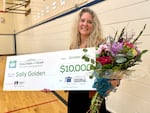
Springfield Public Schools special education teacher Sally Golden was named Oregon’s 2025-26 Teacher of the Year earlier this month.
courtesy of the Oregon Department of Education / OPB
The community transition program is for students with disabilities who have graduated high school with a modified diploma or a certificate of completion. The program serves people ages 18 to 21 and helps prepare them for life after high school through job training and volunteer opportunities.
Sally Golden is a special education transition teacher for Springfield Public Schools. She was recently named Oregon’s 2025-26 Teacher of the Year. She joins us with more on working with students in Springfield and what the award means to her.
Note: The following transcript was transcribed digitally and validated for accuracy, readability and formatting by an OPB volunteer.
Dave Miller: From the Gert Boyle studio at OPB, this is Think Out Loud. I’m Dave Miller. We turn now to Oregon’s newly named Teacher of the Year. Sally Golden has been a special education teacher in the Springfield Public School District for 21 years. For most of that time, she’s coordinated the Community Transition Program. She works with young adults with disabilities, helping them transition to employment, college, community participation, and independent living. She joins us now. Congratulations, and welcome to Think Out Loud.
Sally Golden: Thank you so much, Dave. I’m happy to be here.
Miller: Can you tell us about the moment you found out you had won this award?
Golden: Well, yes, I had known that I had the regional Lane Regional Teacher of the Year award, and I believed that I was going next door to Two Rivers Dos Rios Elementary School to speak to the students about that. And as I arrived with my group of students and staff following behind me, I saw so many people in the gym, and I even saw Dr. Charlene Williams, the head of the Oregon Department of Education, and I was like, “Oh my goodness, this is much more than I expected.”
Miller: But it was based on your detective reasoning at that moment. So you knew that you’d won based on the muckety-mucks who were there?
Golden: I figured it out fairly quickly, yes. But I didn’t know for sure until the announcement was officially made. I was pretty shocked and humbled and all of those things all at once.
Miller: What does it mean to you to have won this award?
Golden: For me, it’s absolutely a team award. One of the biggest reasons that I even went through this Teacher of the Year process was because I wanted to showcase my program and our team here, and that includes students and parents and staff members and community members. So many people are a part of this. This award is by far, more than anything, a team award for not only my program, but my district.
Miller: One of your former students wrote this in a testimonial that was sent to the Oregon Department of Education.
“I graduated from CTP. I think Sally Golden is the best. She is kind and amazing and beautiful. When I was at CTP I loved cooking, art, going into the community, especially the sports center. I really liked working in the garden, and I liked when I had jobs in the community. The other students were my friends, and Sally helped me to problem solve and know that we are all different, but we are a team.”
What did your students think about this news?
Golden: I’m getting teared up as you’re reading that, even though I’ve read it before, of course.
My students were incredibly excited and cheering me on when they realized what was happening, when the announcement was being made. Many of them came up to me afterward to give me a hug or a fist bump or just to tell me how proud of me they are. It just was so heartwarming, and really that’s the epitome of CTP right there is we are here for each other and we’re like a home away from home and a work family all at once.
Miller: I want to go back a little bit. What attracted you to special education from the beginning?
Golden: So I actually grew up in a daycare home. My mom did daycare for 32 years, and I always loved teaching my peers that were in my home. So I thought I might want to be a teacher or a writer. Those were the two things that I thought I might want to be. And as I went through the Springfield Public School District, I had just amazing teachers all throughout, several of whom I’ve actually been able to speak to ever since this award came out to be able to thank them directly. As I went through high school and then college at the University of Oregon College of Education, I realized that I just loved working with individuals with disabilities. I worked at Jasper Mountain Center, and I did Camp Easter Seal. I just got some experience and realized that’s where my heart was, so I decided to go the special education teaching route and went into my master’s program for that.
Miller: What was it about that particular population that grabbed you?
Golden: I think some people are meant to be doing certain things in this world, and I feel that I just was meant to be doing this. The connection that I have with my students, as well as everybody else on my team here is, I think, a testament that I made the right choice in what field I went into. I think that it’s about heart and soul. I was drawn to individuals who maybe struggled with things but had so much potential to shine and contribute to the world, and I wanted to be a part of helping them find how they could contribute positively to the world.
Miller: Special education spans many ages and grade levels. People may think traditionally about K-12, but one of the hallmarks of your program is that it goes a little bit older than that. You’re focusing on young adults ages 18 to 21. What do you like about this age?
Golden: A lot of people don’t even realize that districts still serve students after they complete high school, and that’s the beauty of this program is we still get to watch students grow and develop from the ages of 18 to 21. There is a ton of development that still occurs at that point in time, for all people. But especially with individuals with disabilities, they may need just a little more time to grow into that adulthood, and we are here to bridge that time span.
So first of all, I feel like I relate very well to this age range. I enjoy conversations with students, I enjoy getting to see them become responsible young adult citizens, which I feel is just so vital to our society. And every single person can contribute, regardless of their ability or disability. Everybody can contribute, and I want to be a part of that.
And I just love being able to have that student be the head of their team because they’re adults. So they are the star of the show, the head of the team, and they are the one that matters the most on this team, and to get to watch them grow and learn how to self-advocate, self-manage, and reach for their goals.
Miller: Can you give us a sense for the kinds of disabilities that students in CTP live with?
Golden: We serve students in a wide range. We serve some students who may have significant learning disabilities. Maybe they struggle with reading, writing, math. They won’t necessarily qualify for a developmental disability, but they still just need that extra support and service as they move on into adulthood.
And then I also serve students who do qualify for developmental disability services, which means that they may have something like autism that they work with, or an intellectual disability, or all kinds of categories of disabilities.
But what we all have in common and what I teach my students is it doesn’t matter whether you have a label or not. We all are struggling with things in our lives. We all have to figure out how to overcome the obstacles that we face. Each person is unique, and I’m here to support them through that and to find the resources to help support them as they age out and move on into adulthood after my program as well.
Miller: Can you describe what an average day is like in your program?
Golden: Sometimes we call it structured chaos, because someone that’s observing might be like, “Wow, there’s a lot happening here.” But the students know what’s happening, they know where to go and what to do. And it’s because we are very dynamic and have a lot of activities and skill building going on throughout each day. I have a staff meeting every day because my team is essential and they’re amazing. So we start off, make sure we’re all on the same page. Students come in. I run a large group in the morning, then students go out in small groups with my team of assistants to do things such as working out at the local gym, going shopping for food that they’re then going to make during cooking group the next day, or going to a work site like St. Vincent de Paul. So they’re going into small groups into the community to work on their adult living skills.
They come back for lunch and then they go back out for the afternoon for a different group. And then they come back at the end of the day where we have what I call afternoon debrief with students, and we cover things as a group. And then we have a sign out and check out routine at the end of the day. That’s a typical day. And then we also have many fun events and fun Fridays and all kinds of activities that we throw in throughout the year as well.
Miller: What kinds of specific skills have you found you focus on a lot, year after year?
Golden: Definitely social skills and interpersonal skills. That’s probably my favorite thing to work on with students, and it’s something that almost all of them need to work on. That can be in so many different settings. They might need to learn how to work as a team in a work setting, or they might need to learn how to get along with the peer who sits next to them that really annoys them. How do you deal with that? How do you manage yourself when you’re frustrated, but you have to be there around that person? And so working on those individual situations all throughout the community as well as our building is one of my favorite things to do and never goes out of style, for sure.
Miller: I want to read one more part of a testimonial in support of your award. This is from a parent of two of your students, one former and one current. This parent wrote:
“Sally Golden is the engineer and architect of this dynamic, thriving, successful program that’s characterized by respect, collaboration, integrity, kindness, accountability, adaptability, and innovation, all within the scope of school and community. Skills that might be second nature for ‘typical’ students can be challenging for my daughters. Sally Golden is able to create a culture in her classroom where these skills are taught in a way that’s uplifting and interesting and exciting. She’s able to build relationships student-to-student, staff-to-student, and community-to-student, and in doing so, the students feel successful and respected.”
I was struck by that list of the different levels of connection or sort of spheres of connection that you’re working on: student-to-student, staff-to-student and community-to-student. We could probably spend a long time talking about each of them, but for that last one, community-to-student, what are you trying to do in both of those directions?
Golden: She really was very eloquent in her words, and I’m so grateful to her and all of my parents there. I work with the best students, the best parents, and the best community members.
As you mentioned, community, that’s in our name – the Community Transition Program – because that is what we are all about. And when I find community-based sites such as Saint Vincent de Paul, or our local Catholic Community Services building, or our next door neighbors at Two Rivers Dos Rios Elementary School, I’m looking for community partners where we can have a mutually beneficial working relationship, where our students are going to give to them by volunteering and serving their needs, while they are giving to my students by providing work experience and other skill building opportunities so that the students can continue to grow and learn in a community-based setting. Because the whole idea is that students aren’t just sitting in a classroom all day. We call CTP a program, not a school, because we’ve gone beyond school and we’re now in that post-high school world that is an adult world, and we want to emulate that adult world as much as we can.
So I’m actually connecting students to a variety of agencies as well in order to wrap support around them so that when they graduate from CTP after they turn 21, they’re not just going out into the world with no support. They may have developmental disability services, as I mentioned earlier. They might have vocational rehabilitation services to help with finding and keeping a job, and through that, a job developer potentially. And also making sure that they’re connected to things such as SSI, making sure they have their Oregon ID cards and their food handler cards, and just many of the documents and things that they need to be successful adults.
Miller: In the time that you’ve been doing this work, have you seen shifts in the way people in broader society talk with or interact with your students? I’m just wondering if there have been improvements in inclusion?
Golden: I absolutely think so. Our community partners love having our students. For instance, our LTD bus drivers, the city bus. We use that to access many of our activity groups, and the bus drivers often mention that our students are their favorite riders because they know how to be respectful and kind and appreciative and to behave like you would expect a responsible adult to behave. I feel like we are out there so much that people start to get to know who we are, who our students are, who our staff are, and they become our extended family even beyond CTP.
And I think that also in general, I love to talk about my program and what we do. Even within my own world, my friends and my family love to hear about the things we do here. I think my own excitement and love of what I do helps to bring a positive light onto individuals with disabilities and what they have to offer the world.
Miller: How do you know that you’ve succeeded with any given student?
Golden: I think that the words that you read earlier from a former student really captured that. I feel that I have succeeded when a student is grateful, when a student is loving and humble, when a student comes back to me years later, or maybe even just months later after they graduate, and says, “Hey, I got the job. I’m working at Fred Meyer. I’m working at Bigfoot Beverages,” wherever it might be that they’re getting jobs, because they have continued to move forward toward their goals, and they’re utilizing those services that we’ve put in place before they exited CTP. Sometimes we just see sprouts of students while they’re here, but then years later we see the full bloom. And I love when they come back to tell me about that.
Miller: Do you have any kind of ceremony when your students age out?
Golden: Yes, we have a really fun graduation. In June, we do what we call a drive-through graduation. This started because of COVID, but we actually loved it so much that we’ve kept this model. So we have a large parking lot behind our building where parents will come get their grad student, that student’s in the passenger seat, and they drive down where there’s a breezeway where we have many of us, as well as community partners, parents, family members and friends, lined up with signs and party blowers and whatnot as they drive by and we cheer them on.
And then at the end, we have district administrators as well as myself and my administrator, Hai, are there to give them gifts and signs and take pictures. And then they all go park, and we have a ceremony on our lawn here where our baking crew makes these beautiful homemade cupcakes and everybody gets to enjoy those. And then each of my staff members writes a grad letter to each grad, so each grad has a letter written to them that gets read at this ceremony and it’s very personal and individual, and it’s just a lovely way to send them off into the world.
Miller: You mentioned that you went to Springfield schools yourself. You’re from there, you went there as a student before you became a teacher. When you first started 20-something years ago, were you working with any teachers that you had had as a student?
Golden: Yes, I definitely was because I actually worked at Springfield High School for my first six years of teaching, and I also had done student teaching there as well. So I was very familiar with all of the teachers, not only as a co-worker, but as a former student. And many times, I had teachers as I was walking through the halls to stop me and say, “Hey, where’s your hall pass,” making jokes, because I was so young at the time and still looked like a student, so they would joke about that. So, I had great professional relationships with them, as well as personal.
Miller: So what does it mean to you to be so from a place? It’s so common now for people to move far away from where they grew up. You haven’t done that. I mean, obviously you went to school, although U of O was not that far away. But you have made your life in the place where you started your life. I’m curious how you feel about that?
Golden: Well, I love it. I did live in Springfield for the first few years of my adult life but moved into a rural community right outside of Springfield not long after that, and that’s where I’ve raised my kids. But I am so honored to be able to serve the hometown and the district that I was raised in, because I had a great childhood. I had a wonderful time at all three of my schools – Mount Vernon, and Springfield Middle School, and Springfield High School – and the staff there really helped shape me and guide me. And I just feel like this is serendipitous that I get to serve that community that did so much for me as a child and young adult growing up. I just feel truly honored. And really, I’m just a hometown girl at heart. I’m just an average person, I really am, and I get to do what I love.
Miller: If you could give all of us one bit of advice about being better people when it comes to spending time with people with diagnosed or undiagnosed disabilities, what would you tell us?
Golden: That’s a really great question. As I mentioned earlier, I think I’ve even noticed in my own personal life that people in my life who maybe never were around people with disabilities or not much, are becoming more and more comfortable with the idea of frequent interactions with individuals with disabilities.
I think the biggest thing that happens is people become uncomfortable because they think they don’t know what to say or how to act. And my advice is just be a human because you’re talking to a human – be human to human – because we all are the same in that regard. We all get nervous in certain social situations. And I think generally speaking, the issue is not the individual with a disability not wanting or knowing how to interact, but often it’s others just not wanting to say the wrong thing or do the wrong thing. You’re not going to. Just be human, just be friendly, talk to them like you would anybody else, and you will find such joy in that interaction.
Miller: Sally Golden, congratulations again. It was a pleasure talking with you.
Golden: Thanks so much, Dave. I appreciate it.
Miller: Sally Golden is Oregon’s K-12 Teacher of the Year. For 21 years, she’s been a special education teacher in the Springfield School District.
“Think Out Loud®” broadcasts live at noon every day and rebroadcasts at 8 p.m.
If you’d like to comment on any of the topics in this show or suggest a topic of your own, please get in touch with us on Facebook, send an email to thinkoutloud@opb.org, or you can leave a voicemail for us at 503-293-1983.