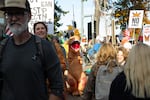
Hundreds of people fill the sidewalks for the No Kings protest in Bend, Ore., on Oct. 18, 2025.
Kathryn Styer Martínez / OPB
More than 40,000 people turned out in Portland alone for the No Kings protest, and people turned up en masse in scores of cities and towns throughout Oregon and Washington.
They were part of an estimated 2,500 coordinated demonstrations across the country against President Trump’s use of presidential authority, extrajudicial deportations, immigration sweeps and attempts to deploy the National Guard in Democratic cities, including Portland.
We’re joined by two organizers for a firsthand report of what the protests were like: Isabelle Fleuraud in Burns, Oregon, and Alan Unell in Vancouver, Washington.
Note: The following transcript was transcribed digitally and validated for accuracy, readability and formatting by an OPB volunteer.
Dave Miller: This is Think Out Loud on OPB. I’m Dave Miller. We start today with a recap of the No Kings protests that happened nationwide this weekend. According to organizers, nearly 7 million people took part in more than 2,700 demonstrations all across the country. That included about 40,000 people in Portland. Demonstrators took to the streets in overwhelmingly peaceful protests to demonstrate against President Trump’s use of executive power, extrajudicial deportations and immigration sweeps, along with his push to deploy National Guard troops in Democratic cities.
We’re going to talk to two Northwest organizers right now, starting with Isabelle Fleuraud in Burns. She is the chair of Harney County Democrats and also a yoga teacher and librarian. Welcome back to Think Out Loud.
Isabelle Fleuraud: Thank you.
Miller: Can you give us just an overall sense for what the protest in Burns was like?
Fleuraud: We had 52 participants, which probably seems pretty small for many people, but for us here in a tiny little town in a very conservative area it was a pretty good number. It probably was more than 52. I counted 52 who stayed there the whole two hours, but there were a few who came by, talked with us, stopped by, but didn’t stay the whole time. And it was very, I would say joyful and convivial, but also many of the signs concerned very important and grave issues.
Miller: What made it joyful?
Fleuraud: Just seeing all of us getting together from – we truly had a very good age range – it went from toddler to people in their nineties and people coming, many of the individuals that I know from various places, but quite a few I had never met before, many who are not involved with the Harney County Democrats, politically so it was not … Although I am the chair of the Harney County Democrats, the event was truly for anyone who opposes many of the policies that are pushed by the current administration. There were quite a few costumes, which was nice. We had unicorns, and the frog, and a cat, and some of the signs were very serious, but some of them were very humorous too.
Miller: Did you have any favorite signs?
Fleuraud: Did I have any favorite signs? Yes, but I forgot to write down what they were, but we do have photos.
Miller: Right, we’ll look online. You know, when you said that there were 52 participants, I just made this assumption – and famously, none of us should do that – that you knew everybody. So it’s striking to me that you’re saying that, even though you absolutely did know some of the participants, some of them were completely new to you. What did it mean to you to find more people who felt the way you did?
Fleuraud: Well, that was very encouraging because one of the persons there, for example, is a veteran. She was there and her son had to do with the current administration disrespecting the military. And that is an issue that I don’t think of very often. It’s not one of the issues I’m concerned with, but it’s an issue where I totally agree with her, that it is very important to respect the role of the military, as the military being there to uphold the Constitution and not serve one man.
And also, because this is a very small community, sometimes you feel like you know everyone. It’s always nice to see that we can find common ground on certain issues, even if we disagree on many other political issues. So that is very encouraging.
Miller: Speaking of the military, what have you been hearing in the last three weeks from people in Harney County, from your neighbors, about the potential deployment of National Guard troops in Portland?
Fleuraud: So, look, the reason we have an authoritarian president, the Congress have abdicated the powers granted to them by the Constitution, so they are allowing that to happen. And our own Congressman Cliff Bentz, is absolutely one of the enablers because we see it in him supporting the $10 million being spent on a possible deployment of troops to Portland, despite him having said publicly that he knows Portland is not a war zone.
But in his interview, he mentioned that many of his constituents still believe that Portland is a war zone. When in the right circumstances, he says that he knows it’s not the case, but I think it’s very convenient for him to let the people that are far from Portland here on the east side believe whatever conspiracies that are being thrown out there by the right, about what is happening in Portland.
So I don’t know what very conservative people think about troops being deployed in Portland, but I know that everybody at our protest definitely thinks it’s appalling. And I think one reason why many were wearing the funny costumes was a reference to our support for Portland in this pretty appalling situation, where possibly troops will go to Portland for absolutely no reason except for intimidating those who oppose the Trump administration.
Miller: What kinds of responses did you get from people walking by or driving by on Saturday?
Fleuraud: We got a lot of honks, people rolling down their windows, cheering us and thumbs up. We did get a few thumbs down, one or two insults, and we always get a few pickup trucks rolling coal when they go past. More often than not, there’s at least one of them who tries to do it in front of us, but he’s at least one block away by the time he does it, so we choose to just laugh about it.
But really, we had a lot of very positive responses this time around, which was very nice. And we actually were spread out on the four corners of the intersection on the main road that goes through Burns. So anybody driving through between noon and 2 [p.m.] saw us there. And as I said, we had a lot of positive responses.
Miller: I guess the broader question I’m wondering is what it’s like to put on an anti-Trump protest in a county where 78% of voters last November voted for the president?
Fleuraud: Well, one thing I can say is that people who reached out to me, either because they had seen the event listed on the No Kings website, or on the Harney County Democrats Facebook page here in Harney County – and I did get some responses and we got them also in June, when we did the No Kings protest on June 14 – is people saying, “You know, I wish I could join, but I don’t feel comfortable doing it.” Essentially, people don’t want their neighbors and maybe their friends, and I suppose customers, if they have a business, knowing that they’re not MAGA supporters.
And my response to these people is always that protesting, putting yourself out there, is not for everyone and there are many other ways to support a cause you believe in. I personally understand the fear, and I understood it during the occupation. I don’t know if you remember, Dave, but you actually interviewed me during the occupation also. What I said [was] there is an aspect of MAGA which is violent because of the obsession with gun culture. So in a way it is frightening, but I and the people who demonstrate or protest in this type of environment, we know it can be frightening, but we choose not to be frightened and intimidated. And to me, that’s very important and I think that there may have been people who drove by who wish they could have joined, but maybe they didn’t because they feel intimidated or because they don’t want to lose customers. I don’t know, I could lose my job next week, maybe, but I’m not going to let that stop me from carrying out my First Amendment right to protest.
The way we do it, my understanding of the No Kings movement, is rooted in the philosophy that peaceful protest is an essential tool of Democracy. But it’s more than that, I think many of us in the Indivisible group and in the No Kings movement, we also embrace the notion that it’s not just peace that we practice, it’s unconditional loving, kindness and acceptance of others, of all others, and that is central to our movement.
So everything that we call for is for the benefit of everyone. Everything we want, everything we ask for – affordable health care, affordable housing, respect for every lifestyle, if that’s what people want to call it – when we ask for that, we ask it for everyone. We ask for that for ourselves, for our children, for our relatives, our neighbors, and we ask for that for all the people out there who may have voted for Trump but also need it ...
Miller: If I may interrupt, just because we’re running a little bit out of time for this conversation … You did mention the occupation. For folks who may not know exactly what you’re talking about, that’s the Malheur National Wildlife Refuge occupation, and I think the last time we talked was in your home when you welcomed us there. That was nearly 10 years ago. How much has that time, those 41, I think it was, days, been on your mind recently?
Fleuraud: Well, every day. I will tell you that my husband and I probably still have undiagnosed PTSD from it, but I have friends here in town who actually have PTSD and who will never ever be the same again. I will never be the same again. When I drive around the Western United States … When I first arrived in America as an immigrant, it was in Wyoming. So to me, the sagebrush steppe is my America, and the occupation has really, really damaged that for me.
So it is difficult, and for many of us, the convicted felon occupying the White House is the same as Ammon Bundy occupying the wildlife refuge. It’s lies and threats and depicting an image of reality which is not reality.
Miller: Isabelle Fleuraud, thanks very much.
Fleuraud: You’re welcome. Thank you for having me.
Miller: That’s Isabelle Fleuraud. She’s one of the organizers of the No Kings protest in Burns on Saturday.
Alan Unell is a retired mathematician and aerospace engineer. He helped organize the No Kings protest in Vancouver as one of the leaders of the Greater Vancouver Chapter of Indivisible, and he joins us now. It’s great to have you on the show.
Alan Unell: Thank you for having me.
Miller: What was the scene in Vancouver like on Saturday?
Unell: We had about 12,000 people show up at Gretchen Fraser Park to peacefully protest. We organized it at a park with a few speeches, and we followed that with marches along Mill Plain Blvd, which is a major thoroughfare in Vancouver.
Miller: About 12,000 people is your estimate. How did that compare to earlier protests over the last nine months?
Unell: We have been holding protests since Trump was inaugurated. I’ll be frank with you, they started very small – 600 and 700 people. At the No Kings day in June, we had about 7,000, so we did quite a bit better. I’d point out that that’s about 2% of Clark County, Washington. So that’s significant.
Miller: What do you see as the issues that most motivated people to come out, to hold signs, to march, to speak, to listen?
Unell: One of the major issues is having Immigration and Customs Enforcement agents on our streets. There have been a number of instances where they snatched parents as they’re dropping children off, which is just horrendous. There are some people who were taken. There’s actually one fellow I know of; he and his wife own three restaurants in the Vancouver area. His wife is a citizen, but he was brought here as an infant as a DACA recipient and checks in regularly.
They picked him up and told him he could either be deported to Africa, or he can self-deport to Mexico, where essentially, he never lived. He’s self-deported and now he is not allowed to come back to the U.S. for 10 years. He has no legal recourse and his family with little kids is here. This is horrendous.
In addition, people are upset about losing health care. I don’t know if you’re aware, but in my district, Washington’s 3rd Congressional District, Medicaid will be cut. I don’t know if you’ve read the big ugly bill of Trump’s, but there are provisions in there that force every state to cut Medicaid, no matter what. In our area, between 100 and 200 people each year will die because of lack of access to health care. Additionally, about 10,000 people in my district will lose nutrition assistance, many of them children. This is just not who we are as a country. It is not who we want to be.
Miller: One thing that strikes me, as you’re talking about that, is how you think about the different messages here, because that bill, that was passed by Congress. Obviously, people have very strong feelings about it and we’re still waiting to see what the effects will be, but according to all kinds of nonpartisan analysis, they’re going to be profound.
Nevertheless, that does seem to me to be different from a lot of the central messaging of the No Kings movement, which is much more about fears of authoritarian tendencies or actions. How do you think about all this together? Because one thing is more like a standard, very intense partisan debate about a bill. The other is about the executive branch’s executive actions.
Unell: We are very concerned about the executive actions in particular – there are several. There’s the threat of troops on the street to foster no dissent. Now, make no mistake, that is high on everybody’s list. No troops. We in Vancouver have “No Troops” protests on the street once a week, we also have “No ICE” protests in our hotels once a week. We have “Hands Off of Our Social Security, Education, the VA” protests once a week and banner drops over the I-5 freeway several days a week. So, we are out there for all of those issues.
I brought up medical care and nutrition because that’s not often mentioned. Let me point out that having troops on the streets now will make people accustomed to seeing troops on the street, so that when that election comes up next November, they will not be surprised to have them there. I would also, if they are present there, expect that there would be interference in the election from them.
Miller: What do you think constitutes a successful protest? I mean, there are the sheer number of people, there are the people passing by who see that, but what does success mean to you?
Unell: This is a long haul. This is not something short. The most important thing is to make people aware that their voice matters and their voice has power. Being out in the street, as we heard earlier, getting people honking and supporting, it’s important because it encourages both sides to know that you’re not alone fighting back against the authoritarian, against the dictator – let’s be clear, because that’s where we are.
It also helps bring out more people. And the more people that come out, the better it will be, because eventually we need to have 3.5% or 4% of the American population willing to stand up on a weekday, when there’s work and school, and say, “We won’t take it.” And that’s the lesson that we have from Harvard over the past century, that when you can get that kind of a mass, willing to say they won’t take it anymore, then the government backs down.
Miller: Alan Unell, thanks very much.
Unell: Thank you for having me.
Miller: Alan Unell was one of the No Kings protest organizers in Vancouver with the group Indivisible Greater Vancouver. He is a retired mathematician and aerospace engineer.
“Think Out Loud®” broadcasts live at noon every day and rebroadcasts at 8 p.m.
If you’d like to comment on any of the topics in this show or suggest a topic of your own, please get in touch with us on Facebook, send an email to thinkoutloud@opb.org, or you can leave a voicemail for us at 503-293-1983.