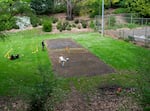
A father and son find a place to play at Creston Park, near the tennis courts, right, April 21, 2025.
Kristyna Wentz-Graff / OPB
Portlanders may have been surprised to find a ballot in their mailbox this month. Unlike last November’s election, where the city’s crowded ranked-choice ballot led to some voter confusion, this year’s ballot mostly focuses on one seemingly simple question: Should Portlanders pay higher taxes to keep the city’s parks department operating?
But there’s complexity behind this ballot measure. The proposal to renew and increase the city’s Parks Levy has reignited a debate around how the city’s cash-strapped parks department is financed. And there’s a lot on the line.
Here’s a breakdown of what Measure 26-260 does – and doesn’t – do, and how it relates to the parks department’s financial crisis.
How is the city’s Parks Bureau funded?
The city department has a number of funding sources.
The bureau’s annual operating budget for this current fiscal year is around $168 million. Nearly half comes from the city’s general fund, the pot of money that pays for parks, police, homeless services and other programs and is discretionary, meaning there is some wiggle room in how it can be spent.
The other half is covered by revenue collected through the Parks Levy.
What is the Parks Levy?
The levy, first approved by voters in 2020, taxes property owners $0.80 per $1,000 assessed value annually.
That means the owner of a house with an assessed value of $221,600 — the median for a Multnomah County home — pays $177 per year, or $15 monthly. The median commercial property owner pays about $251 per year, or $21 per month.
That money pays for parks programming – like swim lessons, summer camps, sports programs – and allows the Parks Bureau to offer free or reduced-cost programs to low-income Portlanders. The levy also covers some maintenance work, like trash pickup and tree planting.
Notably, the levy cannot pay for major maintenance projects, like replacing a community center roof or repairing a playground.
This matters because the city’s parks maintenance backlog is central to the bureau’s financial crisis.
Okay, so what’s the funding problem?
Portland’s political leaders haven’t created a long-term financial plan to pay for deteriorating parks facilities, a point underscored in a recent city audit of the Parks Bureau.
According to the Parks Bureau, nearly 90% of all of its facilities are in poor condition. And there’s no immediate plan to resolve this problem. The bureau estimates that it would cost between $500 million and $800 million to restore all park facilities to a “reasonable level” of wear and tear.
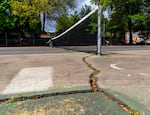
The tennis court at Colonel Summers Park in Southeast Portland, April 21, 2025.
Kristyna Wentz-Graff / OPB
Meanwhile, the city continues to open new parks.
That’s largely because the bureau also leans heavily on a third revenue source: System Development Charges. These are fees paid to the city by developers to improve parks, streets and other neighborhood utilities.
But that money comes with specific restrictions. It can only be spent on new parks and projects, and cannot be used on maintenance.
In the past year, the Parks Bureau collected $6.7 million in SDCs, contributing to a $200 million annual SDC budget. That money has gone toward opening several new parks and expanding facilities at others.
The funding leaves the city paying for new parks that it can’t maintain, further worsening the massive maintenance backlog.
Will the Parks Levy ballot measure fix this problem?
Not really.
The Nov. 4 ballot measure increases the current levy taxing rate from $0.80 to $1.40. That means the median homeowner would pay about $310 a year and the median commercial property owner would pay around $440 annually. If approved, the levy would raise an estimated $84 million in the first year.
Like its predecessor, this levy mostly pays for parks programming and classes.
Councilors who referred it to the ballot did add a line ensuring that roughly 2% of levy revenue goes to major maintenance costs. That would raise about $2 million annually – a tiny dent in the hundreds of millions of dollars of delayed maintenance needs.
While the levy doesn’t help with the park’s maintenance drama, it does protect the bureau from another financial mess.
If the measure fails, the city estimates the Parks Bureau will lose nearly half its annual operating budget. That means laying off about half of the bureau’s staff and shutting down beloved parks programming, youth classes and other activities.
Who supports the levy?
Nearly all members of Portland City Council back the measure – with most of them donating to the campaign. Mayor Keith Wilson, who oversees the city budget, also supports the levy. The renewal also has the support of all Multnomah County Commissioners, Metro Councilors, Portland Public Schools Board members, and several legislative Democrats who represent Portland at the State Capitol. Local environmental organizations, groups that advocate for communities of color, public labor unions, and neighborhood groups have also signed on.
Notably, the measure has backing from the Portland Metro Chamber, despite the group’s support of a moratorium on new and increased taxes. The business lobby said this only applies to unjustified and unsustainable taxes, which doesn’t include the Parks Levy.
Who opposes it?
A few people and groups have been vocal in their opposition. That includes Bob Weinstein, a former city council candidate turned government watchdog, and the Taxpayers Association of Oregon, a nonprofit that advocates for lower taxes.
In the voter’s pamphlet, the group argues that the levy’s $2 million in annual maintenance dollars would hardly scratch the surface of the hundreds of millions of dollars of unfunded maintenance needs at Portland parks. And they warn that, without a significant overhaul to the bureau’s funding model, the city will only continue to hike the tax rate.
City Councilor Dan Ryan is noticeably absent from joining his 11 fellow councilors in endorsing the measure.
According to his office, Ryan is currently “not opposed” to the measure, but wants more answers from parks leaders before making a decision.
Are there other plans to fix the Parks Bureau’s funding problems?
The Parks Levy was never written to address the department’s maintenance issues. Elected city leaders and administrators are responsible for park finances.
In a response to the recent Parks Bureau audit, City Administrator Michael Jordan pledged to create an overarching financial plan for the city’s parks. Several city councilors have also floated the idea of placing a general obligation bond on a future ballot that would solely pay for city maintenance.
Now what?
Portland voters have until 8:00 p.m. Tuesday, Nov. 4 to drop their ballot off at an official election site. Mailed ballots must be postmarked by Nov. 4.
Correction: A previous version of this story misstated the amount of annual SDC revenue collected by the Parks Bureau. OPB regrets the error.