It’s been a little more than a year since four dams on the Klamath River came down — the biggest river restoration project in U.S. history. In that time, tribal, state, nonprofit and federal scientists have been closely monitoring the changes happening on the river.
What they’ve found has shown the profound impact dam removal can have on water quality and the wildlife that depends on it.
Water temperatures below the former dam sites are more natural. Dissolved oxygen — what fish and other creatures need to breathe — has stabilized. Toxic cyanobacteria, which often clogged the dam reservoirs during the late summer, have nearly disappeared.
“The river seemed to come alive almost instantly after dam removal,” Damon Goodman, Mount Shasta-Klamath regional director for California Trout, said at a press conference this month.
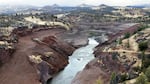
After Iron Gate Dam was removed, salmon were able to swim past the former dam site in Northern California for the first time in more than 60 years in October 2024.
Brandon Swanson / OPB
And then the river’s restoration reached a huge milestone in mid-October: Monitoring crews with the Klamath Tribes and the State of Oregon found a group of fall Chinook swam all the way up into the Williamson and Sprague rivers above Upper Klamath Lake for the first time in more than a century.
“It’s mixed feelings for many tribal members, both rejoicing and a blessing. But also, a certain amount of remorse,” said Klamath Tribal Chair William Ray, Jr. “All those elders and all those generations that didn’t get to see this happen. … They did not get an opportunity to see their victories, because this is a victory for the Klamath Tribes, to essentially make it right again for us.”
One of the biggest changes observed on the Klamath River has been water temperature. For returning salmon, the temperatures in the fall are particularly important.
Returning salmon use less energy when the water is colder, meaning they’re healthier and have more energy left for the main event — spawning — once they arrive upstream.
Before dam removal, the reservoirs on the river would get hot over the summer and release warm water throughout the fall. This kept river temperatures unnaturally high as salmon were making their way upstream.
“With those reservoirs in place, they were kind of like heat batteries,” said Toz Soto, senior policy and research advisor for the Karuk Tribe.
Now, with a year of post-dam data, scientists are seeing river temperatures more naturally fluctuating as the weather changes — getting colder when it matters most. The water below the former Iron Gate Dam site in California is dropping to around 60 degrees Fahrenheit about a month earlier than it did when the dams were in place.
This coincides with Chinook salmon exploring the 400 miles of newly accessible habitat made available by dam removal. The fish have been spotted going over the fish ladders at the remaining Keno and Link River dams and swimming through Upper Klamath Lake.
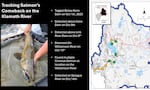
A guide to salmon returning to the Upper Klamath Basin created by the Oregon Department of Fish and Wildlife in October 2025.
Courtesy of Oregon Department of Fish and Wildlife
“Those fish look pretty good. They really do,” said Soto of the fish now being documented above the old dam sites.
In the spring, before dam removal, the “reservoir battery” would work in the opposite way. The lake water would get cold over the winter and keep the rivers artificially cool in the spring. Now, without the dams, 2025 temperature data show spring river temperatures rose faster, which is beneficial to young salmon as they hatch and move downstream to the ocean.
While boosts in water quality are undoubtedly beneficial to the salmon, lamprey and other wildlife on the river, Goodman says it’s too early to make blanket statements about how dam removal will ultimately affect salmon recovery in the Klamath Basin.
Chinook are on a three-year return cycle. Most of the offspring of the fish that are spawning upstream of the removed dams this year won’t return until 2028. Researchers say it will likely take even longer before they can measure and understand the true impact of the river restoration on salmon populations.
In these All Science Snapshots, “All Science. No Fiction.” creator Jes Burns features the most interesting, wondrous and hopeful science coming out of the Pacific Northwest.
Find full episodes of “All Science. No Fiction.” here.