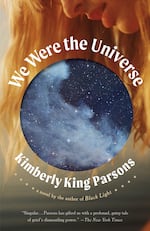
Kimberly King Parsons debut novel follows young mother Kit as she deals with grief, trauma and motherhood.
Courtesy of Knopf
Kimberly King Parsons debut novel, “We Were the Universe,” received the Oregon Book Award’s Ken Kesey Award for Fiction earlier this year. The novel explores grief, trauma and psychedelic experiences as readers follow young mom, Kit, through journeys both physical and emotional. Parsons joins to discuss Texas, motherhood, loss and more.
Note: The following transcript was transcribed digitally and validated for accuracy, readability and formatting by an OPB volunteer.
Dave Miller: From the Gert Boyle Studio at OPB, this is Think Out Loud. I’m Dave Miller. It is rare for a debut novelist to win their state’s top literature honor, but that is exactly what Portlander Kimberly King Parsons did. She won the 2025 Ken Kesey Oregon Book Award for Fiction for her debut “We Were the Universe.” The novel’s central character is Kit. She’s a young mother who is grieving the loss of her sister. There are many journeys in the narrative, both physical and psychedelic, but threaded throughout, woven darkly and brightly, is grief.
Our senior producer Allison Frost talked to Kimberly King Parsons recently. As I mentioned, this was Parsons’ first novel, but she had already been published widely, including an acclaimed collection of short stories called “Black Light.” Allison asked what appeals to her about short fiction.
Kimberly King Parsons: I love short stories. As a reader, I first learned how to write by reading short stories. I remember reading Amy Hempel’s “Reasons to Live,” and I loved it so much and I was so surprised by how she had managed to break my heart in 14 pages – actually, I think it’s even shorter than that. I wanted to know how to do that.
And there’s something about the precision and compression of short fiction. You don’t get sloppy sentences in a short story. It’s somewhere between poetry and a novel, I think. So it’s a little bit more compressed and pressurized, and I love that. So I always gravitated towards reading those and then writing them. And for many years, I thought, oh, there’s no way I can write a novel. I really just love this world of short stories … And then times change.
Allison Frost: Things happen. [Laughter] Well, I certainly don’t see any sloppy sentences in this novel, for the record. But what was the sort of short form, the seed or kernel that this novel grew from?
King Parsons: I was on a vacation with a really good friend of mine and we were in a place called the Boiling River in Montana, which actually no longer exists because of flooding. It took me so long to write this book, the place doesn’t even exist anymore that I was writing about. But while we were sitting there, he had just been through a breakup, which is similar to …
Frost: Your friend?
King Parsons: Yes, my friend. And similar to the circumstances in the book, I was there on a sort of heartbreak trip with him. But while I was there, I was just really reminded of some things in my own life that I had been sort of keeping at bay. And something about being in that emotional state with my friend, but also being in this beautiful natural environment, kind of just brought a bunch of things up for me.
I imagined, well, what if I fully unraveled in this river? [Laughter] I didn’t. I got myself together and went back to my life, but I’m always attracted to characters who are a little bit more extreme than what I am and what I know. So I thought, well, I’m going to sit with this voice for a while – and she really wouldn’t shut up. So I started as a little short story, a little short piece, and then it really just kept growing from there.
Frost: And in real life, some of what you were suppressing was partly because you were a mother, right? You were a new mom and that is so overwhelming.
King Parsons: Absolutely. And in fact, I was still breastfeeding my baby when I was there sitting in that river, so I was having all this sort of mammalian milk spewing stuff happening and your body is no longer yours in the same way. I missed my children desperately at that time – this is my second son. And yet, I also really wanted that autonomy back of the body. All of those things were happening at once.
Frost: Yeah, as a mom, I remember that and totally relate to that. I’ve heard you describe this book as … the very, very short form, a book about motherhood and psychedelics.
Kings Parsons: Yes.
Frost: And while this character was sort of hatched out of the experience that you just described. Of course, she was a mother, so that’s a fundamental part of it. But I wonder why you were so sure that you wanted to write a novel about psychedelic experience?
King Parsons: Well, just personally – this is, again, real life stuff – I’ve had a lot of very positive formative experiences with psychedelics as a young person. And something that I did not see represented in literature were mothers who were not sublimating their desires and interests anymore, so I really wanted to see a mother who was being a good mom and doing all the right things, but who still lived in this brilliant past. And in that past was where the psychedelic experiences took place.
So I wanted to write something that put all of that stuff together. But then they asked me, “We want to do a two-book deal. What do you, what are some subjects that you would like to write about?” I literally said “Texas, motherhood and psychedelics.” Those are the things that I know the most about. So I felt qualified to write a book about.
Frost: Yeah. Well, of course, as you say, the psychedelic experience, the character is not doing that as she is a young mother.
Kings Parsons: Right. Absolutely.
Frost: So if anybody’s worried about that, that’s not the kind of novel it is. But in some ways, it seems like people might hear those as contrasting things: motherhood and psychedelic experience. But of course, they’re woven together so beautifully in your narrative and both of those things are part of who she is and how she expresses herself. Did you see that from the beginning or did that evolve in the years that you wrote this?
King Parsons: No, I am always really fascinated by friction between things, between the unexpected, and again, writing characters who are not sticking to moderation so much. Even though Kit is, at this point in her life, just a mom, a regular mom, she’s not doing drugs anymore. She’s just remembering her past. But I like writing characters who are still excited by and intrigued by ideas that maybe other people would think, “well, you’re a mom now, how can you possibly have desire in this way still,” or “how can you possibly have these memories of this time in your life?”
So yeah, that was really where that came from. I always knew that there was friction between those things and just by the way that people would sort of immediately be intrigued and concerned when I said I was writing about motherhood and psychedelics.
Frost: Well, we learn a lot about Kit pretty quickly in the book. I don’t think it’s spoiling anything to sum up what we learned in the first 40 pages or so. She has a 3-, almost 4-year-old daughter named Gilda who she’s still nursing. She’s bisexual. She’s in a traditional marriage with a man, has a bit of a porn obsession, you could say – there’s many ways to describe it. And prior to having her daughter, as we mentioned, she’d done a lot of drugs and also suffered this extremely significant loss of her sister.
I wonder if you could read from page 42.
King Parsons: Well, this part actually, there is something interesting. When we were in the editorial process for this book, I had two editors – both brilliant, just for different reasons. My first editor, Tim O’Connell said, “so this line,” the first line here I’m about to read says, “the fact that I’m still breastfeeding an almost 4-year old is either my greatest accomplishment or my secret shame.” And he said, “Do we need to say almost 4 years old? That’s older, right? Like we could say 3-year-old, we could say toddler, we could say it in a bunch of different ways.” And it was really important to me, again, to not sort of …
Frost: Gloss over
King Parsons: … move things into moderation. Yeah, to sort of say, no, this is in fact an age at which people will have an issue with it. And even she knows her cut off is 4 years old.
But I like to tell people who my characters are, right out of the gate. That way, if they don’t like them, that’s fine. Let’s save both of ourselves a lot of time. We choose our readers with every aesthetic decision that we make. And so it was important for me to show that. So, I’ll just keep reading from there. OK.
[Kimberly King Parsons, reading from her novel, “We Were the Universe”]
“So the fact that I’m still breastfeeding an almost 4-year-old is either my greatest accomplishment or my secret shame, depending on the company. Some of my crunchy message board moms seem to think this is just fine, ideal even. Gilda calls breast milk ‘good good.’ Says, ‘I need good good because my heart gets thirsty.’
“I only nurse her before bed or first thing in the morning, or like now, when she gets hurt or scared and needs quick comfort. The body takes care of Gilda when the mind is elsewhere. There used to be a sort of rush, a blissed out hormonal thing that happened. The happy feeling is supposedly caused by the same chemicals that rinse your brain when you get to the chorus of your favorite song, meted out dopamine sweeping through, carrying you to the next verse.
“Nursing is a shortcut, I know, but I don’t understand the problem with shortcuts, so long as something nice is on the other side. My high school guidance counselor called me pleasure seeking, and I still don’t understand what’s so bad about that. Beats the alternative.
“But I haven’t felt the happy feeling in a very long time. Lately, my skin crawls when Gilda latches. Finally, my friend Yesenia said when I called to confess, ;This time to cut that [beep] out.’”
[Reading ends]
Frost: It’s in the text that you read a little bit, but what problem does continuing to breastfeed Gilda solve for Kit?
King Parsons: Kit is dealing with sort of complicated grief after the loss of her sister, and anyone who’s experienced grief knows that one of the things that it does is it robs you of your ability to experience the present moment. So she wants to be present with her daughter because one thing about children is that they demand the present moment. So she wants to be present, but her mind is elsewhere because she is in her grief and her guilt.
One of the things that she does is she uses her body as a means to take care of her daughter. So she’s continuing this path because it’s a way for her to know that her daughter is taking care of, even when her mind isn’t on task. And also, I think it’s because Kit herself was under-parented and she is trying to develop that closeness with her daughter that she felt like she was lacking.
Frost: I like that phrase, and I both like and don’t like that phrase: “under-parented.” It’s a very kind way to refer to some unhealthy experiences that a child might have with their parents, including neglect and some other bad choices.
But I want to just stick with this for one more question about breastfeeding, because it is so unusual and is one of the things you talked about. This is set in Texas and she is only 25 – that is a pretty young mother. I imagine that even in urban Portland – a very different culture than Texas, small town Texas – it would still be similar. So I wonder why did this story need to be set in Texas and what might have been lost if you try to set it in, say, Eastern or Central Oregon.
King Parsons: I am a fifth-generation Texan, born and raised there. I tried desperately to get out of there. And since I’ve been out, it’s like I can’t shut up about it. It’s the only place I want to write about. I think it’s just formative core memories, it’s home. All of the sort of complicated feelings that I have about that place just really come out in the writing and I knew from the beginning that Kit needed to be there.
I think also, I was in an environment where a lot of my friends got married at 17, 18, and I didn’t do that. I went and went to graduate school and had a different path, but I sort of imagined a shadow self, a shadow version of myself who would have stayed and had a very different experience in Texas. So that’s kind of where I was putting that.
Also, I felt like even when I was pregnant with my first child at 32, I just felt like a teen mom, even though I was clearly not. There’s something about motherhood that I was so unprepared for, even though I had read plenty about it. But I felt like a very young 32.
Frost: I felt like a very young 40. I’ll just say that … [Laughter]
Well, your character is so complex and it’s, again, so absorbing. She is dealing with a lot and she’s using coping mechanisms that she has, but she’s not able to use the coping mechanisms of casual sex and and drugs as an escape. But, in other ways, she is using them because she’s remembering them in flashbacks that you’re weaving in and out, and it doesn’t really seem like it would work.
If someone described this to me, I would … in fact, my producer Rolie Hernandez, when I was telling him about this book, I said, “you wouldn’t think it works, but it really does.” And I’m so glad he agreed.
But in any case, were you thinking about how to make this stream, in some ways a stream of consciousness in some parts, switch back and forth between present tense and past tense?
King Parsons: I always knew that I was really focused on the tug of nostalgia. And because, again, in the same way that grief pulls you from the present moment, I think that nostalgia just jerks you backwards. So I was interested in attempting that. But at one point, this book was actually all in present tense, because the other thing that I experienced myself was that I would see a place just out in my life and suddenly I would be propelled backwards or propelled to a time because of grief. Grief makes you a time traveler, in a way.
So, at one point, I had the whole book like that, where it would be a Kit sitting on a park bench and it would say, “Julie is 9 and she’s got pigtails,” because that was how I experienced that. It was like almost that you could sort of see a person at every phase they’d ever been, their whole life would come to you in these really brilliant, really vivid flashes.
I love this idea and I tried it for a while, and my beautiful editor – the same one who was talking to me about the 4-year-old breastfeeding line – said, “Hey, I have a really great idea. What if we put the past in past tense? Might that not be helpful for your reader?” So I do think of it as a short story perhaps, and maybe that’s where I was coming from originally. I think you could pull it off in a short story by having everything in that consistent, urgent plane, the present plane.
But certainly, just to make things a little bit easier for the mechanics, I started to make just two parallel tracks. So there’s the past tense, which is Julie in the past and their teen life, and that’s where all the psychedelics and the sex stuff happens. And then there’s the present tense, which is with Gilda. But both of them are incredibly vivid for Kit.
Frost: And they also just come up in almost every scene. And even though it is a consistent part of the narrative, it still sometimes surprised me, when you’re in the middle of some completely, say, mundane office scene or something – I can’t actually think of one of those – and then you’re like blasted into the past where she’s doing psychedelics in her in her teenage years.
There’s so many wonderful characters besides Kit. I mean, I feel like we could talk for 15 or 20 minutes about each of them. But since we don’t have four hours [Laughs], I wanted to focus on the sort of familial trinity: Kit, her sister Julie, and their mother. And of course, this gets squarely to grief. Losing Julie, obviously the mother, her mother, lost a daughter. It plays out so differently for both of them.
Without getting too personal, the way Kit communes with Julie, she not only has flashbacks, but she also has some instances of sort of talking with her or almost having feelings like Julie is talking through her. And that really resonated for me, having lost both my parents in the last six years, but also sometimes it feels like yesterday.
How did you draw on your experiences with grief and creating Kit’s character and experiences?
King Parsons: Well, I think it’s that you think you’re past something and then you are reminded just by driving past a certain McDonald’s or something. There’s just this whole catalog of a life and suddenly you are propelled backwards to that moment, or you see a certain color, or you hear a song, or all of those things. They’re not resolved, they never resolve, in fact, and we figure out ways to move on.
Kit is experiencing grief very much in her own mind and from the outside, she’s fine. She’s going to gymnastics class and she’s doing mom stuff, but her mother is having a much different version of grief. And in the book, her mother’s dealing with hoarding issues and that is basically the sort of physical representation of loss. Whereas Kit is outwardly composed, inwardly a mess, and her mother’s chaos is on the outside. So they are bumping heads in a lot of ways because their expression of grief is so different, and also for the fact that Kit sort of still has resentful feelings about the way that she was parented.
Frost: The other thing that felt very authentic was Kit’s survival guilt and the complicated set of emotions that comes from loving an addict, being in this very, very close relationship with an addict – which Julie was. I wonder if you could read another short piece from [page] 153.
King Parsons: [Reading from her novel, “We Were the Universe”]
“You can check in with your addict. You can disapprove or approve, or toggle between approvals. You can aid, or abet, or refuse. You can recognize the problem, or be on top of the problem, or ignore the problem, or be a part of the problem, but the problem is they’re waiting, sealed up, ruthless, no matter what you do.
“The problem is the person. The destruction is a race between the person and themselves. You know, part of you does, there’s nothing you can do to stop it. You can hold it off, but there comes a time when you have to rest, enlist others to help. You don’t want it to happen on your watch, but worse, you don’t want it to happen off your watch.
“Not happening at all is not an option. It’s coming. You’ve known for years. The most you can hope for is that you’ll be the one calling to tell the others. You’ll be vigilant enough to witness the crescendo. You hope at least to be on the inside of the bad news, to be the one making the terrible phone call, not receiving it. The call is coming either way.”
[Reading ends]
Frost: That was so powerful. I want to talk about that call because the characters both did get that call. And, as you mentioned, Tammy, Kit’s mother, has evolved into hoarding as a kind of coping mechanism. I think that’s the implication?
King Parsons: Mm-hmm.
Frost: OK, but is there anything in Kit’s mind, do you think, that she could have done differently to have reversed this course, even though it’s not her responsibility? Her mother is not her responsibility, technically, regardless of what one might feel about being responsible for one’s parents.
King Parsons: Yeah, I think the hope is that there can be some good from a tragedy and that it can bring people together, and I’m sure that if there was some way that Julie’s death could have brought the two of them together earlier. I do think that by the end, without giving too much away to the novel, that there is some resolution.
Yeah, I think that they’re just struggling to figure out how to accept the situation, but I think that they’re just coming at it from very different perspectives. And I also think that Kit holds this grief of being the bad Texas daughter, which is the Texas daughter who moves.
Frost: Who left.
King Parsons: Who leaves, so there’s the abandonment part. She feels that she abandoned Julie and she feels that she abandoned her mother, and she has a lot of guilt for surviving.
Frost: You mentioned, the title of the book, “We Were the Universe,” comes from the band, We Are the Universe, which of course would be nothing right without Julie. It seems like everybody had some talent and their best friend Yesenia was part of that – and she’s a great character too, not a huge character, but such a great character.
Kings Parson: Thank you.
Frost: I really wish we could have more time to talk about her. But why was it so important to make Julie, not just charismatic – I mean, lots of people are in bands in high school, so she’s not just a charismatic performer – but she’s really something of a musical genius. Why was that important?
King Parsons: I mean, I think that my own personal experience in a high school band is that there were no geniuses in our band, but I always imagined, what if one of us had actually been very talented? No, I thought that I wanted some sort of a contrast for Kit to show that having talent is not necessarily enough, and it’s not the thing that got Julie out of this town and helped her. They imagined she would rocket to stardom because she has these gifts and I think that there are plenty of beautifully artistic people who never fulfill their purpose. I think it was important to show that. So I wanted her to be the real thing and I wanted her to be great, and for that to still not quite be enough.
Frost: And it’s also another one of those great tensions that you were talking about. In some ways it’s not a contradiction, but it’s certainly a tension.
Another contradiction that I’d love to explore with you a little bit that I think many of us deal with – I don’t want to say everybody does – [and] you don’t think about it, but then if you read about it, it kind of comes to life in a new way. And that is what you talked about earlier, about Kit having some issues, still, with her mother and the way she was raised … what did you call it, under-parented. But still, there’s a fundamental wholeness that remains, and of course that love remains.
I’m wondering if you could read another short passage on [page] 221. And I just want to say that this is after 221 pages where Kit’s daughter, Gilda, has been wanting her, needing her, demanding her – and Kit’s delivered. So this short passage comes after Kit’s just gotten off the phone with her mother, Tammy, and has called Gilda to the phone to talk with her grandma, who she calls Mimi.
King Parsons: [Reading from her novel, “We Were the Universe”]
“Gilda stops whining, grabs the phone, shouts into it, presses some buttons. ‘It’s me, Mimi,’ she says. She pulls out her usual performances, her jokes and songs. Then the phone is upside down and she’s losing interest, nodding her head in response to the questions my mom is asking. She holds the phone out to me. ‘Mimi’s gone,’ she says.
“I’ll get that feeling sometimes, same as anybody, that I need my mother. At the end of a bad day, when I’m aching for Julie in a way that feels dangerous, I think, who of all people might understand? I need my mother, but I can’t make myself reach out.
“Is it possible to remember what your mother said to you before you knew a language? I mean, the primordial prelingual, her lilt, her timbre, her warm breath. I swear I miss it, the way it felt to be held by her, my head on her chest, no vocabulary to tie to the loving nonsense that fell all over me.”
[Reading ends]
Frost: Loving nonsense. In some ways it sort of describes the whole mother-daughter or parent-child relationship. I don’t want to spoil this, but it might be a little bit of a light spoiler for some – at the very end, we actually get Julie’s perspective for the first time. After the whole book, it really surprised me. I just wonder, why did you go there?
King Parsons: Yeah, well, this book is structured in a really strange way. There’s sort of the psychedelic trip right in the middle, that is a link between the first half of the book and the second half of the book, and it’s really shaped more like a fractal, and it’s kind of like the experience of a psychedelic trip. I knew that I wanted to repeat that same trip from a different perspective at the end of the book, so that we get just a different angle of what has taken place.
And also, I’m exploring the sort of transcendent connection between family, and whether or not Kit is actually communicating with Julie doesn’t really matter. I don’t think so. It just matters when you are someone who is grieving and you need that closure, getting that closure can feel magical. And I think that that’s why I wanted to have that kind of that at the end.
So, it ends on a higher note. And actually, the book is about grief. It’s also very funny or supposed to be very funny, and humor is a huge part of it. So I knew, when I was writing this, I didn’t want to write a sad book about grief. I wanted to write a funny book about grief and a horny book about grief. I wanted it to be all of those things at once.
Frost: It’s surprising as well. Yeah, absolutely. I mean, I love that and it also made me kind of wish that I heard more from Julie. I was like, oh, what kind of a book would that have been if I heard both voices throughout?
It also strikes me when you said the whole book is sort of structured in some ways, like a psychedelic trip. In some ways, grief is – I’ve heard this not just from my own experience, but [how] other people have described it – a sort of a trip that’s almost impossible to describe.
King Parsons: Yeah. Well, I think it’s the waves. It’s the waves, in the same way that people … I’ve heard waves of euphoria when experiencing psychedelics. The waves of positive things. But I think for grief, it’s waves of things are fine and then suddenly things are not fine. And it could be as simple as just hearing a word or seeing a color and suddenly you’re back into that same place.
Yeah, I think it’s a physical sensation, too. Grief really does put you in your body, in a big way, which is something that I wasn’t prepared for, as a person who does not feel very in-tune with my physical body. I like being in my head and my brain. I was shocked by how exhausting grieving is and how it feels, literally like you’ve been sort of tossed around in the ocean.
Frost: Yeah, and how it’s so hard to compartmentalize. It also struck me in this novel like a hub, where so many of these different aspects of a person’s life sort of always are connected to that.
We haven’t talked too much about physicality, but one of the things that I wanted to explore was this idea of what we carry around with us. And this is something that does not infrequently come up when a kid is going somewhere with Gilda. As all parents can relate, you feel like you have a suitcase every single time you go anywhere, even the grocery store.
I think the line is … she was looking for something in one of the park scenes and she said something like, “well, I do” or “don’t have this.” I can’t remember exactly, but the line was, “what we carry defines what we need.” And I just wonder what you were thinking about there?
King Parsons: Well, I think there’s something that happens when you’re parenting, where there’s almost this sort of judgment about who is very prepared at the playground or who has the right things for their child.
Frost: Who has the band-aid?
King Parsons: Who has the band-aid, who has the right snacks? There are certain moms who really seem to have their act together in a big way, and Kit is not exactly one of those. But she does have these sorts of things, [like] Gilda needs like her EpiPen. She needs a few things that she carries. But I just like this idea that what we have determines what we’ll need.
I think also, for Kit, growing up in an environment that was sort of somewhat neglectful and it’s not exactly full of opportunity, I think she learned to make do with what she had. She’s resourceful in that way and resilient, and she and her sister made the best of what they could.
So yeah, I like the idea of analyzing what these moms have. Because there’s another mom, Nancy, who Kit is sort of in opposition to, who’s this mom who seems to have everything together and is so ideal. Kit really struggles with that, because truly, when you have a child, you’re put on a playground with a bunch of people that you don’t have anything in common with except that you have offspring. Same thing in the dog park.
Frost: Daycare …
King Parsons: Daycare and school as well. Yeah, suddenly you’re just like, “well, our kids are the same age, I guess we’re …”
Frost: I guess we’re friends now. [Laughter]
King Parsons: I guess we’re friends, yeah. So she’s having a hard time fitting into that environment, because I think the version of herself in her head is quite different from the version that she has become.
Frost: Those friends also, we didn’t get a chance to talk about the minor characters, but you’ve mentioned the friend Nancy, and then there’s the friend Celadon. And there’s a lot of contrasts and going back and forth between an authentic self, what is the self that you’re presenting, and who are you really?
King Parsons: Yeah, well, because the thing also about having a child is that suddenly people have a lot of opinions about how you parent publicly, and even if that means that someone walks up to you and says, “why don’t you have socks on your baby?” You’re very much on display in a way that I think, when you’re not walking around with a child, you can sort of fly under the radar. So suddenly Kit is very aware of her role in this ecosystem of parents in this neighborhood.
Celadon is the hot mom, the hot playground mom who she’s intrigued by. She’s sort of mysterious and Nancy is like the very prepared mom who’s very organized, and Kit is just trying to figure out where she fits in there.
Frost: I mean, we should say Nancy is sort of unique in the fact that she’s one of the few people that Kit does not fantasize about.
King Parsons: It’s true. It’s true. Yeah, I think, I think she might be the only person in the whole book. [Laughter]
Frost: Yeah, it’s delightful. I know that a lot of attention is sometimes paid to this idea of porn and “she likes porn.” But it’s interesting that that was just one part of the character that you draw, she also happens to be bisexual. We didn’t even talk about that. But why did you want to make these things kind of just everyday facts and not go deeply into them as themes or something that dramatically affected the narrative?
King Parsons: I think because they are a part of everyday life. I think that fantasy is really normal and that in this case, it is one of Kit’s escape hatches – just like fantasy is, I think, along the lines of memories and along the lines of the nostalgia. But I think that it’s something that she uses to get through her day. There’s the fact that some of these things that you do as a parent are really boring and there’s ways to make them more exciting, and that’s by having a sort of really vivid interior life. And that can involve fantasy.
I think that it’s interesting that she does, at various points, just a couple of times, refers to porn. I always think if this was a male character, it wouldn’t even be mentioned. But because it’s a woman and because it’s a mom, it’s something that’s, again, there’s friction there because people think, well, when you have a child, you sublimate your desires entirely or you just no longer have those things. I find it to be not just not true. But also, I think that that sort of low-key, inner fantasy life is something, certainly, that I’ve experienced, but I feel like most people probably walk around experiencing that as well.
Frost: That’s interesting that you say that if it was a man, it would just be like, well, of course, men are allowed to have their desires and that’s expected, but not so much of women and certainly not so much ...
King Parsons: Of mothers
Frost: Yeah, exactly. And not to leave Jad out altogether, but before we run out of time … The marriage is really an interesting one because it seems very healthy and stable, and she has this great interior life. She doesn’t share all of it, maybe not even most of it with Jad, but it seems like that’s a healthy thing.
King Parsons: Yeah, I think it is a healthy thing. I think that we have our own interiority that’s ours and it’s not necessarily something that you have to get permission or approval from. And again, I think that the idea that men walk around with sexual fantasies is like, well, yeah, of course, but the idea that women might do the same thing is somehow a little bit more confusing for people, especially mothers, like you’re saying.
But yeah, she has a really healthy, happy marriage. Part of that marriage involves occasionally looking at pornography and having fantasies about other people in her mind.
Frost: This novel was so beautiful and there’s so much to dig into. So even if someone has listened to every word of this, there’s still so much to get from reading this novel. I was so pleased to get to talk about it with you. Thanks so much for joining us.
King Parsons: Thank you so much for having me. It’s been so great.
Frost: Kimberly King Parsons’ debut novel, “We Were the Universe,” won the 2025 Ken Kesey Oregon Book Award for Fiction.
“Think Out Loud®” broadcasts live at noon every day and rebroadcasts at 8 p.m.
If you’d like to comment on any of the topics in this show or suggest a topic of your own, please get in touch with us on Facebook, send an email to thinkoutloud@opb.org, or you can leave a voicemail for us at 503-293-1983.