Portland’s public camping ban is going into effect this weekend.
According to Mayor Keith Wilson, Portland police will begin issuing citations and running warrant checks on people camping or living in vehicles on public property as soon as Nov. 1.
It’s not immediately clear what the change will mean for Portlanders living outside. But here’s what we know so far.
What is the policy?
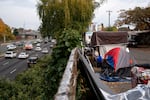
RVs and tents line a street above the highway at an encampment of unhoused people in Portland, Ore., on Oct. 31, 2025.
Eli Imadali / OPB
People are prohibited from tent camping or staying in a vehicle on public property — like sidewalks, parks, streets, and other public areas — if “reasonable shelter” is available. If shelter is not available, the policy limits what people can do while camping.
For instance, there are prohibitions on using a propane heater, digging into the ground, starting a fire, selling bicycles or car parts, or blocking access to private property while camping.
People who violate these rules can be issued a citation, a charge that comes with a fine of up to $100 or up to a week in jail.
This policy was adopted last year, under a previous city council and mayor. But Mayor Keith Wilson said in February that he would not begin enforcing the policy until he could open up hundreds of new overnight shelter beds — his top campaign promise.
Related: Oregon is in the midst of an ‘unrepresented crisis’ of public defender shortage, but why?
Why is it being enforced now?
Wilson says the city has enough “consistent available capacity” at its overnight shelters to meet the needs of people living outside.
To be sure, there are not enough available beds for Multnomah County’s estimated 7,400 people living outside. There are roughly 3,500 total shelter beds in the county — including the 1,000 or so new overnight-only shelters.
The majority of those beds are occupied on a given night. The only exception is the city-run overnight shelter beds. Those new shelters have had high vacancy rates, with some having up to 80% of their beds empty nightly on average between August and October.
Vacancy rates have begun to dip at the nights grow colder. During the week of Oct. 20, the city reports that most shelters had over 50% nightly occupancy.

Portland’s Salvation Army Female Emergency Shelter, or SAFES, has 100 available beds, including 54 on the main floor, Sept. 23, 2025.
Kristyna Wentz-Graff / OPB
Data has found that the so-called “congregate” style shelter spaces that Wilson has championed — large, open rooms filled with rows of beds — are not desirable.
But to Wilson, high vacancy means more beds available for people camping in public to move into.
“Having a system with no empty beds means our system fails,” Wilson told OPB in a recent interview.
How will this be enforced?
According to the city spokesperson Cody Bowman, Portland leaders still don’t have “standard operating procedures” in place for enforcement.
But enforcement will be carried out by officers with the Police Bureau’s Neighborhood Response Team and Central Precinct Bike Squad.

A notice of illegal camping is posted on the fence above the highway at an encampment of unhoused people in Portland, Ore., on Oct. 31, 2025.
Eli Imadali / OPB
While enforcement will begin this weekend, Bowman said that doesn’t mean police will be issuing loads of citations right away.
Bowman said officers will prioritize which encampments they focus on based on the negative impact that camp has had on the community and environment. For instance, if the camp is close to a school or if there has been reported criminal activity at the camp, it may rise to the top.
This is similar to how the city prioritizes which encampments to sweep.
“Trained officers also have discretion to act on observed violations in the field,” Bowman writes.
Bowman said that police will also be arresting anyone they encounter during these camp checks if they have an outstanding warrant.
Related: Courts, homeless service providers await answers as Portland camping ban enforcement looms
How will the officers determine whether ‘reasonable shelter’ is available?
Bowman said that “reasonableness” will be determined by officers on a case-by-case basis.
This terminology has gotten the city in legal trouble in the past.
Under a 2021 state law, cities can be sued if their anti-camping policies are not “objectively reasonable.”
That happened to Portland in 2023, when an earlier iteration of its camping ban was challenged by attorneys representing unhoused Portlanders. A circuit court judge agreed with the attorney’s arguments that the policy was “unreasonable.”
The current policy could be vulnerable to a similar challenge.
Becky Straus is a lawyer with Oregon Law Center, the nonprofit that sued the city over its camping ban in 2023. In an email to OPB, she wrote that an overnight shelter bed “is less safe than the bare minimum of survival” found on the street.
“That alternative is not reasonable,” Straus wrote.
What are the penalties for violating this rule?
If someone received a citation for violating the camping ban and refusing shelter, they will be given a court date. If they fail to show up, a warrant will likely be issued for their arrest.
If that person does show up to court, Wilson said he hopes they will be connected “with services and resources through the courts in lieu of penalties.”
But Multnomah County’s criminal justice leaders don’t know how that will work. Chief Criminal Court Judge Michael Greenlick, who oversees the operations of the county’s criminal court system, said he isn’t aware of any new system in place to connect people with services as a way to avoid criminal charges.
Greenlick said this kind of “diversion” program would require extra funding to set up. Both the city and county are facing budget shortfalls.
The county’s district attorney’s office could also play a role in offering ways to lower charges to people with a public camping citation. District Attorney Nathan Vasquez said his office is still thinking through how to handle these new citations.
“We are eager to support the mayor’s efforts to get people off the streets,” said Vasquez in an email to OPB. “We will seek to be as creative as possible in finding community resources and connecting them with individuals who come before us.”
Some advocacy groups are lobbying for another path to lessen camping charges: deflection.
Deflection is the name of the relatively new option given to people in Multnomah County charged with possessing small amounts of drugs, following the recriminalization of low-level drug offenses in Oregon last year.
Related: Proposed Oregon ballot measure would make it easier for cities to sweep homeless camps
Under that system, someone can avoid charges for drug possession if they agree to be transported to the county’s deflection center and engage with drug treatment services within 30 days.
Criminal justice reform advocacy group Partnership for Safety and Justice is pushing for local officials to expand the county’s deflection program to include people cited under the camping ban.
In a press release, the group argues that people charged with violating the camping laws should be able to “deflect” those charges by agreeing to engage with social services.
Vasquez, who helped shape the county’s deflection program, is open to it.
“We are in ongoing discussions with the chair and the deflection group on expanding that program to include these type of charges,” he told OPB.
So, what does this mean for people who are cited under this policy right now?
It’s not clear.
There are several limitations that could keep those charged under this new policy from getting their day in court in a timely manner.
One issue is Multnomah County’s shortage of public defenders. Greenlick said this shortage means people charged with a crime in Portland who can’t afford an attorney often have to wait months to have one assigned. Attorneys are prioritized for people charged with violent offenses, a category that wouldn’t apply to a camping violation.
According to data collected by the state, there are currently over 1,000 people facing criminal charges in Multnomah County who are waiting for an attorney.
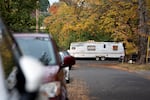
An RV sits parked at an encampment of unhoused people in Portland, Ore., on Oct. 31, 2025.
Eli Imadali / OPB
“Individuals are waiting months without counsel with their liberties restrained, and during that time they’re not getting any services or anything to address the things that led them to [a citation] in the first place,” said Grant Hartley, the local director of Metropolitan Public Defenders, one of the two nonprofits that provide legal services for people in Multnomah County who can’t afford it.
Hartley said that adding new criminal citations to the courts only adds to an “already overburdened and under-resourced system.”
He noted that, even if the county had enough public defenders to represent people, the court doesn’t have enough judges or staff to manage a surge in new cases.
And the county jail has limited vacancies for people who are sentenced to jail time under the new charge — or are arrested for missing their court appearance.
“People will go to jail as a result of this, even if that is not necessarily the intention of it,” Hartley said.
Multnomah County Sheriff Nicole Morrisey O’Donnell, who oversees the jail system, doesn’t want that to happen.
“Our jails were never designed to absorb the weight of inadequate housing, medical, and behavioral health systems,” Morrisey O’Donnell said in a statement shared with OPB. “They should not be seen as the default response to illegal camping or unmanaged crises.”
When the city council first adopted the camping ban last year, Morrisey O’Donnell told the city she wouldn’t allow the jail to be used to hold people charged under the policy. She hasn’t made a similar announcement this time around.
Morrisey O’Donnell told OPB that she sees Wilson’s leadership more in line with her values.
Vasquez said his prosecutors will “do everything we can to keep people out of jail — it is a last resource.”
Clarification: This story has been updated to include more recent nightly shelter occupancy data.