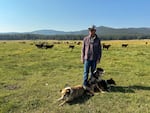
Dean Defrees is a fourth-generation rancher at the Defrees Ranch in Sumpter Valley, Ore., on Aug. 30, 2025.
Lillian Karabaic / OPB
Dean Defrees thought about becoming a veterinarian — maybe even a salesman.
But after college, he found himself back in Eastern Oregon’s Sumpter Valley, continuing the family tradition of ranching and forestry that began 118 years ago, when his great-grandparents arrived in a covered wagon.
“I’m fourth-generation, and I’ve got seven grandkids that kind of are around,” Defrees said. “That’ll be the sixth generation.”
For this month’s installment of “At Work With,” we mooooved out to Baker County to find out what it’s like to be a rancher.
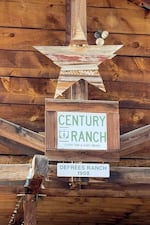
The Defrees ranch in the Sumpter Valley began in 1908.
Prakruti Bhatt / OPB
What does a typical day look like for you on the ranch?
This rhythm of moving cattle shapes the day. Ranch life runs on the seasons — each with its own chores, challenges, and rewards.
“We really have the four seasons for sure,” said Defrees. “[In] summer we irrigate, move the cattle daily, get our hay supply in for the winter.”
The fall is about preparation. “We’ll do a lot more fence maintenance. We’ll get in my firewood for the winter. We’ll do some work in the forest. We’ll work the cattle, get them vaccinated before winter,” said Defrees.
When winter sets in, they need to supplement with hay as the ground gets covered in snow and frost so they’ll spend the morning feeding cows, and do maintenance work on the timber grounds.
Because of their high elevation, they start their spring activities a little later. “A lot of people start calving in February and March. In my environment, it’s much easier for me to calve in April and May,” said Defrees.
“I figured out with just [my wife] Sharon and I here basically watching the cow herd, 90% of my calving issues were weather-related when we were calving in March and February,” he said.
“I’ve moved that back and it’s just much easier on everybody. I don’t have to worry about cold calves as much and making sure somebody isn’t born in a snowbank and that kind of thing.”
When the cows give birth, it’s one of the busiest — and most rewarding — parts of the work, with constant trips to the barn to make sure that everything is going smoothly, especially for the younger birthing heifers.
What’s the hardest part of the job?
“We enjoy it a lot, but it is time-consuming and can be very stressful.” Defrees said you have to have the right personality, “Not let it get to you. Go with the flow,” he said.
That’s because the work can be very overwhelming, “I lay awake at night a lot of nights, thinking about all the things I need to get done and how I’m going to do that, prioritize, and that kind of thing. So that’s just stressful.”
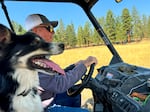
Dean Defrees drives the side-by-side off-road vehicle on the Defrees Ranch, alongside Chuck, one of his ranch dogs. Chuck is one year old and still learning the finer points of his job herding.
Lillian Karabaic / OPB
The menial tasks never seem to be done. Especially fixing fences. “I’ve done so much of that. I’m just sick of it,” said Defrees. “I get about 40 semi-loads of hay in a year, and so I’m really tired of unloading hay and stacking it.”
But there are benefits. “It’s a fantastic lifestyle because you’re your own boss. There’s ups and downs, pros and cons, but a lot of people today don’t want to work six and a half or seven days a week, 10 hours a day, and not make a lot of money,” said Defrees.
How do you care for your cattle through the hot Eastern Oregon summers?
“The way it’s been the last few summers, we have had some terrible heat waves, and this summer actually was really good,” said Defrees.
But being at a high elevation with an attached forest makes a huge difference for his herd.
“We live in a place where I don’t get a lot of hot days. I do have shade in, I have a lot of trees, so if it gets really hot, I’ll make sure that they’re in pastures that have trees and shade cover, and that makes a huge difference,” he said.
“We do cool-off almost every night,” said Defrees of their high elevation. “What is really is stressful for a cow is a 90 or 100 degrees during the day, and then it doesn’t cool off. But we very rarely have a night here that’s over 60 degrees,” he said.
Have wildfires changed the way you plan?
“We do have a contingency plan for wildfires, but if we have a wildfire here, it would be up in the timber ground,” said Defrees.
The meadows are green and unlikely to burn.
“Even in the summer, I would always have a safe spot for my cattle to go to. The danger would be if we got a fire in the timber ground,” he said.
They have a “wet line” or a ditch between the pasture and the timber grounds as a way of preventing fire from spreading.
What’s the biggest challenge of ranching in Baker County compared to other places?
“There are advantages as far as it’s just a great place to grow grass, but I’d say the challenges would be winters — having to stockpile feed for the winter months without a lot of options,” said Defrees. “We do have neighbors that’ll transport their cattle to a lower elevation,” but that’s expensive and time-consuming.
What’s the biggest issue facing the cattle industry right now?
Nationally, screwworm flies are a growing concern for ranchers.
“It’s mostly a southern U.S. and Mexico issue,” said Defrees. “The industry’s pretty scared about it, and it’s actually shut off a lot of our supply of cattle from Mexico because they’re quarantining them at the border,” he said.
Additionally, labor shortages on ranches and in meat-packing plants are an industry-wide issue.
What season do you buy cattle?
“I don’t buy any cattle. I raise all my own replacement heifers,” said Defrees. “We take our yearlings all the way through the finishing stage.”
“I take the yearlings to a facility in Boardman where they continue to be out on pasture, but they’re fed a finishing ration.”
Why livestock and not other crops?
The Defrees ranch is about 25 miles outside Baker City, at 4,200 feet elevation. In this area, there are limited options for commercial agriculture.
“With our lands, and much of Eastern Oregon, I can [only] grow grass,” said Defrees. “There’s no human crop that I know of that would be economically feasible for me to grow with the water I have and the growing season I have.”
“My wife tried for 40 years to grow a tomato and never could get it done because we can frost any day of the year up here. We had a frost on Aug. 8 this year — which is crazy,” he said.
This summer, Sharon Defrees tried to grow her tomatoes in the large hay bale pile to keep them warm. It didn’t work. Next year, she’s hoping a hoop house will be the magic solution.
How do you manage your pasture?
Defrees runs what’s called a managed rotational grazing system. His cows are split into different groups, each with their own pasture for the day.
The number of groups “depends on what stage of growth the grass is in and how many cattle I’ve got at the time,” Defrees said.
The cows get a new salad bar almost every day, moving between the 52 different fields, and it gives the grass a chance to rest in between.
“We move these cattle every morning, each group, just so they’re on fresh pasture, and it gives the grass a chance to regrow from the pasture that we moved them from,” he said.
He tracks all the pasture data in an app on his phone — movement dates, precipitation, climate data are all recorded. Ranching isn’t as analog as it once was.
What role does water availability play in your work?
“That’s a huge issue,” said Defrees. “It’s just a matter of managing the water [and] irrigation rights. We get our water out of the Powder River upstream, and so water is a huge issue.”
Defrees said they get about 25 inches of rainfall a year, which would be substantial if it wasn’t mostly in the form of snow. “That snow is stored upstream in the mountains until mid-summer,” and they have to make sure it gets into spread across the ground during the summer.
What’s the cows’ favorite grass?
Clover.
“It’s a little dessert,” said Defrees. “Unfortunately, the elk like the clover, too.” Often elk will graze the clover-heavy fields the night before his cows are due to rotate there “because everything’s grown up and it’s nice and lush and they all get it first,” he said.
Do ranchers ride horses all day?
Defrees mainly uses a side-by-side off-road vehicle or an all-terrain-vehicle to navigate around the Defrees Ranch forests and pastures. When he was growing up, they used horses on the land. Horses are still the best way to get around on rocky and mountainous terrain.

The odometer on the Defrees all-terrain-vehicle shows it has gotten 11,032 miles driving around the Defrees Ranch and timber grounds, often as part of moving cattle between paddocks for a rotational grazing system.
Prakruti Bhatt / OPB
What skills do you think surprise people about being a rancher?
“Anybody that’s still in the ranching business has to be, I feel like, a pretty good businessman,” said Defrees.
“It’s a lot of paperwork, more than people realize. And so, a lot of people went out of business in the tough times in the ’80s and ’90s just because they were not real good business managers,” he said.
“They either need to hire really good people to help them or have those skills themselves. So it’s a tough, stressful business that way, trying to hang on.”
Dean’s wife Sharon is the spreadsheet master for the Defrees ranch. She spends about 10 hours a week on the paperwork side, in addition to her work on the land. There’s a lot of regulations and paperwork to ensure they have met the standards of the marketing co-op Defrees Ranch is part of, Country Natural Beef.
Sharon also projects how much hay they’ll need to buy to get the herd through the winter. Over-buying means the hay could spoil, but under-buying could be disastrous.
“I don’t want to over-order, but I really, really, really don’t want to under-order,” said Dean Defrees.
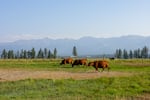
Most of the Defrees herd is the Red Angus breed.
Prakruti Bhatt / OPB
How many cattle do you have?
Defrees said that question is one of the first things that non-industry people ask “That’s the first question I get almost every time. And the second one is, how many acres do you have?”
But it’s considered impolite to ask any rancher how many cows or acreage they have. “Cattlemen bristle a little bit about that question,” he said. “That’s basically asking what your net worth is.”
Do you graze on any public lands?
“We used to, but it got to be such a hassle and reduction in numbers in the ’80s, we stopped doing that.” Now, all the Defrees herd grazes on deeded land.
What would you recommend if someone wants to get into ranching?
“It’s a terrible business to try to get into because the costs are so prohibitive,” said Defrees. Most ranchers end up in the business because they inherit.
Working as a ranch hand gets you some of the practical skills, but not the finances. “There’s lots of opportunities for young people to work for a place and see if they like it, but then the problem becomes, well, how do you get into it and get a place of your own and make it work financially?” said Defrees.
“If you’re really motivated and can find a place to lease or work with an existing rancher that maybe doesn’t have another way to a succession plan, that’s one way to do it,” said Defrees.
“There are some programs through the government that give low-interest loans to beginning ranchers, but it is really difficult,” he said. That’s one reason that ranchers are aging as a group.
Who will take over your ranch when you retire?
Sharon and Dean Defrees hope their kids decide to take over the ranch. But the cattle industry was so bad in the 1980’s when the kids were growing up, they told all three to have a backup plan.
Their daughter, Dallas Hall Defrees, lives on the ranch and works as a nonprofit program director, focused on regenerative ranching for Sustainable Northwest. She’s very interested in taking over the ranching work.
One of their sons is a doctor and lives about 25 miles away in Baker City, and comes out to the ranch on the weekends as much as possible. The other is a schoolteacher in Seattle.
If you weren’t ranching, what do you think you’d be doing instead?
When Defrees went to Oregon State University to study animal science, he thought he might go on to veterinarian school.
The agricultural industry was hiring salespeople, but he didn’t think he’d be good at selling. “The labor market at that time was really tough. Interest rates were terrible. Jobs were hard to find,” said Defrees. “I could see that my dad needed help back here, so I came back.”
His wife, Sharon, was talked into moving out to the Sumpter Valley and working on the ranch alongside teaching high school. “She was kind of a city girl, but she’s done fantastic,” said Defrees.
Sometimes, when fixing fence posts for what feels like the millionth time, Dean Defrees thinks he could’ve chosen an easier career. “I’d probably be retired by now,” he said. “I try not to think about things like that.”