
Five-year-old Eliza Gamage plays in a puddle as rain falls outside One Life Food Pantry, located in Real Life Foursquare Church in Vancouver, Wash., on Nov. 1, 2025. With all the uncertainty surrounding SNAP, it was her and her mother's first time at One Life and their second time at a food bank in two weeks.
Eli Imadali / OPB
By 9 a.m. on Saturday, the lobby at One Life Food Pantry in Vancouver, Washington, was nearly full. About 50 families waited for their number to be called.
For Kennita Baker, it was her first time at One Life.
“I just looked up a food bank, and I was like, ‘Let’s go here this morning and see if we can get just anything,’” Baker said. “Because it’s rough.”
Baker is one of the more than 900,000 Washington residents that receive benefits from the Supplemental Nutrition Assistance Program.
Now, she and many others fear they will lose their SNAP benefits amid a prolonged shutdown of the federal government. The Trump administration has declined to use contingency funds.

Andrea Walker, CEO of One Life Food Pantry, explains their ticketing system to people waiting to pick up food.
Eli Imadali / OPB
More and more, people are turning to local food banks to partially fill the gap, according to volunteers and staff that spoke to OPB.
“We’re constantly seeing an increase in the number of new people, which is kind of abnormal for this late in the year,” One Life CEO Andrea Walker said.
SNAP benefits were set to pause Saturday, but two federal judges ruled Friday that the Trump administration must use emergency reserve monies to fund the program.
Still, many could see weekslong delay in receiving their November benefits. In many states, it already takes several days to load SNAP debit cards, according to the Associated Press.

Volunteers Nayami Abraham and her father Mohit Abraham, respectively at left and right, and Lisa Bartucca, center, register food recipients in the lobby.
Eli Imadali / OPB
Within an hour of opening, 15 new people signed up at One Life — staff said they usually see a handful sign up each Saturday.
One of them was Elaine Leonard, who arrived with her daughter Eliza. As a single mother, she said she typically relies on SNAP to afford food, but has had to start visiting food pantries.
“It doesn’t feel good to have to go to a food bank to get food,” Leonard said. “My compassion is, as always, for people who are struggling. And now to find myself also in that position — it’s humbling.”
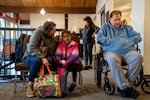
Elaine Leonard adjusts the hair of her daughter, five-year-old Eliza Gamage, as they wait in the lobby for their turn to get food.
Eli Imadali / OPB
In a perfect storm situation, food banks also have fewer items to distribute to people. Earlier this year, the U.S. Department of Agriculture made cuts to its Emergency Food Assistance Program, which food banks say has led to fewer items available for people.
One Life, for example, had no meat to distribute Saturday. Staff distributed flyers on how to prepare dried beans, so people could still have protein in their diet. Walker said they’ve had to decrease how much food each person receives.
Just across the state line in Portland, lines Saturday morning were even longer. The Northeast Emergency Food Program saw 334 people arrive to receive food.
Program Manager Jon Makler said they’ve seen an influx of new arrivals in the days leading up to the pause in SNAP benefits. On Oct. 29 alone, 101 people — about a third of all people who visited the pantry that day — were new.
“Already, you have so many families who are on the edge,” Makler said. “This just pushes more people over the edge.”
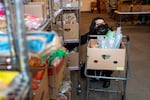
Casper Cohen picks out food for himself and his partner, who has various dietary restrictions due to a chronic illness, at One Life Food Pantry, located in Real Life Foursquare Church in Vancouver, Wash., on Nov. 1, 2025.
Eli Imadali / OPB
NEFP has also faced supply shortages. On Saturday, they had no rice and only canned chicken for meat. Makler said, while they usually have around 20 different dried goods to offer people, they had only eight.
“As 2025 has gone along, the quantity and quality of food that’s been available to us has decreased, and we’re having to think much more about how much food we can give to each client,” he said.
Meanwhile, Elizabeth May sat in the NEFP waiting room to be called. She also uses SNAP, but has been visiting food banks more frequently. She said there’s a stigma surrounding SNAP recipients, and she’s hopeful the government shutdown can shine a light on just how many people rely on the program.
“There are people I don’t tell, because I think they’re not going to look at me in a positive way, like I’m taking from the government or I’m lazy,” she said. “It’s not about that at all.
“I know so many people that really value its use.”

Rain falls on a discarded grocery list outside One Life Food Pantry.
Eli Imadali / OPB