Standing inside the Laurelhurst Club in Southeast Portland, Karen Willard said some of her family members believe she’s in a cult.
It’s not hard to see why. She and hundreds of others have arrived to sit in a giant square and sing old haunting tunes about death and the afterlife, all for an audience of no one.
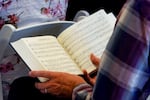
Singers perform from the Sacred Harp songbook in Portland, Ore. on Oct. 19, 2025. The notes look like triangles and squares, and it's meant to be an easier way to read music.
Joni Land / OPB
“It’s not at all unusual to see tears trickle down the faces of some of the singers,” Willard said.
Hundreds of singers gathered recently for the 34th Pacific Northwest Sacred Harp Singing Convention. They’re performing one of the oldest styles of American folk music, called shape note singing.
Sarah McIntush recently moved to Oregon from Texas and said shape-note singing has been in her family for six generations. She acknowledged the sound — which many consider to be harsh and loud — can be divisive among some people.
Singers are encouraged to sing as loudly or as quietly as they want. Unlike more traditional choirs, there’s less emphasis on singers staying in the same key and matching one another. The result is a cacophony of different voices blending together.
“I’ve heard people describe it like a magnet, like they’re drawn to it,” McIntush said. “Some people are just kind of repelled by it, because it’s just so intense.”
Shape note music has been around since the early 1800s. It started in New England as a simplified method to teach music to those who could not read sheet music. The notes in the song books resemble triangles and squares, making it easier to find the pitch in a song.
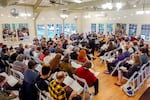
Hundreds gather for the 34th Pacific Northwest Sacred Harp Singing Convention in Portland, Oregon. on Oct. 19, 2025. Singers sit in a square and face each other while performing.
Joni Land / OPB
And the songs at the Portland convention come from the “Sacred Harp,” a famous songbook in publication since 1844. Willard said people are initially attracted by the striking harmonies, but become drawn to the lyrics.
The lyrics are almost always religious, but primarily focused on death, yearning for the afterlife. Dolan Dolan-Wolfe said while he’s not religious, there’s still something therapeutic about embracing the topic of death head on. He led a song called “Ocean,” with lyrics about God creating giant waves that swallow sailors at sea.
“We love to sing and shout cheerily about death,” Dolan-Wolfe said. “Just sitting there, singing about how pleased we’re all going to be to die makes life and death seem so cozy.’
These singing conventions also aren’t arranged like a traditional choir. The singers sit in a large square, facing each other. Each side of the square is a different section: alto, tenor, bass and treble. Each person takes a turn standing in the middle of the square, selecting a song and setting the tempo.
“It’s like being in a pipe organ,” Willard said. “The sound hits your body on all four sides, and you can feel it thump against your body.”
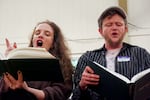
Singers perform at the 34th Pacific Northwest Sacred Harp Singing Convention in Portland, Ore. on Oct. 19, 2025.
Joni Land / OPB
One of the most striking things about the music of the Sacred Harp is that it isn’t rehearsed beforehand. For each song, the group sings the melody together, and then starts the song over with the lyrics. And despite the large size of the choir, there is no audience — everyone is singing for each other.
It’s those connections that have kept people interested in this type of music for hundreds of years.
“When we have learned a song well enough to get our nose out of the book, we look across the square and lock eyes,” Willard said. “We might only see these people at an all-day singing, but the depth of the bond is remarkable.”