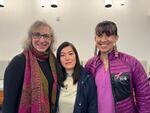
Pink Lemonade CEO Susan Stearns poses with mentee Miyuki Yaegashi and mentor Tina Sixberry. All are breast cancer survivors who shared their stories with "Think Out Loud," Nov. 3, 2025.
Allison Frost / OPB
The Vancouver-based Pink Lemonade was started in 2010 by two doctors Allen and Cassie Gabriel, a plastic surgeon and an anesthesiologist.
They saw a gap in non-medical, emotional support for women being treated for breast cancer in the Portland-metro area. They began offering retreats and support groups locally, eventually adding a mentorship program where breast cancer survivors who have gone through treatment mentor others who have more recently gotten a diagnosis.
And 15 years later, the nonprofit serves people in all 36 Oregon counties and six in Southwest Washington.
Susan Stearns is the CEO of Pink Lemonade and was its first staff member who was also a survivor. Tina Sixberry has been a mentor since 2019 after participating in other programs. Miyuki Yaegashi met Sixberry and became her mentee earlier this year, shortly after she was diagnosed.
All three join us in studio to talk about creating connections and community, and making sure those facing breast cancer diagnosis and treatment know they are not alone.
Note: The following transcript was transcribed digitally and validated for accuracy, readability and formatting by an OPB volunteer.
Dave Miller: From the Gert Boyle Studio at OPB, this is Think Out Loud. I’m Dave Miller. The Vancouver-based nonprofit Pink Lemonade Project was started by two doctors in 2010. They saw a gap in non-medical, emotional support for women being treated for breast cancer in the Portland-metro area. Fifteen years later, the nonprofit serves people in six counties in Southwest Washington and all 36 in Oregon.
I’m joined now by three breast cancer survivors with ties to the group. Susan Stearns is the CEO of Pink Lemonade Project. Tina Sixberry has been a peer mentor since 2019. And Miyuki Yaegashi became her mentee earlier this year, shortly after she was diagnosed. Welcome to all three of you.
Susan Stearns: Thank you so much.
Tina Sixberry: Thank you.
Miyuki Yaegashi: Thank you.
Miller: Susan, first – what was the need that Pink Lemonade Project founders recognized that they wanted to address 15 years ago?
Stearns: So, medical treatment really helps along the treatment part of breast cancer. And after a cancer diagnosis, there’s really a lot of emotional work to do and support needed to get someone along their journey; whether it’s through recovery to survivorship or if someone might be diagnosed with a stage 4 metastatic or terminal diagnosis, really support along the course of their life and to end of life.
Miller: When did the mentor program start?
Stearns: The mentor program was Pink Lemonade Project’s second program. It would have started in 2011 or 2012, but the need was really identified for one-on-one support. So, matching oncology-trained peer mentor or survivor, who had been through the breast cancer journey, with someone who is more newly diagnosed, or is possibly needing some support or some guidance three, four or five years out after their diagnosis.
Miller: And the support that you’re providing can go that far out?
Stearns: Absolutely. And the need, after a diagnosis, can be anywhere for the rest of your life. Cancer does change things, and it’s not like there’s a black and white finish line. So emotional support’s needed when you least expect it or maybe when it surprises you.
Miller: Tina, what was your first experience with Pink Lemonade Project?
Sixberry: I’d actually heard about it since I was looking into one of the doctors that had started it. My mom was a big fan, like, “You need to go check this out. There’s a support system.” Really, it was going to my first event. It was across the street from where I worked. Typically, I don’t like to go places where I don’t know anyone, but being recently diagnosed and the thought of meeting others who could understand what I was going through, or what I’d already been through, just sounded great.
So I’m like, “It’s right across the street from work. I’m going to be a big girl.” [Laughs] I made a friend there and that started a little connection. Then I was told about their retreats and I had signed up for that. And after that weekend retreat, oh, sealed, done deal. Like, Pink Lemonade Project just helped so much with that emotional healing for me.
I just had this community of women that I honestly didn’t think would be possible in just a short weekend. We arrived Friday evening and then we left Sunday morning. I was thinking, “There’s no way that this will work.” I remember driving out to the area and it wasn’t too far away, thinking, “What am I doing? It’s cold, it’s wet, it’s dark …”
Miller: I’m gonna be talking to strangers for a weekend.
Sixberry: Right. I’m going to be talking to strangers for a weekend. Which, I know a sense of community. I do other volunteer work. I volunteer at a kids’ cancer camp and I get to see how those kids change, but it really takes them until Wednesday. They come in on Sunday and it’s not till Wednesday till the bond starts, until things start to change. So I’m like, “I’m gonna be gone for like a day-and-a-half. Is there really going to be anything that’s gonna change? I think we need more time.” But we didn’t.
Miller: Am I right that part of it was that you didn’t have to explain too much? That you had enough shared experience that you could get past some of those introductions and get straight to the heart of what mattered?
Sixberry: Yeah, exactly. I think when you’re dealing with a big … like cancer, when you’re dealing with cancer, there’s a lot of trying to support your family, like, “Oh, I feel fine. I’m doing OK. Don’t worry.” You know, you’re putting up this front and answering all these questions. When you’re with your peers who all get it and know, there’s no pretending, there’s no front. It’s just being real and there and honest. And I mean, that’s where I feel like healing begins.
Miller: Did you decide at that time that you were going to be a mentor yourself?
Sixberry: Yes. [Laughs]
Miller: You did? Early on, like that first weekend?
Sixberry: Yeah, early on, just meeting others. And then I wanted to know how I could volunteer, how I could help out, what I could do. That was February of 2019, and they can’t get rid of me.
Miller: Miyuki, I mentioned that, my understanding is that you were diagnosed with breast cancer just about a year ago. First of all, how are you doing right now?
Yaegashi: I’m feeling good. Thank you.
Miller: How did you hear about Pink Lemonade Project?
Yaegashi: So first, I didn’t know who I should talk to other than the doctors. I was just searching on the website and also, I’ve seen the pink garbage cans out there. I was wondering, my daughter was wondering what they are, then it says, “Pink Lemonade.” And the website – I checked and called to find out what they’re here for, and I contacted them to find out. They told me they can have a mentor for me to tell me, explain how was their situation and how they healed, and all that.
Miller: What were you hoping for from your mentor, who turned out to be Tina? Before you met her, what did you want from the relationship?
Yaegashi: Oh, relationship … When I got diagnosed the breast cancer, I just so sad and then I’ve been so healthy, never really had to take any medications, never had to go to the hospital. So I needed somebody to talk to. I did the surgery at the end of January this year, 2025, so the days coming towards the surgery, I was just, day-by-day, all freaking out and scared, and I don’t know what’s going to happen.
And doctor was telling, “it’s OK,” but didn’t explain like really super details and stuff. Tina actually told me the small details about like, after the surgery they are actually going to have a hole and the tube will be coming out from the side of the the body, which I never knew. And that helped me so much after the surgery, like, “Oh, OK, I’m so glad Tina told me before …”
Miller: Your doctor, the surgeons hadn’t told you about those drains, but it was Tina who did?
Yaegashi: Yeah, she showed me the picture. I think just a doctor, it may be a day-by-day thing and a daily thing, so it didn’t occur to them to explain in too much details. So those little things, and she also grabbed me some little gifts for me and then trying to cheer me up. Then, yeah, I was in tears.
Miller: Tina, how do you approach those first meetings?
Sixberry: I know when you’re first diagnosed, there’s a lot going on, so I don’t ever want to be too aggressive. There’s been a few that I unfortunately hadn’t been able to make contact after a few tries, but I’m like, maybe they need their space.
Miller: You’ll reach out or text or something, and then if they don’t respond at a certain point, you just let it be.
Sixberry: Yeah. I’ll try two to three times, depending on how it is. I’ll ask if there’s a good time for them to set up to talk. I’ll introduce who I am; and then once we make that connection, that call, I kind of start off that I’m just here to listen if they want to talk, or if they have questions that they’re thinking about or what they want to know. And then if they seem to be a little more shy, I’ll just offer up, like, “Well, if you want, I can tell you my story, and kind of give you a little idea of what I was diagnosed with, what I went through and just some of that journey” – to help open them up, I guess.
Miller: Susan, my understanding is that when you were hired as CEO in 2020, you were the first person on staff who was, themselves, a breast cancer survivor. What do you think was missing from the leadership before that? What could you bring based on your own experience?
Stearns: Great question. I think it’s a combination of two things. One is, I did have the lived experience. So both from just elevating the organization to tell the story of the importance of emotional, psychological and financial support during a journey, it makes a difference if you’ve just been a patient before.
The other side is, I did have a health care policy background. So I think I understood the complexity and the systems of the health care system in a way that no previous staff member at Pink Lemonade Project had. So, whether it’s just how to find the best health navigators, expand the lists of social worker contacts that we had, to really getting in front of leadership across all the cancer centers to let them know that we are available. And I was hired at the beginning of March of 2020. So …
Miller: You started in March of 2020?
Stearns: Two weeks before the stay-at-home order. So, I showed up and we had 10 days in the office and then we were all working from home like the rest of the United States. We went about our work, first of all, leaning into our ability to offer all of our programs in a virtual format, as the cancer centers were closing and stopping cancer support programming as non-essential medical care. In those early 2020 days, I talk about both the value of Pink Lemonade Project’s mentors, our support programs, our education programs all could pivot and be done in a virtual format, when the health care system couldn’t even offer emotional support to their cancer patients.
But just understanding how to reach people and let the health care system know that our doors were open and we had programs for their breast cancer patients. I think my background, both as a patient and as understanding policy made me uniquely positioned for that.
Miller: Speaking of the pandemic, I remember hearing at the time that breast cancer and other cancer screenings dropped precipitously then. Not just mammograms, say, but colonoscopies and other things. Five years on, are you still seeing the effects of that?
Stearns: Yes, period. Devastating. Our screening rates in both Oregon and Washington have dropped more than 10 percentage points since before the pandemic. So we have not even returned to the pre-pandemic screening rates. We also know that there are more younger women getting diagnosed under the age of 40, which is concerning, and those are trends that likely were aggravated by the pandemic.
People just got out of their routine of preventive health during the pandemic and it’s just been hard to get people back into that awareness. There were projections in 2020 and 2021 by the National Cancer Institute, by Epic, which is the health care system, of later stage diagnoses, more aggressive treatments and more breast cancer related deaths. So for preventable, screenable cancer, we really want to get the word out that we want people back in and early detection literally saves lives.
Miller: Tina, I’m thinking about the example that Miyuki mentioned, that you were the one who told her about what to expect post-surgery. Just broadly, do you see the necessity for Pink Lemonade Project at all as an indictment of the medical system? I mean, do you think that the kind of support that you all are providing is something that should be provided by a health system, not by a nonprofit?
Sixberry: Well, yes, 100%. At least someone should be there to help provide that support and that knowledge. I know everyone handles information differently, but I know I am the person who wants to know everything bad that could happen just so I can mentally prepare myself for those things. So, talking about the drains, I wanted Miyuki to just know that they would be coming. And then I wanted to give some pointers on how to help do the drains, because a nurse had shown us [to] use alcohol wipes so it’s slick and smooth, and it doesn’t hurt or you’re not tugging on it too hard. So it was just sharing those little bits and pieces that, along the journey, made things a little bit easier for me that I wanted others to know.
So I think if the medical field could also help provide some of that, since our nonprofit … I mean, it’s growing, but there is breast cancer and hospitals all over that we don’t have the reach for. It would be nice to know that that was available, I think.
Miller: Susan, is there something specific about breast cancer that makes this kind of mentor program particularly necessary? I mean, something that’s different from the experience of, say, ovarian, colon or lung cancers?
Stearns: So … what do I want to say? Breast cancer is one of the top diagnosed cancers, so there are more of us, and due to really understanding early detection and more treatments, there are more of us who live to tell about it and live a long life after our diagnoses.
Across the country, there is the navigation process, the liaison role between the health care system and community resources. That was developed first for breast cancer and I think that model can apply to other cancers. There’s so many of us that I think that there’s a real opportunity for the health care system to work in partnership with community-based organizations like Pink Lemonade Project, because the health care system can’t do it all by themselves.
Miller: Miyuki, we heard from Tina’s experience that she got a lot of help from this nonprofit and then became a mentor herself. Is that something that you can imagine for yourself in the coming years, helping out a newly diagnosed woman through her challenges?
Yaegashi: I would love to help out, yeah. Like how she helped me out, I was thinking like I have someone to help. When I had the diagnosis, it was so hard and the people out there helped me a lot. The doctors, nurses, they’re there for me too, but there’s just so much things to do and too busy, and they will not be with me to talk and to chat and trying to cheer me up. There’s a nurse, some of the nurses helping me out, but only maybe 10 minutes.
Miller: Miyuki, Tina and Susan, thanks very much.
Stearns: Thank you, Dave. Thanks for the chance.
Sixberry: Yeah, thank you.
“Think Out Loud®” broadcasts live at noon every day and rebroadcasts at 8 p.m.
If you’d like to comment on any of the topics in this show or suggest a topic of your own, please get in touch with us on Facebook, send an email to thinkoutloud@opb.org, or you can leave a voicemail for us at 503-293-1983.