
Milo Morris, age 3, plays while his dad, Portland State University student Tyson Morris, watches at an indoor playground DiG PDX in Portland, Ore. on Thursday, Nov. 6, 2025. Morris is a returning college student who works part-time and relies on SNAP benefits to pay for the family's food.
Saskia Hatvany / OPB
Tyson Morris learned his benefits from the Supplemental Nutrition Assistance Program, or SNAP, were restored just after midnight on Friday.
His ex-partner and mother of his two children called him to let him know. She was ecstatic.
“Thanksgiving is essentially saved,” Morris said. “It was just a huge relief to both of us, that we’re not going to have to struggle or worry about that this year.”
Just hours before that, Morris was unsure of how he was going to make ends meet for himself and his family in the coming weeks.
Morris, 29, is a student at Portland State University and he works part-time at a downtown Portland restaurant. He’s also received SNAP benefits off and on since the start of the COVID-19 pandemic.
“A lot of the money, almost all of it, goes directly to the kids,” Morris said Thursday at an indoor sandbox playground he takes his son Milo Morris, 3, and daughter Grace Hagerty, 13, to from time to time.
Later that night Morris planned to make spaghetti and meatballs for his children. He bought the ingredients with a combination of coupons, a bottle return deposit voucher, and benefits from the Special Supplemental Nutrition Program for Women, Infants, and Children, or WIC.
“But then at the very end I paid cash,” Morris said. “So there were four different transactions that went into buying my groceries.”
For Morris, access to SNAP benefits has been life-changing for him and his family. It’s become an even more valuable resource after he decided to become a full-time college student, pursuing a degree in social work at PSU.
“The broke college student is still very much prevalent in the United States,” Morris said.
“When we take away students’ basic resources, we take away their ability to learn, we take away their hope and optimism.”
Related: Oregon SNAP recipients will receive November benefits today, Gov. Kotek says
Morris receives income from a part-time job, a rental subsidy through the affordable housing nonprofit College Housing Northwest, and grants and student loans to cover tuition and expenses at Portland State. But all that is still not enough to cover his family’s basic food needs.
And Morris is not alone. A 2025 report from the Hope Center for Student Basic Needs at Temple University in Philadelphia found that 59% of surveyed college students experienced at least one form of basic needs insecurity. Forty-one percent of students reported experiencing food insecurity specifically.
Over 34,000 college students in Oregon were enrolled in SNAP in July of this year, according to an Oregon Department of Human Services spokesperson. Some of these students have been feeling the extra financial pressures over the past week.
“Some were even thinking about, ‘Maybe we need to quit school because we have to figure out how we can provide for ourselves, and our family’,” said Bennie Moses-Mesubed, who leads equity programs at Eastern Oregon University in La Grande.
Oregon colleges and universities have been stepping up to fill the gap left by the SNAP pause this week. Schools have increased communications with students about alternative food resources, partnered with local food banks to fill campus pantries and held financial literacy workshops to help students manage their money.
Related: As millions of Americans struggle with SNAP lapses, food banks are swamped with demand
Food scarcity is already rampant in rural areas like Eastern Oregon, said Moses-Mesubed. So the university was already well equipped to address the issue.
“We often tell our students to save their money for extra groceries and textbooks,” Moses-Mesubed said. “And when SNAP was cut, we really started to talk to them about getting rice, flour and beans in the [free food] pantry, see what’s available, and then eliminate what you can get for free in the pantry.”
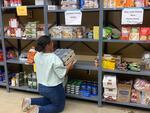
An Eastern Oregon University student volunteer restocks a campus food pantry.
Michael Dakota
Portland State’s food pantry saw an influx of food donations and community support over the past two weeks.
“Thousands of pounds of food have been donated. People have been amazing,” said PSU Smallwood Food Pantry coordinator Tess Conley. “I have been brought to tears more than once this week because of the outstanding community support we’ve received.”
PSU’s pantry usually receives about 1,600 visits from students a week. That number has not fluctuated significantly this week. Conley thinks that’s because most students who utilize the pantry had been stocking up already.
But with the holidays coming up, Conley said college students — especially those who don’t return home over break — will still need access to free food resources. And she said her pantry has been struggling to fill its shelves ever since Congress passed the One Big Beautiful Bill in July, making deep cuts to SNAP.
“Even though SNAP benefits have been fulfilled for this month, the need doesn’t go away,” Conley said. “It does almost feel like a false sense of security because we know we’re OK right now but nobody knows what’s going to happen in the coming weeks.”
The Trump administration filed an appeal of the latest court decision, mandating SNAP benefits be paid. In its filing Friday, the administration argued that the court cannot force a solution that is up to Congress to find.
“This is a crisis, to be sure, but it is a crisis occasioned by congressional failure, and that can only be solved by congressional action,” the appeal said.
With pending court decisions and an ongoing government shutdown, SNAP beneficiaries are worried that their benefits may be in jeopardy in the future.

Tyson Morris watches as his children, Grace Hagerty, left, and Milo Morris play at an indoor playground DiG PDX in Portland, Ore. on Thursday, Nov. 6, 2025.
Saskia Hatvany / OPB
For now, PSU student Morris is grateful that his SNAP benefits are back. He said access to food is a basic human right and the funding pause from this week is an obstacle that SNAP recipients like himself never should have faced.
“You can’t really account for this kind of thing. It’s unprecedented territory,” Morris said. “We’re just hoping for the best and preparing for the worst.”