OPB followed 25 students from first grade through high school as part of the Class of 2025 project to track the state's progress toward 100% high school graduation starting in 2025.
The project’s final documentary is now available on YouTube, and will air on OPB-TV on Thursday, Nov. 13 at 9 p.m. You can also attend a free screening and discussion at Mt. Hood Community College on Sunday, Nov. 16 at 3 p.m. Register here.
“Oregon probably has one of the most ambitious goals in the country,” Education Northwest’s Michelle Hodara said in OPB’s new documentary “Class of 2025: Growing Up In Oregon Schools”.
That goal is 40-40-20. It’s the idea that by 2025, 40% of young Oregonians should have a 4-year degree, 40% should have a 2-year degree or other credential, and the remaining 20% would have at least a high school diploma or GED. All 100% would graduate from high school.
Oregon’s Higher Education Coordinating Commission has been tracking progress on the goal. An October report shows progress has been made, but Oregon is still far from 40-40-20. Currently, it’s more like 39-18-20, according to the HECC. That doesn’t add up to 100%, so the overarching graduation goal hasn’t been achieved.
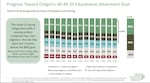
The Higher Education Coordinating Commission has been tracking progress on the state's graduation and higher education goals for over a decade.
Higher Education Coordinating Commission
Educational outcomes for Oregon students have improved since the 40-40-20 goal became law in 2011, but progress has stalled in the years after the pandemic. Moving forward, Oregon’s education leaders are rethinking the state’s targets, with K-12 and higher education sectors taking separate paths.
“[40-40-20] was inspiring to me as a vision for what we could become,” said Ben Cannon. Cannon, current executive director of the HECC and former Oregon state legislator, served as education policy advisor to Gov. John Kitzhaber when he began implementing systems to support the goal in the early 2010s.
“It reflected a vision of the state’s future, a future economy that would benefit from having well-educated Oregonians.”
What happened
Back in 2011, Oregon was in a different place. Building that community of well-educated Oregonians pulled folks from both the education and the business worlds. There were structures meant to encourage communication and collaboration. But after Kitzhaber resigned in 2015, things started to fall apart.
In 14 years, a lot has changed, and Oregon’s statewide graduation rate has yet to reach 100%. Graduation rates for the Class of 2025 are not publicly available yet, but the statewide graduation rate for the Class of 2024 was 82%. That is a drastic improvement from Oregon’s 69% grad rate when 40-40-20 was first announced, but Oregon still remains in the bottom third of states when it comes to graduation.
At the higher education level, the percentage of Oregonians with a four-year degree has increased, but Cannon said some of that can be attributed to college-educated people moving into Oregon.
“We have not closed all the equity gaps, and we need to do more to fulfill the promise and commitment that we’ve made to Oregon students,” Cannon said.
Much of the improvement in Oregon’s high school graduation rate happened between 2011 and 2019. When the pandemic hit in 2020, it wreaked havoc on Oregon’s progress.
“Oregon saw two or three times the learning losses as other states in the country because of the pandemic,” Hodara said, “and that has long-term effects on high school graduation and college enrollment. We’ve also been seeing stagnant college enrollment rates for more than a decade in Oregon.”
Is 100% high school graduation ever possible? Was the goal realistic or more aspirational?
“I think it’s both,” said Oregon Gov. Tina Kotek. “It seemed like it was the right set of targets based on where we were at the time.”
“The goal was clearly aspirational from the standpoint that no one actually expected that we would get to a point where 100% of young Oregonians would complete high school, but aspirational in an important way,” Cannon said.
“It started conversations,” said Ericka Guynes, former principal of Earl Boyles Elementary School, the Southeast Portland school where OPB’s Class of 2025 project began.
“It started, like, ‘what is success? What will it take for my child to graduate? Do they want to go to a trade school? What do they want to do afterwards?’ So I think what it did ultimately, maybe it wasn’t a hundred percent successful, but it started conversations and it raised awareness in teachers and in families … and districts as well.”
New goals
As she was campaigning for Governor in 2022, Tina Kotek settled on a new goal for high school graduation: 90%.
In 2023, when OPB reported on Kotek’s new goal, district officials like Carla Gay questioned the change from 100%.
“40-40-20 was really about 100% of our K-12 students having a high school diploma or GED,” said Gay, executive director of innovation and partnerships at Gresham-Barlow School District.
“If we lose sight of 100% of our students need to complete high school with a diploma or a GED, and we settle for anything less than that, then once again, we let ourselves off the hook and my question would be: Which 10% are we not going to graduate? How are we deciding that?”
Kotek said she looked at data to get to her new goal.
“For me, getting to 90% by 2027 seemed achievable,” she said earlier this year. “So that’s not the end point. It’s where you want to be in 2027, and we’re on track for that.”
Armed with a new goal, Kotek is aiming to track the progress and tie funds to those goals through an accountability plan.
Education Northwest’s Michelle Hodara said that’s one way to turn things around.
“Technically, some might say we don’t have a good return on investment, but the right approach to that is not to take money from schools,” Hodara said. “The right approach is to spend resources in the right way.”
The higher education sector is planning for a new goal too.
“It makes sense to me that over the next year or couple of years, we would look to refresh that goal with the legislature, engage them and other education leaders in Oregon on what the next iteration of that goal should be, perhaps for the class for 2035 or 2045,” Cannon said earlier this year.
Cannon said the 40-40-20 goal will inform the new goal, but it may look different.
“It’s difficult to use a goal like 40-40-20 for the purpose of institutional accountability when there are so many contributing factors to 40-40-20, some of which are outside of institutional control,” Cannon said.
According to the HECC’s October report on state educational attainment goals, creating a new goal comes with a challenge: “balancing our deeper purposes with what is measurable and controllable.” An “interim process” slide in that report states the goal may become a proposal ahead of the 2027 legislative session.
As OPB’s Class of 2025 project discovered, goals are one thing. The paths of the people those goals represent are another.
Asking the Class of 2025 students about the high school graduation goal that prompted a 13-year reporting project, they say life - and reality - often gets in the way of reaching a goal.
“There’s so much stuff going on for people personally,” said Class of 2025 student Kaylie. “If they have to take care of siblings, or parents that get sick, what are they going to do … so they can still go to school?”
“Everyone comes from different backgrounds, you can only understand so much,” Anais said.
“You have to constantly keep working to see what works and what doesn’t to help students understand what they’re working with and how life is going to hit them. You can only do so much.”