Observers have rejoiced at recent sightings of Chinook salmon swimming past former Klamath River dam sites toward historic spawning grounds.
Scott White, general manager of the Klamath Drainage District, shared in the celebration but grew nervous after spotting Chinook in canals used to divert water to agricultural land.
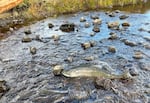
A fall-run Chinook salmon seen on Oct. 16, 2024, in a tributary of the Klamath River in Oregon.
Courtesy of Mark Hereford / Oregon Department of Fish & Wildlife
He said long-planned screens to keep fish from washing onto farmland are not yet in place.
“They’re in our canals, which don’t get me wrong, it’s pretty darn exciting to see salmon in our canals,” White said. “But obviously, we want to make sure that the fish are protected, just as much as we want our growers protected.”
The 2016 Klamath Power and Facilities Agreement, made among state, federal and other stakeholders in the Klamath Basin, set a goal to limit new regulatory burdens on irrigators from the reintroduction of fish species, like salmon. Part of the agreement was to support “entrainment reduction facilities” — or fish screens.
White is frustrated that it has remained unfilled.
“Why are we having to wait until fish are here for us to act on this?” he said. “We’ve had nine years to be able to prepare for this, and here we are.”
White said he wants to ensure fish traveling the Klamath River are protected and that farmers aren’t blamed if endangered species are found stranded on their land.
“[Oregon Department of Fish and Wildlife] and partners are leading long-term efforts to expand fish screening across the Klamath Basin,” the agency said in a statement. “Decades of work have gone into fish screening projects, but much work remains to be done.”
Building fish screens isn’t an easy task, the ODFW said, because they must be tailored to each site’s unique flow and sediment level. “Klamath River conditions rule out simple, off-the-shelf designs,” the agency said.
Demand for fish screens from landowners has outpaced supply, ODFW said. However, the agency recently received $1.25 million in Oregon Lottery Bond funds for the effort.
The Klamath Drainage District is also working with federal and state agencies on a $4.5 million multi-screen project within the Ady Canal. The first screen is planned for 2026, pending funding approval.
Those screens are important for the district’s Ady Canal Reconnection Project. The plan is to allow fish passage through Ady Canal to the Lower Klamath National Wildlife Refuge, connecting the habitat to the Klamath River and providing potential new spawning grounds for salmon.
Justin Higginbottom is a reporter with the Jefferson Public Radio newsroom. This story comes to you from the Northwest News Network, a collaboration between public media organizations in Oregon and Washington.
It is part of OPB’s broader effort to ensure that everyone in our region has access to quality journalism that informs, entertains and enriches their lives. To learn more, visit our journalism partnerships page.