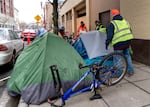
Rapid Response Bio-Clean teams perform campsite removals in Portland’s Old Town Chinatown, March 9, 2025.
Kristyna Wentz-Graff / OPB
Budget talks in Portland City Hall have exposed a political chasm between how some city councilors and Mayor Keith Wilson want to address homelessness.
Wilson entered office this year with a strategy to end unsheltered homelessness in Portland by Dec. 1, a plan that involved swiftly opening new shelters and enforcing the city’s camping ban. City councilors have let Wilson roll out his ambitious plan without significant interference and saying they wanted to give him the chance to meet his deadline.
But, three weeks before December, a city budget proposal is illuminating some councilors’ critiques of Wilson’s approach.
“We have a lot of people who are suffering right now, and I am not seeing that the mayor’s shelter plan is going to adequately alleviate that suffering,” Councilor Angelita Morillo told OPB in an interview. “Our office feels the need to act.”

Councilor Angelita Morillo at a Portland City Council meeting on Feb. 5, 2025, Portland, Ore.
Anna Lueck for OPB
Morillo has introduced a proposed $4.3 million cut to the city’s Impact Reduction Program, which dismantles homeless camps and removes trash from public spaces. The money would specifically come from the program’s budget for campsite removals — commonly called sweeps — and would be spread among programs that support housing, food assistance, businesses and immigration services.
“Portland cannot sweep its way out of this crisis,” said Councilor Mitch Green, who is co-sponsoring the budget amendment, which councilors will vote on Wednesday. “City, county and state agencies have spent millions of dollars on sweeps and temporary shelters in recent years, and the result is more death, more suffering, and more people on the streets. It’s become clear that the Mayor’s plan is more of the same.”
An unusual budget process
City councilors adopted their current budget in June. Morillo’s proposal is part of a process where city councilors can tweak spending plans midway through the year. In the past, the process has been a way to move around unspent or unanticipated revenue. But this year, the city has no extra cash to redistribute. Due to an unexpected dip in business tax revenues, the city has nearly $20 million less than anticipated to cover the rest of this fiscal year’s budget, which ends in June.
Wilson’s office said now isn’t the appropriate time to make major budget changes, like the one Morillo has floated.

Portland Mayor Keith Wilson speaks during a press interview in his office in Portland City Hall on Oct. 22, 2025.
Eli Imadali / OPB
“When we went into the last budget process, that involved an enormous amount of community input and conversation to design something that’s going to carry us through the whole year,” said Taylor Zajonc, a spokesperson for Wilson. “Disrupting a funding stream mid-year has a really outsized impact on the services that we can actually offer.”
Councilors approved a $16.6 million budget for the Impact Reduction Program in June. The city then lost some state funding to pay for camp removals along state highways, shrinking the budget to $14 million. Morillo’s proposal would cut roughly 30% of the program’s current budget.
Wilson framed the cuts as a 75% reduction in the program’s services given the city is halfway through the year, and said up to 100 people could be laid off.
While Morillo’s proposal directs the program to only reduce the camp removal work, Zajonc said that it would still impact the program’s trash removal efforts. That’s because much of the campsite removal money cannot be touched due to legal requirements, like warehouse leases and work contracts. The mayor’s office estimates the cuts would result in an estimated 4 million pounds of street trash and biohazards being uncollected.
A political divide
In a newsletter sent over the weekend, Wilson wrote that Morillo’s proposal “would be devastating for every neighborhood” by not allowing city staff to remove camps. Wilson, who doesn’t have a vote on city council, urged Portlanders to encourage city councilors to reject the proposal at this week’s council meeting.
Wilson’s call for action has gained traction in some business and neighborhood groups, which have separately issued emails and held meetings to urge councilors to reject the budget cuts.
Morillo said Wilson didn’t contact her office to share these concerns before sending this weekend’s newsletter.
“I would like for him to express some maturity by picking up the phone when the legislative branch is making certain decisions so that he can actually execute our vision, which is what his role is as the executive branch,” she said.

The Salvation Army Female Emergency Shelter, or SAFES, has 100 available beds, including 54 on the main floor, Sept. 23, 2025. The Portland shelter, at the corner of Southwest Ankeny Street and 2nd Avenue, is a fundamental component to Mayor Keith Wilson’s homelessness plan.
Kristyna Wentz-Graff / OPB
The councilors’ critiques go beyond the city’s camp removal work.
Both Morillo and Green point to Wilson’s recent decision to start enforcing the city’s camping ban, which sticks people with a criminal citation for camping on public property. Since police began enforcing that rule Nov. 1, they have issued at least seven citations. Officers have also used the sanction to stop people and check whether there’s a warrant out for their arrest, according to the mayor’s office. At least 40 people living outside have been arrested on outstanding warrants in the past 10 days.
“Attempts to police our way out of poverty have been a catastrophically poor investment,” Green said.
Other members of the council’s six-person progressive caucus have echoed this concern online. In a social media post, Councilor Jamie Dunphy wrote that he’s noticed more encampments pop up in his East Portland district following the camping ban enforcement.
“The Mayor isn’t solving a problem,” Dunphy wrote, “he’s forcing the problem into the neighborhoods that are already suffering the most.”
Dunphy’s fellow District 1 councilor, Candace Avalos, shared his post and noted her support.
The pushback is the most coordinated opposition Wilson has received from city councilors since unveiling his homelessness plan earlier this year.
“I think it wouldn’t just delay the outcomes we’re looking for,” Zajonc said. “It would reverse the gains that we’ve already made.”
Wednesday’s vote
It’s not clear if Morillo has the support of enough councilors to advance her proposal at the Wednesday council meeting.
Councilors Olivia Clark, Eric Zimmerman and Dan Ryan have expressed their support for the mayor’s camping policy, and previously advocated for the Impact Reduction Program’s work. In an email to OPB, Councilor Steve Novick pointed to a recent poll that showed Portlanders are more in favor of defunding the city’s outdoor shelters than the camp removal program.
He doesn’t support the proposal, and said he believes the public needs more time to give councilors feedback on an impactful policy before it goes to a vote.
Councilor Loretta Smith is the only councilor outside of the progressive caucus to publicly support Morillo’s proposal. Smith has long been critical of how the city funds its homelessness programs and believes the proposal helps fill federal funding gaps.
“We don’t know what’s happening at the federal level in terms of funding,” Smith said. “This puts rent assistance and food assistance front and center. I’m for that.”