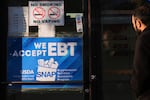
A customer walks into a bakery with a SNAP EBT information sign displayed on the front door in Chicago, Sunday, Nov. 2, 2025.
Nam Y. Huh / AP
Last Friday morning, Oregonians were able to begin accessing their full monthly benefits for the Supplemental Nutrition Assistance Program after a federal judge ordered the Trump administration to fully fund the federal food aid program which serves more than 42 million Americans.
But many of those households face new uncertainty after the Supreme Court granted on Friday night the Trump administration’s emergency appeal of the ruling.
In a statement, Oregon Gov. Tina Kotek said the state had acted lawfully in sending out the SNAP payments and vowed to fight the U.S. Department of Agriculture’s demand that states “undo any steps” they took to issue the full November SNAP benefits.
Food pantries across Oregon, including at William Temple House in Portland, have mobilized in recent weeks to help people like Elaine, one of the more than 750,000 Oregonians who are SNAP recipients. To protect her privacy, OPB is identifying Elaine only by her first name.
She says SNAP has been a lifeline to her for nearly 20 years while being unable to work full-time because of a disability and experiencing periods of homelessness.
Elaine joins us to discuss the restoration of her SNAP benefits after nearly a week without them, and the uncertainty about the program’s future.
“Think Out Loud®” broadcasts live at noon every day and rebroadcasts at 8 p.m.
Note: The following transcript was transcribed digitally and validated for accuracy, readability and formatting by an OPB volunteer.
Dave Miller: This is Think Out Loud on OPB. I’m Dave Miller. We start today with the personal toll from the political fight over food benefits. It’s hard to overstate just how head-spinning the back and forths over SNAP benefits have been recently. As we talked about last week, Supplemental Nutrition Assistance Program benefits for the month of November had been put on hold because of the government shutdown. Then a federal judge ordered that the Trump administration had to fund the program and the administration eventually said it would, but only at about half of the regular amount. After that, a judge said, “No.” The Administration had to fully fund SNAP benefits, and Oregon beneficiaries did see the full amount on their EBT cards. Then the Supreme Court put that order on hold. Finally, just yesterday, some Senate Democrats joined with Republicans to pass a measure that will likely lead to the end of the government shutdown.
We’re going to hear what all of this has meant for one Oregonian right now. Elaine joins us. We’ve agreed to use just her first name to protect her privacy. She says SNAP has been a lifeline to her for nearly 20 years while being unable to work full time because of a disability. Elaine, welcome to Think Out Loud.
Elaine: Thank you. Thank you for having me on the show today.
Miller: Thanks for joining us. When it had seemed like you were only going to get about half of your regular monthly amount, and perhaps you’d have to wait for that for many weeks, what had your plans been?
Elaine: At first I was somewhat concerned when I heard about the government shutdown and how that affected SNAP benefits in particular, because like millions of Americans, I too currently depend on receiving SNAP benefits to eat. I say “somewhat concerned” because as a Christian I have the understanding that God is my provider and that SNAP was just a vehicle by which he delivered that provision. That being said, I was confident that I wouldn’t go hungry, so I wasn’t panicked by the news.
However, I did have concerns about the possibility that I might not be able to strictly follow my medical diet during the shutdown. Strictly following a medical diet for me means being able to avoid unwanted side effects from chronic health conditions that affect my mobility. Typically, specialty foods such as gluten-free are more challenging to obtain for free from food pantries, as they aren’t typically donated, let alone donated in bulk. Nevertheless, I knew that God would provide for my needs. I just wasn’t sure how. During the shutdown, I learned how, and my faith was strengthened. God came through for me and others in the most unexpected and delightful ways.
Miller: We’ve talked to a few food banks over the last few weeks. They’ve reported a huge uptick in demand. That was even before EBT cards were not refilled at the beginning of this month. Have you seen that? I mean, have you been to a food bank recently and seen that?
Elaine: Yes, I have indeed. I’ve been to a couple of them. Let me tell you about my experience. From my experience, when I wasn’t able to get what I needed from a food bank – for example, during the shutdown due to my special needs – an acquaintance, a woman who goes to the same pantries I go to, blessed me with a $20 bill so I could buy what I needed to eat, as she was aware of my special needs. I also witnessed other human kindnesses in action, when others depended on SNAP at food pantries would share food they had just received with others who didn’t get anything due to the higher than normal demand, as well as giving others empty containers to redeem for cash so that they wouldn’t go hungry.
Additionally, surprisingly actually, a number of Portland restaurants stepped up to offer free meals to SNAP recipients during the shutdown. I would just like to express gratitude to all those that came together during the shutdown to provide free food and drink to your neighbors in need. Thank you and God bless you for demonstrating what it looks like to love your neighbor.
A special shout out to Kevin, the Director of Human Services, and his team at William Temple House for doing an amazing job of serving the community, but especially during the shutdown by handling the increased need with the resources William Temple House had on hand. Also to Teresa and her team at Lift Urban Portland, thank you for always doing your best to meet the needs of the community. And to all those who showed up for work at DHS to help navigate assistance during the shutdown with food resource lists, you all rock. Keep up the good work.
Miller: As I mentioned, late last week, the full amount – or even, as I understand, a little bit more in some cases – was put on folks’ EBT cards last week. But then the administration has said that they want to try to claw back that money from states. When you got that money on your EBT card, what did you do?
Elaine: Well, I was relieved and actually surprised because I not only got the EBT back, but I also got a slight increase from previously. It was raised by a few dollars and I was like, “Wow, such a blessing.” I felt very grateful.
Miller: Because it was more than you were used to, and also because of all the uncertainty in the weeks leading up to it, did you use the money quickly to stock up for the month, thinking that maybe it would disappear?
Elaine: I didn’t waste any time in replenishing my provisions, but I wasn’t overly concerned about losing it again because I know that God provides, whether or not government is the vehicle by which he provides. Like I did say, there are other ways in which God provides for his people, and if we all just help one another and share the blessings he gives us, none of us will go hungry. None of us would be without.
Miller: What has SNAP meant to you over the last 17 years?
Elaine: It’s meant that I’ve been able to follow my medical diet more strictly, and that has helped benefit me and my health. That has been a very important aspect. I believe that God used this temporary shutdown to move people to show kindness and compassion for their neighbors in need, as well as to test our faith and to show us again his unfailing faithfulness by his provision in the absence of SNAP assistance.
Miller: All of this shutdown delay has happened before other massive changes to SNAP from the One Big Beautiful Bill Act have taken effect. Do you yet know how the new eligibility rules will affect you going forward?
Elaine: I do not know at this time.
Miller: The messaging from Republicans when that bill was being debated, the bill that’s led to big cuts to Medicaid and SNAP in the medium term, it’s basically that, “Yeah, we want to help people who really need it, but we want to kick the freeloaders off.” What has it been like for you to hear that?
Elaine: From their perspective, I do understand where they’re coming from. I think that the way they judge who the freeloaders are and who is deserving of the benefits, there’s a gap there in clarity. You don’t know a person’s situation unless you allow them to inform you of their situation. Everyone’s situation is different, and I can only speak for my own situation.
I have worked all my life. I paid into the system. I paid Social Security over the years, and I think most people that contribute in different ways deserve the benefits. People have worked all their lives – seniors, people with disabilities. And what about those who can’t yet work? What about children? Is it right to take food out of their mouths? How we judge whether someone is worthy of eating or not, I think every human being deserves to eat. It’s a basic human right. I don’t think anyone has the right to take that away.
Miller: Elaine, thanks very much …
Elaine: Thank you.
Miller: And best of luck to you. That is Elaine, who is one of hundreds of thousands of Oregonians who rely on SNAP food benefits.
If you’d like to comment on any of the topics in this show or suggest a topic of your own, please get in touch with us on Facebook, send an email to thinkoutloud@opb.org, or you can leave a voicemail for us at 503-293-1983.