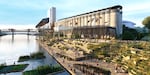
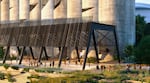
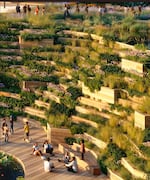
A rendering shows the 1803 Fund’s intended transformation of the former Louis Dreyfus Co. grain terminals on the Willamette River near the Oregon Convention Center and Moda Center in Portland, Ore. Source images by AD—WO, MALL and Wayside Studio; Rendering by The Light We Make
Courtesy of 1803 Fund
There’s a lot of talk about Portland being in a “doom loop” these days.
But Rukaiyah Adams, one of the city’s more influential figures, isn’t having it.
“While everybody else is crying into their beer about doom, it takes generations of Black folks with ancestral knowledge to know how to pivot to the future and begin anew,” Adams said on Tuesday.
The 1803 Fund, which is restoring and redeveloping historically Black areas of the city, purchased $70 million worth of real estate in inner North Portland. Adams, the CEO of the 1803 Fund and a member of OPB’s Board of Directors, spoke during a media event to unveil architectural renderings for the group’s signature project thus far.

CEO of 1803 Fund Rukaiyah Adams speaks at the unveiling of plans for a new development, Tuesday, Dec. 2, in Portland, Ore. The Initiative was created to restore and redevelop historically Black areas in the city.
Saskia Hatvany / OPB
The project includes the site of the former grain silos near the Moda Center. It’s there, Adams said, she envisions much of the design work to be centered around the culture of learning. She wants kids who live in the city but whose parents can’t take them to Paris or Washington, D.C., to be able to study river ecology or riverfront farming.
The 1803 Fund was formed in 2023 after Nike co-founder Phil Knight and his wife, Penny Knight, pledged $400 million toward the effort.
Portland Mayor Keith Wilson also spoke at the unveiling, noting that the project “isn’t about just a particular population.”
“This is about our collective Portland we’re talking about right now, the soul of our city,” Wilson said. “Albina is a cultural cornerstone of our city, and we all have a vested interest in its success.”
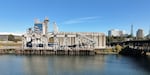
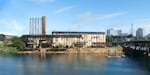
The group’s first investment, called the Albina Riverside, is a three-acre site along the waterfront, which includes the former Louis Dreyfus Co. grain terminal on the east side of the Willamette River, just north of the Steel Bridge. The silos were built in 1914. The group says they will reunite Albina with the river and create public access, recreation space and space for intellectual activities. They will keep the grain silos as part of the redevelopment.
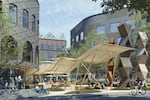
A rendering showing The Low End district, a mixed-use development planned by the 1803 Fund.
Courtesy of 1803 Fund

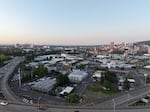

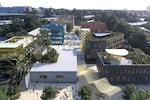
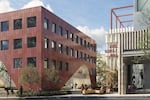




The other area is known as “the low end” and will be a mixed-use property. It includes about 20 tax lots in the lower Albina neighborhood, south of the Fremont Bridge and west of Interstate 5. It is more than seven acres along the western edge of Russell Street in the historic part of Black Portland. The group said this will become the “heart of Rebuild Albina.”
In the 1960s, more than 80% of Portland’s Black residents lived in Albina, after being pushed out of other regions of the city through the use of racist housing policies such as redlining.
The 1803 Fund’s total investment is $70 million in the Rebuild Albina properties, and it said Tuesday that is just the beginning. Another phase of investment is scheduled to be announced in 2026. Project leaders said they expect planning and permitting for the initial phase to take about two years, plus another two years for construction.

Community members, officials and affiliates of the 1803 Fund attend a press conference for the Albina neighborhood development on Tuesday, Dec. 2, in Portland, Ore.
Saskia Hatvany / OPB
The group believes the redevelopment will generate hundreds of jobs and $700 million in economic impact. The property in “the low end” has significant contamination and will require environmental remediation.
“Environmental stewardship is a public benefit rooted in Black tradition: transforming what was discarded into something extraordinary,” a press release from the group notes.
The 1803 Fund’s name comes from the year that York, an enslaved man, joined the Lewis and Clark expedition.