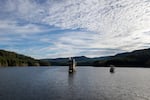
FILE: Bull Run Watershed, Dec. 3, 2019. Water stored in reservoirs in the Bull Run Watershed has served the Portland metro area with drinking water. It is human-built reservoirs like this one, as opposed to natural lakes or ponds, that the researchers studied for their floating solar potential.
Kaylee Domzalski / OPB
A recently published paper led by an Oregon State University researcher suggests that installing floating solar panels on top of existing reservoirs could have a variety of positive results. Those results include cooling the solar panels, allowing for greater energy generation from those panels and preventing the water in shallower reservoirs from warming to temperatures that are challenging for fish and other aquatic life.
According to lead researcher Evan Bredeweg, there are relatively few of these kinds of installations in the U.S., but in countries that have embraced solar and non-fossil fuel energy, they are relatively common.
Bredeweg joins us to tell us more about the study and the potential floating solar has for wide-scale adoption.
Note: The following transcript was transcribed digitally and validated for accuracy, readability and formatting by an OPB volunteer.
Dave Miller: This is Think Out Loud on OPB. I’m Dave Miller. We start today with floating solar panels. These are hydrovoltaic panels that are installed on top of existing reservoirs. A new paper by researchers at Oregon State University and the U.S. Geological Survey modeled the impact of these systems on reservoirs in six states. They found that floating solar could have a variety of positive results, including an increase in energy generation and a reduction in water temperature, but they are not a panacea.
Evan Bredeweg was the lead author of this study. He is a former postdoctoral scholar at OSU, and he joins us now. It’s great to have you on Think Out Loud.
Evan Bredeweg: Thank you so much.
Miller: Can you first explain just what we’re talking about here? What floating solar panel arrays are?
Bredeweg: Yeah. We looked at this as a utility scale, where you would take these PV panels that we often see on tops of houses, but instead install them on large floating arrays on reservoirs. So instead of having a firm structure on land or on buildings, we’re putting them on rafts at a very large scale so that they can generate power on these reservoirs.
Miller: How common are these right now around the world?
Bredeweg: Around the world, there’s a lot of interest, particularly in Southeast Asia. There’s been very widespread installations across China, there’s been some test installations throughout the United States and in Japan and Korea. But it has been very variable based on how the administrative side of the installation can go.
Miller: What did you set out to study or to model exactly for this new paper?
Bredeweg: Because these are really new opportunities to install these kinds of structures, there’s a lot of open questions on how they might impact the functioning of the ecology of these lakes. So our goal was to look across a variety of different reservoirs to see if we could understand how this kind of an impact might have some general impacts on the ecology of the lake.
Miller: I mentioned six different states, where were you looking?
Bredeweg: So we were basically harvesting models. So we used very high-level models of these reservoirs that recreate the physics and the chemistry that happens within these lakes. And so we were able to find research researchers that had developed models in different reservoirs across the U.S. So these 11 models that we were able to find were ones that had been developed for those water bodies. We used those models that had been developed to kind of put into the stress test of understanding what it might look like with floating solar.
Miller: Using computers to say, “We have all this data about how these reservoirs behave. What would happen if we put floating solar panels on top of them?”
Bredeweg: Exactly. So from an ecology side, the incoming sunlight is a really big driver of the ecology of these lakes. They drive the thermal behavior of the water, they change how the water body circulates, and that changes how nutrients are created and circulated. And so when you have something that shades the surface of the water like these floating solar panel arrays, it could then kind of trickle down and impact all the different functionings of those ecology.
Miller: When I’m envisioning this, is it almost like a complete solar panel blanket in some of these places? Or is it more like a checkerboard where there’ll be some number of these panels, but a lot of sunlight is still hitting the water?
Bredeweg: It really depends on the extent of these kinds of arrays. They’re never going to be a complete shield on the surface of the water for the entirety of the reservoir. Each of these kinds of rafts, depending on the mounting system, some of them have walkways, some of them have boat access for maintenance. In Southeast Asia, there’s some that will actually have transformers alongside the solar panel arrays. It’s never going to be a complete coverage of the water body. But even within that, there’s still going to be a lot less light hitting the surface of the water than you would have with an unobstructed surface.
Miller: And we’re going to talk about what that means. Just in the big picture though, what do you see as the most important findings from your recent research?
Bredeweg: I think the biggest thing that bore out in these models was that there was no uniform right amount of installation that makes sense. There’s no textbook response. There is some generalities, but each of these reservoirs responded very differently, which kind of raises the point that if we look at large-scale installation of these, we really need to understand the actual functioning of that system before making those kinds of large-scale plants.
Miller: It does also make it seem like if it has to be really individually tailored, that seems like it would be a challenge for large-scale production. If every place, you have to treat it as its own place, that strikes me as different than large-scale electricity production at scale.
Bredeweg: I think it depends on the management needs of a given area. One of the benefits of looking at these kinds of installations on a reservoir is they’re not pristine habitats. They’re already areas that have been established because of the dam in the first place. That being said, if you were working in an area that has very sensitive species, you are going to be much more aware of the kinds of impacts and how they’re going to impact those aquatic species that you might have as a management priority. If you are already working in an area that’s highly impacted, that does not have a lot of species of management concern, maybe there’s a little bit more flexibility in the kinds of installations you could go forward with.
Miller: What do you see as the biggest benefits of these floating arrays?
Bredeweg: From the engineering side, what you get when you install these kinds of things on reservoirs is you’re already having power generation next to an area that has transmission lines.
Miller: Oh, especially if this is a hydroelectric dam.
Bredeweg: Exactly. You already have an area that has transmission capacity. You can potentially operate the solar energy production in concert with the hydroelectric energy generation, you can kind of balance those loads. You’re also working on an area that’s very flat and potentially does not have a lot of shading from trees or buildings.
And the other piece of this – what has a lot of engineers excited – is having these panels on the surface water means that they’re actually going to operate it more efficiently. Solar panels like to be in a very kind of comfortable human range. If they get too hot, they actually drop off in their energy efficiency. So if we can keep them cooler by being near a cool water body, that will allow them to generate more electricity than they would if they were in a terrestrial facility.
Miller: Are there benefits for some aquatic life in cooling that water down as well, so the opposite side of that? So, the panels do better if they’re cooler. What about changing the temperature of the water?
Bredeweg: It’s going to depend on the kind of species we’re talking about. For warm water species that really need that warm surface water to thrive, they’re going to probably have a harder time because we’re going to be cooling that surface water by interacting with that incoming solar radiation.
On the flip side, in the Pacific Northwest, we’ve really struggled with reservoirs because of the fact that they heat up the water. And a lot of our native salmon species rely on cool water. So if we’re already able to cool that surface water, that might align with our management priorities for those reservoirs as it is.
Miller: So when the water is released, it’s less likely to be these pulses of hot or warm water that are not correct for some of the river species.
Bredeweg: It may change based on where that is in the reservoir. So if you have this array further up in a reservoir, that’s where that cooling might happen.
We also found that there was changes in the way the circulation in the reservoirs occur because of these panels. So there’s been some work in terms of having cooling towers where you can have selective mixing of water layers to get the desired output temperature downstream. But this writ large would reduce the amount of the thermal energy in a reservoir.
Miller: Are there any reservoirs in Oregon that that seem most like natural fits, given all of the different issues you’re talking about here, the different parameters? Are there any places where you think it actually might make sense here?
Bredeweg: That’s beyond my pay grade. I’m sure there’s reservoirs we can make work. The reservoirs in the Pacific Northwest have really variable pool depths, and so that does create some of its own engineering challenges to be able to understand where that array is going to be anchored, especially with hundreds of feet of reservoir change within a season. I wouldn’t name drop any one reservoir and say this is a good fit.
Miller: How much commercial interest is there in these arrays right now, whether in the Northwest or nationwide?
Bredeweg: I think just like any kind of new technology, there’s a lot of interest. I’m not on the business side of things to know exactly if these are going to get installed or chased down. But I think it is definitely an option that’s worth investigating.
Miller: Evan, thanks very much.
Bredeweg: Cheers.
Miller: Evan Bredeweg is the lead author of this new floating solar study. He’s a former post-doctoral scholar at Oregon State University.
“Think Out Loud®” broadcasts live at noon every day and rebroadcasts at 8 p.m.
If you’d like to comment on any of the topics in this show or suggest a topic of your own, please get in touch with us on Facebook, send an email to thinkoutloud@opb.org, or you can leave a voicemail for us at 503-293-1983.