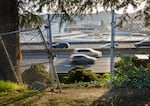
The I-5 freeway is seen through the fencing at the back of Harriet Tubman Middle School in North Portland, April 9, 2021. ODOT's proposed Rose Quarter expansion would bring the freeway even closer to the school grounds.
Kristyna Wentz-Graff / OPB
Faced with a massive funding hole — and no certainty about how they might fill it — Oregon transportation officials opted Thursday to move forward with a multi-billion dollar highway project that would reshape Portland’s Rose Quarter.
With one small portion of that project already underway, the Oregon Transportation Commission directed the state’s transportation department to pursue another round of construction with $167 million on hand.
The elements of that new phase will be hammered out in the coming months, as the Oregon Department of Transportation works with the City of Portland, Metro and community groups to strategize how to best spend limited funds.
But the newly approved spending does nothing to address a major question for a project that is expected to cost more than $2 billion: Where is the state going to find the roughly $1.5 billion it still needs to finish work?
The severity of that challenge became clear this summer, after the Trump administration rescinded $388 million in previously approved grant money, and lawmakers failed to find agreement on a road funding bill.
“This is a really tough subject for the commission,” OTC Chair Julie Brown said early in the meeting. “We are really, really struggling.”
Thursday’s vote amounted to a crossroads for the project, which was approved by lawmakers in 2017.
What began as a proposal to widen Interstate 5 through Portland’s Rose Quarter — estimated price tag: about $500 million — eventually swelled in ambition and cost. The project now includes capping the interstate, a move that would stitch back together the city’s historically Black Lower Albina neighborhood.
The highway cap has united some community groups and local elected officials in Portland, who see the project as a salve for historic injustices. Many Black residents were forced to move to make way for the freeway’s construction.
Those groups offered full-throated support on Thursday, urging commissioners to move forward with a new phase in the project.
“What we are asking you to do is think about the history of commitments our state has made … and to stand firmly on a path forward that not only keeps this project alive, but keeps it moving,” said JT Flowers, director of government affairs with the Albina Vision Trust, the nonprofit leading the effort to redevelop the area above and around I-5.
“We must not let this project pause or small businesses — especially businesses owned by people of color — will feel the impacts overnight,” said Nate McCoy, president and CEO of the National Association of Minority Contractors Oregon chapter. “This is not just a transportation decision, it’s an economic recovery decision.”
But that perspective is far from unanimous. Opponents of the proposal to widen I-5 argued that the state could not responsibly move forward given ODOT’s funding woes.
“A good rule of thumb the commission should use is: Don’t start something you can’t finish,” said Joe Cortright, a Portland economist and founding member of the advocacy group No More Freeways. “The financial crisis you are facing now is not temporary. It’s deep-seated.”
Cortright had an ally in state Sen. Suzanne Weber, R-Tillamook, who told commissioners the state should avoid dumping more money into the Rose Quarter with so many other pressing transportation needs around the state.
“Those dollars should not be used for a project that ODOT has shown it is incapable of managing,” Weber said during public testimony. “Those dollars, which may soon become quite scarce, should be used on other important road projects.”
But commission members did not ever seem to seriously consider pulling the plug on the Rose Quarter project. The main question they mulled during the hearing was whether to approve a new phase of the project that ODOT had proposed — known as “Phase 1b” — or direct the agency to work more closely with community interests in figuring out exactly what Phase 1b should entail.
The commission went with the latter option after hearing from Albina Vision Trust Executive Director Winta Yohannes. Yohannes said her group and others wanted more input in what should be done with the remaining $167 million, to ensure that improvements to the freeway were balanced with projects on surface roads around it.
“We don’t want to come here in the spring and say we don’t agree with what’s in Phase 1b,” Yohannes said. “ODOT sort of going off in a corner and saying ‘this is the only thing that’s possible’ has never been a successful strategy.”
So the Rose Quarter project lives on, but more difficult decisions could be ahead. Lawmakers will likely have to grapple seriously with transportation funding in next year’s short legislative session.
After failing to pass a far-reaching road funding bill this year, the Legislature did succeed in approving a smaller package during a special session that convened in August. But most of the new revenue in that bill — increases to gas taxes, registration fees and payroll taxes — are unlikely to take effect as planned. Opponents appear to have enough signatures to refer those elements to voters next year, and the new taxes would not go into effect until a vote can be held.
That means that ODOT is staring down a sizable shortfall in its operating budget. How lawmakers look to close that gap, whether with layoffs, redirecting funds or other options, will be a major focus next year.
One option some advocacy groups are already talking about: asking lawmakers to shuffle money away from projects like the Rose Quarter. Thursday’s decision may be a signal that the project is politically safe.