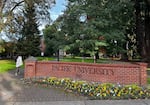
The Pacific University campus in Forest Grove on Oct. 11, 2024.
Tiffany Camhi / OPB
Oregon could see two of the state’s oldest colleges merge into a new private university system, unlike any in the Northwest, as early as next year.
The proposed new system, tentatively called the University of the Northwest, would be a consolidation of Willamette University and Pacific University. If the merger goes through, it would become the state’s largest private university with more than 6,000 students.
Higher education institutions across the country are facing declining enrollment and budget difficulties, but leaders at Pacific and Willamette say they’re not pursuing the partnership due to financial challenges. They say the partnership will lead to better services and expanded career pathways for students, as well as create a regional workforce development hub.
“Our intent is to meet the demands of higher education in the future and to develop this strategic platform where we bring together the legacies of Oregon’s two oldest institutions,” said Jenny Coyle, president of Pacific University.
The schools are looking to replicate the collegiate model, a university framework common to Europe. In that model, different colleges operate under one institution and share resources.
Under the plan, a new university would serve undergraduate students on campuses with familiar-sounding program names: Willamette College in Salem, Pacific College in Forest Grove and the Pacific Northwest College of Art in Portland.
“And the graduate schools are rolled up into the university level,” Willamette University President Steve Thorsett said. “This is a parallel model that brings resources together across the whole university.”
The two universities had previously discussed less drastic collaborations in recent years. But more serious talks about a possible merger between Pacific and Willamette did not materialize until Spring 2025. Coyle said combining forces presents a huge opportunity for the two schools’ graduate programs.
“We attract different students that come to us for different reasons,” Coyle said. “Willamette has law and data science. Pacific has health professions and education.”

People gather outside the Mark O. Hatfield Library on the campus of Willamette University in Salem, Ore., Saturday, April 27, 2019.
Bradley W. Parks / OPB
Mergers between colleges and universities are becoming more common in the U.S. Financial shortfalls, declining enrollment and the streamlining of services are among the most common reasons colleges consolidate, according to a recent analysis of college mergers by the State Higher Education Executive Officers Association.
“All of these pressures, particularly on small colleges, they’re feeling these pressures, and we’re seeing more closings or mergers going on,” said Donald Heller, consultant with Higher Ed Consolidation Solutions, a group that helps colleges and universities in mergers.
Willamette and Pacific are no strangers to budget woes.
Pacific saw a $10 million shortfall in 2020 due to the COVID-19 pandemic, according to the university’s website. The college made changes and was able to end the year with a surplus.
Willamette has struggled financially due to shifting enrollment trends for nearly a decade. The Salem university cut $2 million from its budget last school year, according to reporting from the student paper, The Collegian.
Institutions that are successful in mergers don’t wait until there’s a financial emergency, said Heller.
“You’re in the best position to effect a merger when your institution still has some strength to it,” Heller said. “Unfortunately, many institutions, and the boards and the presidents of these institutions, don’t think about a merger until it’s too late.”
Oregon has seen a number of private colleges fold in recent years, including Concordia and Marylhurst universities, and the Oregon College of Oriental Medicine.
Thorsett said both Willamette and Pacific are running balanced budgets this school year. He said the merger is less about saving money and more about capacity building.
“One of the goals here is to build an institution that’s able to invest in the things it needs to keep up with the changing environment we’re working in,” Thorsett said.
The announcement comes on the heels of a poor forecast for private, non-profit colleges from S&P Global Ratings. The credit ratings agency cited more enrollment competition, rising personnel costs and unprecedented federal policy changes as reasons for its less-than-stellar outlook. The report follows a similarly negative financial forecast in November for the entire higher education sector from Moody’s Ratings.
Coyle at Pacific University said the merger will ensure that the two institutions will be ready to weather these headwinds.
“It’s about looking ahead to make sure we can be strong and sustainable as we look ahead to the next 100 years of Willamette, Pacific and PNCA,” Coyle said.
There are still a lot of details to iron out before the deal can go through, including negotiating a merger agreement and clearing federal regulatory hurdles. Coyle pointed out that the proposed name of the school, University of the Northwest, could change, too. The two schools plan to provide open forums for students, faculty, alumni and other stakeholders to provide feedback over the coming months.
If all goes to plan, the new combined university system could stand up in a matter of months, by summer 2026.
“We really think that if we pull this off, it’ll be a model emulated elsewhere around the country,” Thorsett said.
Editor’s Note: An earlier version of this story had an incomplete name for the consulting firm mentioned. That version of the story was also missing context related to Pacific University’s financial situation.