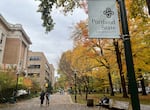
FILE - Students walk on the South Park Blocks at Portland State University on November 4, 2025.
Tiffany Camhi / OPB
Big changes are in store for the federal student loan program. President Trump’s tax and spending bill, which was signed into law last summer, ends a supplemental loan for graduate students and caps the amount they can borrow from the government. It also allows students in professional programs, such as law and medicine, to borrow more than students in other graduate programs, such as nursing or social work.
The bill reduces students’ loan repayment options from seven to two. It also phases out the Biden-era SAVE plan, which was the most flexible income-driven repayment option.
Jennifer Bell is the director of financial aid at Portland State University. Susan Bakewell-Sachs is the vice president of nursing affairs and dean of the School of Nursing at Oregon Health & Science University. They join us to discuss what the changes could mean for students who rely on loans, particularly to get advanced degrees.
Note: The following transcript was transcribed digitally and validated for accuracy, readability and formatting by an OPB volunteer.
Dave Miller: From the Gert Boyle Studio at OPB this is Think Out Loud. I’m Dave Miller. Big changes are in store for federal student loan programs. President Trump’s tax and spending bill reduced the number of loan repayment options. It ended a supplemental loan for graduate students and it introduced new caps on loans for various professional programs, meaning that law and medical students will be able to borrow more than students in graduate programs like nursing or social work. Jennifer Bell is a director of financial aid at Portland State University. Susan Bakewell-Sachs is a dean of the School of Nursing at Oregon Health and Science University. They both join me now. It’s great to have you on Think Out Loud.
Jennifer Bell: Thanks a lot. Thanks for having me.
Susan Bakewell-Sachs: Thank you.
Miller: Jennifer, first, can you explain in broad terms the changes to graduate student borrowing?
Bell: Yeah, absolutely. There are a number of things here. First and foremost, probably the most jarring change for graduate students would be the elimination of the Graduate PLUS loan. The Graduate PLUS loan is basically a supplemental loan that allows students to meet their full cost of attendance. So, to take care of those other things outside of tuition, like housing, books, room, board, transportation, those sorts of things. Additionally, as you mentioned earlier, there are laws going into effect on July 1 that also prorate loans based on students’ enrollment.
Previously, when students were enrolled half time or greater, they were entitled to their full loan eligibility, but going forward students’ loans will be adjusted in proportion to their enrollment levels. So if a student is full time, they get their full loan eligibility. If they’re half time, they get half of that. But of course, students’ housing and living expenses don’t decline because they’re attending half time, so that will be particularly jarring for students. There are also the graduate and professional distinguishing limits. Graduate students will be limited to $100,000 total.
Miller: Or about $20,000 a year.
Bell: Yep, $20,500 per year. So that gets students roughly five years as a graduate student. If you think about that, that covers about two to three years of a graduate program, which works for most students if they’re pursuing one master’s program, or close to five years if they’re doing a PhD program that’s not considered a professional program. Students in a professional program get the $200,000 higher limit, but those are restricted mostly to programs that fall within the realm of medical fields, law, theology, clinical psychology, and there are a few others. Generally though, this isn’t as big of a change as most people realize it is. Most students can comfortably complete a degree within that time frame if they’re completing one degree.
Miller: Susan, can you give us a sense for the previous status quo in terms of borrowing for nursing students at OHSU?
Bakewell-Sachs: Prior to the decision to create two tiers, the cap was about $138,500. As nursing education has moved, for example, to the practice doctorate for advanced practice nurses, who provide a lot of clinical care in Oregon and elsewhere, especially in specialty areas and in rural areas, these programs, the lack of ability to apply for student loans and all the benefits that those student loans have provided and protections will be something that we’re very concerned will dissuade students from being willing to take on financial risk.
Miller: So what specifically do you think, and I should say again, correct me if I’m wrong, but for this part of the conversation we’re not talking about bachelor’s degrees or to get, say, an RN. We’re talking about different kinds of graduate nursing degrees. What do you think the restriction of $20,000 a year will mean for those graduate nursing students?
Bakewell-Sachs: You are absolutely correct, we are talking about post-baccalaureate nursing education. For example, at OHSU those are our master’s programs in nursing education and in health systems and organizational leadership, as well as all of our nurse practitioners, nurse anesthetists, nurse midwifery programs in the DNP – Doctorate of Nursing Practice – as well as our PhD students.
So we’re talking about nurses with advanced degrees. And nurses with advanced degrees represent about 20% of all nurses nationally in the workforce. These are nurses who provide primary care, registered nurse anesthetists – who make up more than 50% of the anesthesia providers nationally, and in rural areas about 80% – certified nurse midwives, who are increasingly attending births, and advanced practice nurses who are also in hospitals.
We’re also talking about nurse scientists – nurses with PhDs who conduct the research and produce the science that underpins nursing practice and nursing education – and nurse faculty. We still have a nurse faculty shortage nationally. The most recent survey data from the American Association of Colleges of Nursing says that there’s about a 10% faculty vacancy in the western United States. Overall in the U.S. it’s about a 7.9% vacancy. So we’re talking about nursing practice and patient care, we’re talking about nursing education and nurse faculty, and we’re talking about nursing research.
Miller: But to go back to the borrowing change, the new limit. Do you know, for example, how much debt your graduate nursing students are currently taking out?
Bakewell-Sachs: We do not have exact data on our graduate students in terms of how much they’re borrowing in total. We do know that last year our graduate students borrowed about $3.5 million in Grad PLUS loans.
Miller: Jennifer, do you have a sense for, at PSU, how many students wouldn’t be able to get money that they’re currently getting if the new rules were already in place?
Bell: At PSU we have about 450 graduate students that are currently using the Graduate PLUS loan. Now, there is a legacy provision that will allow them up to three years to complete their program, where, if they’ve borrowed any type of federal loan through the end of this year, they would have access to the Graduate PLUS loans until they complete their program or for three years, whichever comes first.
Miller: But not somebody who’s going to start grad school in the fall?
Bell: That’s correct. If students, theoretically, were full-time as graduate students, and they’d had access to the full $20,500, if they need any more to pay for their program or pay for living expenses, they would be forced to look at an outside educational loan through a bank or credit union.
Miller: If I understand correctly, one of the administration’s arguments is that the old system – and we haven’t gotten to all the changes yet – was both too complicated and too generous and it led to one of the reasons behind the huge year-over-year increases in what colleges and universities would charge.
The administration and conservative argument is basically, since there was all this federally-backed loan money available, there was no incentive for schools to rein in their costs because they would get their money through these loans. What do you make of that argument? And then the flip side is, if we cut off the spigot a little bit, we’ll force schools like yours to, if not reduce costs, then to slow the increase. Do you think they’re right?
Bell: I would say that there are probably some institutions that take advantage of the fact that there were no limits to the Graduate PLUS loan and students could borrow whatever they needed. But in general, I think schools increased about each year with what we would assume is normal for inflation – somewhere between 3% and 5% is what I’ve experienced over the last 15 years or so at all of the institutions that I’ve been at. Generally, I would say that most students are cognizant of that and do try to limit the debt that students are taking on.
But certainly we do see some students that are on their third or maybe fourth master’s degree, and it doesn’t seem like they always have a strong sense of direction. Or, sometimes there are these students that are maybe avoidant of loan repayments, so they keep going to school because, as long as you’re enrolled you don’t have to make payments. Now, I would say those are the exceptions rather than the rule, but I would say that there is some abuse out there, for sure.
Miller: Susan, we heard from Jennifer a little bit about the change in the definition of professional degrees and she said it may be a little bit less significant than some of the reporting has suggested. I’m curious what you’ve heard from nurses or nursing students about this, maybe even just emotionally. I mean, the administration says that the professional category is not a value judgment, but what have you heard about students about how they feel about this new language?
Bell: If you were to go on social media and to look at LinkedIn, Facebook, to see what nurses are saying about this, you will find that nurses are very upset by this. And nurses are upset about this for a variety of reasons. One is that they will have less borrowing power and there is great concern about them being dissuaded from seeking graduate degrees, and as I mentioned earlier, we have a great need for nurses to seek graduate degrees. The reality of this is also this is one of multiple changes that is going to affect nurses being able to seek advanced degrees.
We had earlier this year the cancellation of the Nurse Faculty Loan Program, which was part of a HRSA program that 74 percent of the graduates year after year after year were found to be in faculty positions and to be paying back and doing service for the payback of those loans. We have changes to the public student loan forgiveness program, the ability of individuals to work in public agencies and nonprofits to pay those loans down over 120 payments. It’s the whittling away of the borrowing power of students to be able to borrow, to be able to have lesser risk if they are borrowing.
And nursing is a profession, I am going to use that term, that has often been a stepping stone for individuals to be able to enter and advance over the course of a career and to have a solid living wage and many opportunities in terms of a career trajectory.
The other place that we are seeing risk is the National Institute of Nursing Research. The NIH funding has been threatened to be reduced, and at one point in the president’s budget, NINR, the National Institute for Nursing Research, which provides predoctoral funding for PhD students, was to be eliminated, and this is one of multiple, multiple risks. So nurses are very concerned about not being included in the definition of profession.
At OHSU, our School of Public Health students are also not included, and our physician associate students are not included. They’re deeply concerned about not being included in that because of the borrowing power for those who might get a master’s and then eventually a DNP or a PhD. We’re not talking about students getting multiple of the same degree, but a progression of degrees that align with career advancement.
Miller: Jennifer, what’s happened? We started with post-baccalaureate, with graduate programs. What’s changing for undergrads?
Bell: The biggest change for undergrads is also a part of the loan program, and I would say it’s related to loan proration. Annual limits for federal loans have not changed for undergraduate students since 2008. So really, students have been losing buying power every year due to inflation, and now to also have a student’s loan be prorated based on their enrollment, it doesn’t get them very far.
Miller: Meaning, like you were saying, if someone’s attending PSU halftime, then they only have half as much they can borrow under new federal rules?
Bell: Absolutely. As an example, a first-year student who’s dependent, so generally under the age of 24, not married, doesn’t have any kids that they support, hasn’t served in the military, first-year students are limited to $5,500 for the academic year. Now, if a student can only attend halftime, they’d only be entitled to half of that for the year. And if you divide that out by term, PSU has fall, winter, and spring terms, that’s $1,833 if they’re full time.
Now, you go with half of that, that’s $900 that a student has to buy their books with, to pay their rent – and you know how much Portland rent costs – it just does not get them very far. It puts students in a situation to either have to have other financial assistance from family or other support systems, or be creditworthy enough to borrow a private loan or have a co-signer that is willing and able to co-sign for them as well.
Miller: Susan, we have about a minute and a half left, but I’m curious about state responses to this. The journalism outfit Stateline reported recently that Georgia passed a measure that will expand a cancelable loan program for physicians working in rural areas. Idaho has a program that offers nurses $25,000 in forgivable loans after three years of service in a rural area. Are there Oregon state-level responses you’d like to see?
Bakewell-Sachs: Well, we do have some state programs in place already, and some of those offer full support for individual students if they stay and work in rural areas in Oregon. There are other options that certainly we would love to see the state be able to look at, which would include perhaps more incentives for nurses who are supporting students, supporting education in areas around the state, and perhaps they could get a tax credit.
These are programs that have been looked at, but we have a good bit of focus on this for nursing students in Oregon, and the state has provided support for nurses, physicians, medical students, nursing students, and clinical students if they are interested in committing to working in rural and frontier areas in the state. We are always looking at what other states are doing and always having those conversations about what might be really beneficial and what might really help us meet our workforce needs across Oregon.
Miller: Susan and Jennifer, thanks very much.
Bell: Thanks for having us.
Bakewell-Sachs: Thank you.
Miller: Susan Bakewell-Sachs is the dean of the School of Nursing at OHSU. Jennifer Bell is the director of financial aid at Portland State University.
“Think Out Loud®” broadcasts live at noon every day and rebroadcasts at 8 p.m.
If you’d like to comment on any of the topics in this show or suggest a topic of your own, please get in touch with us on Facebook, send an email to thinkoutloud@opb.org, or you can leave a voicemail for us at 503-293-1983.