
Ice is a fickle substance. In the Pacific Northwest, most of it comes in the winter and melts away in the summer. Even our glaciers have come and gone every few thousand years as the climate shifts.
But what if you wanted to find the oldest ice on the planet to understand how the Earth’s climate has shifted in the past? You’d have to go somewhere that’s been cold for a long time, where the ice builds up in layers instead of melting away.
Enter Antarctica, which has been amassing ice for 13 million years or even longer.
Researchers with Oregon State University’s Center for Oldest Ice Exploration (COLDEX) have been searching for old ice there since 2021. And now they’ve succeeded in finding the oldest ice ever directly dated: Six million years old.
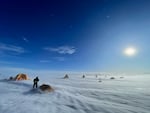
The wind blows across the landscape in Allan Hills, Antarctica in December 2022. In this location, layers of old ice have been pushed toward the surface by slow currents within the ice sheet, meaning older ice is relatively shallow and accessible tor researchers.
Courtesy of Peter Neff/COLDEX
The research team drilled their ice cores in a location called the Allan Hills, in the region of Antarctica closest to New Zealand. In this location, layers of old ice have been pushed toward the surface by slow currents within the ice sheet itself. Consequently, the team only had to drill down about 300-600 feet to find the really old stuff — much shallower than in other locations on the continent.
The team, which included researchers from OSU and the University of Washington, determined the age of the ice by measuring the concentrations of particular gases trapped inside.
The scientists are using the frozen water and the air bubbles it contains to learn how Antarctica’s climate has changed over the past millennia. From these cores, researchers can determine things like past temperature and atmospheric carbon dioxide (CO2) levels. That gives scientists a record of how fluctuations in atmospheric carbon dioxide shifted temperatures over time.

Image of the oldest ice collected from the Allan Hills in Antarctica by researchers with the Center for Oldest Ice Exploration (COLDEX). The team determined the ice is six million years old by measuring the concentrations of particular gases trapped inside.
Courtesy of COLDEX
The ice provides evidence that Antarctica has gradually cooled more than 20 degrees over the past six million years — a trend that is, at least in the past century, being sharply reversed.
Antarctica is currently experiencing increases in temperature (by more than 5 degrees since 1950) and dramatic declines in sea ice cover, which in turn is slowing down ocean currents that help regulate Earth’s climate.
Finding old ice and studying the climate clues it holds provides a long-term framework and context for understanding what lies ahead for people and the planet as a result of human-caused climate change.
The research is published in the Proceedings of the National Academy of Sciences here.
In these All Science Snapshots, “All Science. No Fiction.” creator Jes Burns features the most interesting, wondrous and hopeful science coming out of the Pacific Northwest.
Find full episodes of “All Science. No Fiction.” here.
