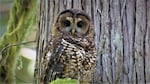
FILE: A northern spotted owl in the old growth forest of Oregon in an OPB file photo.
Todd Sonflieth / OPB
Oregon lawmakers are bringing back a bipartisan bill that would raise the state lodging tax to pay for wildlife and habitat conservation.
The bill would increase the state tax for camping or staying in hotels and vacation rentals like Airbnbs from 1.5% to 2.75%.
According to proponents, that could raise tens of millions of dollars annually for a variety of programs in the Oregon Department of Fish and Wildlife that aim to protect hundreds of imperiled species, everything from owls to frogs to salmon.
The bill’s backers say it will be similar — if not identical — to one that passed the state House of Representatives but died in the state Senate in the final days of the 2025 legislative session. It is poised to revive a debate in Salem over how best to pay for the long-term health of Oregon’s wildlife and natural spaces.
The previous bill saw an unusual alliance between hunters and environmental groups that have historically been at odds over such policies. Together, they argued that Oregon had long underfunded conservation programs, leaving the state without a stable and consistent flow of money to help care for the natural resources they depend on.
Two Republican lawmakers are sponsoring the latest bipartisan bill, in part because it includes money to compensate ranchers whose livestock are killed by wolves. They are Rep. Mark Owens, R-Crane, and Sen. Todd Nash, R-Enterprise. (Rep. Ken Helm — a Portland-area Democrat who couldn’t be reached for comment — is also spearheading the bill.)
Tax increases require three-fifths of the Legislature to pass, but Owens has confidence the bill has the votes. He says the proposed tax increase would not have a major impact on business. “I’m not really a strong believer that a person isn’t going to travel into our great state because a hotel costs $2 more,” he said.
“No tax is easy to support, even in today’s climate,” he said, adding, “It’s going to be a tough vote for our colleagues. It’s going to be a tough vote for me.”
Environmental groups are lining up behind the bill, saying it’s necessary to protect the spaces and animals that make Oregon a prime destination for nature lovers and recreationalists alike.
The majority of the funds would go toward efforts to protect the 321 different species that state wildlife officials have identified as needing conservation. That’s up from 294 in the last count in 2015.
“We have federal rollbacks for fish and wildlife, whether it’s funding or protections with the Endangered Species Act, and this increased number of species headed towards extinction,” said Danielle Moser, the wildlife program manager for Oregon Wild, an environmental nonprofit that is lobbying for the bill. “And so the time is now to act, and that’s why this bill is coming back.”
Other funds would go toward several other programs, including those for protecting species, connecting habitats through wildlife passages and crossings — such as the one over Interstate 5 in Southern Oregon — and anti-poaching efforts through the Oregon Department of Justice. Moser said such a tax could have wide-ranging impacts.
“These smart investments in wildlife and their habitats don’t just benefit the tourism and outdoor recreation economy,” said Moser. “It protects clean drinking water, protects us against drought and wildfire, and keeps species from sliding toward extinction.”
Last session’s bill faced stiff opposition from the Oregon Restaurant & Lodging Association, or ORLA, an influential political force in the state Capitol. The group argues that the proposed tax increase could further kneecap the state and Portland’s economy at a time when it is already facing headwinds.
“It amounts to shooting ourselves in the foot,” said Jason Brandt, the president and CEO of ORLA.
Oregon Gov. Tina Kotek has zeroed in on economic development as a major focus in the coming months, putting forward a multi-pronged plan with the intention of spurring Oregon’s business environment. Her plan aims to cut regulations and use tax changes and incentive programs to promote economic growth.
But Brandt and other industry leaders argue that increasing the state lodging tax could further discourage people and businesses from visiting and working in Oregon. Said Brandt: “This proposal does not align in any way with the governor’s economic prosperity road map.”
“This is not the time to be wrestling with new tax increases,” he said.
The bill’s specifics have not been made public on the Oregon Legislature’s website. The upcoming short legislative session begins in February.