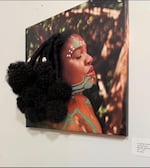
An undated provided photo of a portrait of model CJ Thomas included in the exhibit "Don't Touch My Hair: An Interactive Crowned Experience." The installation is on display at the Rogue Gallery & Art Center in Medford through Feb. 27.
Courtesy Crystal Proffitt
Southern Oregon artist Crystal Proffitt has always had a connection to hair. As a dancer, she grew comfortable styling her own hair for performances, and later worked as a professional hairstylist. But she’s also had strangers touch or tug her curls without asking, an experience that isn’t uncommon for people of color.
Proffitt channeled those experiences and others into the art installation “Don’t Touch My Hair: An Interactive Crowned Experience.” It features portraits of local models accompanied by audio descriptions of their own experiences with their hair. The installation will be on display at the Rogue Gallery & Art Center in Medford through Feb. 27.
Proffitt joins us to talk more about the installation and the ways hair can convey beauty, culture, memory and identity.
Note: The following transcript was transcribed digitally and validated for accuracy, readability and formatting by an OPB volunteer.
Dave Miller: This is Think Out Loud on OPB, I’m Dave Miller. The Southern Oregon artist Crystal Proffitt has always had a connection to her hair. As a dancer, she regularly styled her own hair for performances, and later worked as a professional hairstylist. But she’s also had strangers touch or tug her curls without asking, an experience that’s not uncommon for people of color. Proffitt channeled those experiences and others into the art installation “Don’t Touch My Hair.” She calls it an “Interactive Crowned Experience.” It features portraits of local models accompanied by descriptions of their own experiences with their hair. The installation started at a gallery in Phoenix, and is on display at the Rogue Gallery and Art Center in Medford for the next month. Crystal Proffitt joins me now. It’s great to have you on Think Out Loud.
Crystal Proffitt: Thank you so much. I’m glad to be here.
Miller: So my understanding is you grew up in the Bay Area, but have been in Southern Oregon for about five years or so. What have your experiences in Southern Oregon been like in terms of your hair?
Proffitt: Honestly, it was a bit of a culture shock, I would say. I was so used to everybody being so distant in the Bay Area, there wasn’t a lot of touching. And when I moved here to Southern Oregon and Ashland specifically, I noticed, for one, that the climate was very different. I wasn’t living near the beach and had that moisture in the air, so I needed to start styling my hair in protective hairstyles. That’s very common for people of color to choose braids or twists or some form of a protective style that would really hold in moisture and care for their hair. I noticed a lot of intrigue, and also a lot of unwanted touching when I moved here. So it was a challenge for a while to figure out language, maybe even mitigating circumstances that are not even really mine to mitigate if I made someone uncomfortable about a boundary.
Miller: All of a sudden, that was on you. They crossed a boundary, you would tell them, and then they would be the ones who were made uncomfortable?
Proffitt: Yes, exactly. All of a sudden I was consoling them and making sure they knew, “I understand you’re not a bad person, but also I really like to be asked before I’m touched.” I noticed every single one of my Black friends was saying the same thing. And we started getting into these circles where we would talk about our stories, and I just knew I wanted to start to be active in some kind of way around this.
Miller: Can you just give us a sense for the context for where you’d be where a stranger would touch your hair?
Proffitt: Oh, it could be anywhere. It could be in the most surprising of places. One of the first times that I would say it was the most shocking to my nervous system was when I was in San Francisco working in a legal office, and I think it was a secretary actually was running her fingers in my hair, but I felt her fingers touch my scalp. And it was almost like it was so surprising to her that I had actually gotten my hair so straight. So even when I was doing straight styles, that I now call kind of like acclimating to a more streamlined and normalized hairstyle, even that was still drawing attention. Because I think for one, it’s just so surprising to see a natural hair texture become so straight.
But then when I moved to Oregon, like I said I was braiding my hair and I was putting beautiful accessories, a stranger would walk right up to me, someone I didn’t even know, and just started to say “Wow, your hair is so beautiful” while touching it. And it’s so surprising no matter the circumstance, if it’s someone you know or someone you don’t, you know what I mean?
Miller: I know you’ve also done this professionally, worked as a hair and makeup artist. How has that informed the way you think about these issues?
Proffitt: I know consent is huge, making sure that I also ask a lot of questions about someone’s personal preference. As a hairstylist, I’ve been working in both film and for live events, but you can start to ask your clients about allergies that they might have. You never know what somebody is personally going through, and so one of the things that I’ve really focused on was what works with someone’s natural bodies, down to the oil that I use on their scalp. All of these elements really matter.
Also working in Oregon, there aren’t a lot of people of color in the industry. So noticing that my supplies for makeup and hair are fewer because of that. I’m noticing that I’m having to actually adjust to the clients and actors because of the request for hairstyles like that. It’s definitely changed a lot.
Miller: So let’s turn to this installation. Can you give us a sense for the different artists that you’ve been collaborating with to put it together?
Proffitt: Oh yes, they’ve been fantastic. From the beginning, I wanted to work with this photographer Allie White, she’s also a Southern Oregon-based creative. Her work is really dreamy and cinematic. To me, she’s a storyteller. And what happened was I went on Facebook, and she wrote a post that said “I want to give free photo shoots to BIPOC and Indigenous people,” and I knew instantly that I needed to reach out. I didn’t know ultimately what I was going to reach out about, but once I landed on “Don’t Touch My Hair,” I thought oh, I wonder if she’d be interested. And when we called each other, we both were in tears crying of how excited we were, and how important this work was gonna be. So she was an immediate yes.
Another element to the art is I needed something that would add an illuminated and interactive element. When you see the exhibit, there’s a lot of 3D hair that you can touch and play with. And two of them, you can actually take the hair, touch it to a tree, and the tree glows, it activates the lighting. And this was all done by Robert Quattlebaum, who has always been a lifelong tinkerer. He has worked with like Apple, Nest Labs, Google, and he makes all these interactive light sculptures. And I thought, I’m sure he could tinker with some fairy lights, and I can make that a really elegant part of this exhibit and include that interactive aspect. And he did a phenomenal job.
And finally we’ve got Micah BlackLight, who’s a beautiful brown-skinned catalyst and speaker and mentor, and his art gears a lot more towards fantasy and Afrofuturist tribal art. And I knew if I could get his paint on these canvases of beautiful Black people, it would just elevate it to a degree that puts Black people in a category of being magical, fantastical and powerful.
Miller: What’s the idea behind having that tree light up when people put hair on it?
Proffitt: Yeah, that’s probably the most important part to me. It’s called my ancestor tree for a reason, because I really want, when you are experiencing the exhibit, to hear the stories, to understand what people are going through, especially if they are outside of your own direct culture. And then when the hair is finally touching the tree, it’s symbolic of the connection that our hair has to our lineage, to our ancestry. And there’s an inherent magic with that, that people of color and Indigenous people have always known, how we are connected to the land, and how we are here to be one with the land. That includes the earth also being a very powerful essence in itself, how it will give back to you if you give to it. So the hair connecting is a part of some spiritual practices, where we are being stewards of the land by listening to each other’s cultures and learning from them.
Not to mention, the minute that the hair touches the tree and the tree glows, it’s signifying how important hair is. And I really needed an element of this to be spiritually attuned to the concept that hair is an antenna. It receives, it’s a memory holder, it’s so many different things. So that’s why it’s very important to respect the sovereignty of someone who doesn’t want their hair touched.
Miller: As we’ve said, the name of the exhibit, the first half of the name is “Don’t Touch My Hair.” But you’ve actually crafted this installation to be interactive enough that visitors can actually touch the hair that’s attached to some of the portraits. Why give people the option to do what the title says they shouldn’t do, they can’t do?
Proffitt: Well, for one, it’s an understanding that the title is actually a movement, and it’s a movement that most people who don’t consider themselves BIPOC, they don’t know it. So it’s one way of bringing some awareness and recognition to the Don’t Touch My Hair movement. There’s so many people who’ve created works around it. There’s a video game, there are children’s storybooks, there is music that is literally titled “Don’t Touch My Hair.” And so it’s really just allowing people to recognize that first.
Then I also really think that it should be a consideration, like you hesitate before you start to interact with the art. Because I don’t understand in real life how there isn’t a hesitation before touching. My hope is that there’s a little bit more of that awareness being brought upon the people who might be feeling entitled, I’m not sure. I want that sort of holding back and kind of asking questions, learning a little bit more. And then there’s a connection that we can make by going OK, I understand more and I respect further. So now I’m a part of the story. Now when I touch, I’m respecting and honoring.
Miller: What has it been like for you to watch people take in the exhibition?
Proffitt: It’s been wonderful. So many people will walk up to me in different walks of life and different beautiful, culturally ethnic people, just telling me how they’ve always felt connected to these concepts. And it’s not just hair that people wanna talk about. They want to talk about their skin being touched, they want to talk about their experience of not always being accepted and being bullied. I’ve even spoken to people about women who are pregnant, and the unwanted touching during their pregnancy.
Also consent, lots of conversations around consent, and how we talk a lot about it in conversations around becoming intimate with someone. But in other ways, there isn’t a lot of conversation around consent. And I have to say I’ve just been blown away.
And maybe the last thing I would mention is it’s almost fully accessible as well. So for people with disabilities or maybe even, for example, people with visual impairments, they can enjoy this kind of work as well, because they’re able to interact with art that they might not otherwise be able to. They can touch it, they can even hear auditorily the stories that the beautiful models have experienced. So there’s actually different levels to the exhibit that provide for more people, not just abled bodies.
Miller: What are your hopes for where this installation goes next? As I mentioned, it started in Phoenix and now it’s in Medford.
Proffitt: Well, I really hope to bring it to Ashland next, because it’s where I’m currently living, and I think it would just serve my heart so well. But ultimately I’d love to see it have like a West Coast tour. I’ve been interested in bringing it to Portland or Washington, even California, going back to my hometowns and bringing it to the schools, even talking with schools and educators, and even working with artist programs. I just can really see a lot of people benefiting so much from hearing about this work.
Miller: Crystal, thanks so much.
Proffitt: Thank you too.
Miller: Crystal Proffitt is an artist in Southern Oregon. Her installation “Don’t Touch My Hair” is on display at the Rogue Gallery & Art Center in Medford for the next month.
“Think Out Loud®” broadcasts live at noon every day and rebroadcasts at 8 p.m.
If you’d like to comment on any of the topics in this show or suggest a topic of your own, please get in touch with us on Facebook, send an email to thinkoutloud@opb.org, or you can leave a voicemail for us at 503-293-1983.