Ava, a student in OPB's Class of 2025 project, receives her diploma from David Douglas High School on June 5, 2025. In Oregon, 83% of students in the Class of 2025 graduated in four years.
Dan Evans / OPB
Back in 2013, when Oregon Gov. John Kitzhaber set his goal for 100% high school graduation by 2025, the graduation rate was 69%. That’s when OPB started its Class of 2025 project to follow the goal through a diverse cohort of Oregon kindergarten students who started together at the same elementary school.
Over the last 13 years, the state has tracked a handful of specific student groups to measure their progress. Economically disadvantaged students, talented and gifted students, English learners, migrant students, and students with disabilities all had their own tabs in Oregon’s dataset for the Class of 2013.
Graduation rates for some of these groups were less than half of Oregon’s dismal statewide rate back then. The rate for students receiving special education in 2013 was 37.2%.
About 80% of the students in OPB’s Class of 2025 project graduated on time this past June. Statewide, so did 83% of all Oregon students in the most recent senior class. It’s an increase of one percentage point from the year before - or 500 more students graduating on time.
Eighty-three percent is a high for Oregon and a vast improvement over the rate when the state’s most recent graduates were in kindergarten. But it still remains lower than most other states based on the most recent national figures available. The average graduation rate in the U.S. for 2021-2022, the most recent data available, was 87%.
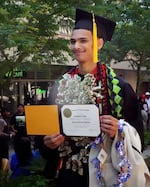
Class of 2025 student Rayshawn poses after graduation with his diploma. Rayshawn graduated from Rosemary Anderson High School on June 8, 2025.
Elizabeth Miller / OPB
Today, Oregon tracks 23 different student groups, in its constant effort to identify groups of students in need of support in school. This year, ODE began tracking the percentage of students graduating who are pregnant and parenting, a group with a graduation rate of 54%.
State education officials report that 19 of the groups they’re tracking reached record-high school graduation rates in 2025. That includes students with disabilities, whose graduation rate was 72%, and migrant students, who reached an 83% graduation rate.
Oregon’s graduation rate is improving, but ODE director Charlene Williams said the state needs to make sure students are set up for success as soon as they enter public education.
“Our work now is to strengthen the full pipeline from early literacy to ninth grade momentum to graduation, so that each and every scholar in every community has the opportunity to thrive,” Williams said during a media call on graduation rates.
Related: DOCUMENTARY | Class of 2025: Growing up in Oregon schools
The Class of 2025 is the first class after the pandemic to have had in-person learning for all four years of high school. But experiencing middle school through distance learning at home took a toll on this group, requiring some extra support when they returned to classrooms in ninth grade.

Class of 2025 student Sam shows off his decorated mortarboard at Springfield High School’s graduation on June 6, 2025. It reads, “People’s dreams never end”.
Rob Manning / OPB
But despite the challenges, the Class of 2025 remained resilient.
Gaps still remain for some student groups. Only 71.3% of students experiencing poverty, for example, graduated on time. The graduation rate for English Learners has improved by double digits in the last decade, yet the four-year graduation rate is still at 69.8%.
ODE’s new Deputy Director of Academics Candice Castillo said it’s up to schools and the state to step in and close those gaps.
“When outcomes differ across different groups, we don’t see that as a reflection of students’ potential,” Castillo said. “We see it as a signal about the opportunities and supports our system has to provide.”
Oregon also tracks a five-year completion rate to include students who take an additional year of high school to earn regular diplomas, modified diplomas, GEDs, an adult high school diploma, or an extended diploma. The five-year rate for the Class of 2024 was 87.4%.
Record high rates
Oregon’s high school graduation rate for the Class of 2025 did not reach 100%. But some districts and student groups got pretty close.
Oregon’s highest graduation rate for any statewide student group is 98%. That’s for the nearly 14,000 students who completed two credits in a career technical education program.
“We believe this graduation rate highlights the importance of providing engaging coursework,” said Jon Wiens, ODE Director of Reporting, Accountability, and Data.
Banks School District saw a 10.9 percentage-point increase in its graduation rate from last year. The Banks Class of 2025 graduation rate was 98.1%. Banks superintendent Brian Sica attributes that to school staff taking small steps to improve outcomes for the 103 students in its most recent graduating class.
“We have leaders who know that their job is to take bite-sized chunks out of this goal,” Sica shared.
Thirty-three Oregon school districts set records for high school graduation rates in 2025, with high schools big and small represented, from the coast to the Idaho border.
They include Vale, St. Helens, North Wasco County, Dallas, La Grande, Medford and Sisters. Hillsboro School District achieved a 90.4% graduation rate for 2025, an almost three percentage-point increase from 2024.
“The systems and structures we have put in place and refined over the past few years have had a huge impact on our growth,” Hillsboro assistant superintendent Audrea Neville said.
“This includes our on-track work, Career-Technical Education pathways, literacy plans, language supports, and summer school, as well as alternative and supplementary options like the Pathways Center, Oak Street Campus, evening programming, and Hillsboro Online Academy.”
Oregon Department of Education director Charlene Williams said the state is reassessing its goal now that 2025 has passed.
“It’s an active conversation that we’re having across agencies … to determine how do we ensure that our students are ready for post-secondary opportunities,” Williams said, “and what do those measures look like?”
Other measures of success, post secondary preparation

A student holding a diploma and balloon after Jefferson High School’s graduation on June 2, 2025. Jefferson’s graduation was one of the seven ceremonies that included students in OPB’s Class of 2025 project that OPB attended.
Elizabeth Miller / OPB
For years, Oregon has faced criticism for removing one of its requirements for graduation: having students prove they’ve mastered Essential Skills, usually through performance on a state assessment. The state’s suspension of the requirement is set to end in the 2027-28 school year.
Oregon education officials say they’re still figuring out their plan for graduation requirements as the state implements a new statewide accountability system, intended to help the state keep better tabs on how local schools are doing. Districts’ four-year graduation rates and the share of students who are on track to graduate at the end of ninth grade are among the key metrics the state plans to monitor. The accountability system remains a work in progress as state education officials work with school districts.
It will be an adjustment for local schools, which will also have to use state-approved assessment tools and track achievement in language arts and math.
For high school students, graduation and ninth-grade on-track rates are only a part of the story. But further metrics — such as assessment results — are challenging. Oregon has a permissive opt-out law, which leads many high school students to avoid taking state standardized tests.
The state cites other data, like passing scores on Advanced Placement exams, to show students are ready for the next step after high school. Students can earn college credits and improve their chances at being admitted to exclusive college through their performance on AP tests. Oregon education officials say the number of students enrolling in and passing AP exams lately has increased.
CORRECTION: An earlier version of this story incorrectly named Candice Castillo. OPB regrets the error.