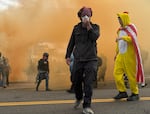
FILE - Protesters recover after gas is deployed at the U.S. Immigration and Customs Enforcement facility, Portland, Ore., Oct. 4, 2025.
Alejandro Figueroa / OPB
Note: This story contains descriptions of violence.
A federal judge has set the stage for accountability measures on the federal officers who respond to protests outside the Immigration and Customs Enforcement facility in Portland, which could result in curbing their ability to use force.
For months, people engaged in nonviolent protests, a constitutionally protected form of speech, have been hit and sprayed by chemical munitions from federal agents using “excessive force on peaceful protesters at and around the ICE Building,” the ACLU of Oregon argued during a hearing Friday and in court filings earlier in the week.
The legal nonprofit is working with a group of several attorneys representing protesters. They want U.S. District Court Judge Michael Simon, who is overseeing the case, to prevent federal officers from using too much force towards protesters or dangerously using crowd control munitions in violation of their own agency policies.
Not all of the protest activity at the ICE building in Portland has been peaceful. Federal prosecutors have charged at least 40 people with crimes they say happened near the ICE facility, including damaging government property, assaulting federal officers and failure to comply. The ACLU’s lawsuit, however, focuses on the extent to which officers used physical force or fired munitions on crowds engaged in nonviolent protest.
Simon won’t make a final decision until after a three-day hearing set to begin March 2 in Portland.
Related: Portland councilors urge Mayor Wilson to carry out new penalties on ICE facility
But during Friday’s hearing, the judge introduced ideas for oversight that attorneys for the protesters might ask him to mandate. He asked about federal officers wearing body cameras, as well as officers — particularly masked ones — wearing some other form of identification.
“I am definitely sensitive to doxing problems, but I also think we can’t allow law enforcement officers to be relatively anonymous,” Simon said.
“We like the idea of accountability,” Matthew Borden, an attorney representing protesters, replied to the judge. Borden said he first wanted to see whether the federal government would agree to that without needing a court order.
“Ultimately, if push comes to shove, this is relief that we would want to ask the court to issue,” Borden said.
Attorneys for the protesters cited the experiences from more than two dozen protesters and experts, including an emergency room doctor and a former head of the Border Patrol; one of several law enforcement agencies the U.S. Department of Homeland Security has sent as part of its response to protests outside the Portland ICE building.
Related: DHS identifies people shot by Border Patrol in Portland; 6 arrested in protests after shooting
Gil Kerlikowske, who served as Commissioner of the U.S. Customs and Border Protection from 2014 until early 2017, wrote in a sworn statement that materials he’s reviewed as part of the case show DHS officers have continually failed to provide warnings before using force and also misused “crowd control weapons” including firing pepper balls “directly at people.”
“DHS has exhibited a consistent pattern of deploying excessive force against protesters and journalists around the ICE Building,” Kerlikowske wrote, “including by using force against people who are not engaged in threatening acts, misusing crowd-control munitions and teargas, and indiscriminately using force that needlessly injures people who pose no threat to law enforcement.”
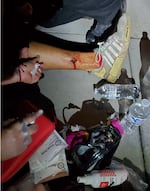
Freelance photographer Aaron Smith, 42, says he was shot in the leg by a munition when filming the protest on Sept. 30, 2025.
Court declaration by Aaron Smith
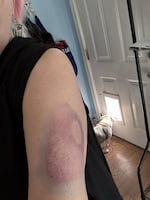


Kerlikowske, who also previously served as Seattle’s Police Chief, concluded his statement by saying defense of federal property primarily means establishing a perimeter around the building, and that “there is no reason to target or disperse journalists or protestors who do not pose a threat from that position.”
Elderly veterans and costumed protesters were among those who also filed declarations, stating they’d be willing to testify about the actions of federal agents during protests they attended at the Portland ICE building.
Stephen Hall, an 84-year-old army veteran, described in a sworn statement to the court that he was knocked to the ground by a federal agent while attending an Oct. 4 protest at the ICE building, which he described as peaceful.
“I felt an impact that reminded me of playing hockey when I was younger,” Hall wrote, noting that he and his wife both landed in gravel.
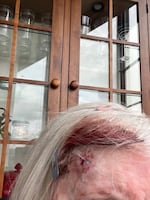
In a separate court filing Laurie Eckman, 84, wrote that she was also at the Oct. 4 protest. She and her husband joined after they spotted the crowd from the window of their home in the South Waterfront neighborhood. She said she didn’t witness the crowd do anything to provoke federal officers before they began firing munitions into the crowd.
“Suddenly, I heard a loud bang and felt an extremely hard and direct impact that caused a sharp pain on the right side of my head near my right temple,” Eckman wrote. “I was immediately in severe pain. I was coughing and choking. I couldn’t see. I was disoriented and very scared.”
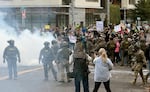
Gas is deployed at the U.S. Immigration and Customs Enforcement facility, Portland, Ore., Oct. 4, 2025.
Alejandro Figueroa / OPB
A 42-year-old school psychologist, named Calley Ekberg, wrote that tear gas was launched “without any warning or audible instruction” from officers atop the roof of the ICE facility on Oct. 18.
“As I moved through the gas, I lost vision and began crying involuntarily, and felt extremely disoriented and afraid. My eyes had to be flushed three separate times before I could see well enough to safely walk to my car and drive home.”
Ekberg wrote that her doctor prescribed her two inhalers for a restricted airway the doctor said was a result of tear gas exposure.
Related: Hundreds of students walk out of class across Portland to protest ICE
Dickinson, a frequent protester at the ICE facility known for dressing up in a chicken suit, told the court that federal agents have exposed him to chemical munitions dozens of times over the past five months. During a Jan. 19 protest over Martin Luther King Jr. Day weekend, he said, federal agents dragged him across the ground and cut his knee through multiple layers of clothing.
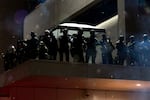
Federal officers stand atop the U.S. Immigrations and Customs building shooting munitions at nonviolent protesters in Portland, Ore., Oct. 18, 2025. where about 500 people gathered to continue protesting following the “No Kings 2.0” rally. The officers deployed tear gas, pepper balls and flash-bang grenades on Saturday evening.
Eli Imadali / OPB
At the hearing Friday, Judge Simon said he was concerned about what could transpire over the course of the next several weeks.
Simon asked whether the ACLU and the federal government could agree to some interim measures “that could give me some comfort in knowing that we have reduced the likelihood of inappropriate irreparable harm.”
Both parties were skeptical.
Andrew Warden, an attorney with the U.S. Department of Justice, said he didn’t know what might be possible in the short term.
“The folks at DHS are following their policies,” Warden said.
OPB’s Tony Schick contributed reporting.