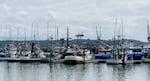
FILE - Newport's Dock 5 on May 2, 2025.
Kyra Buckley / OPB
A 2022 study from the Oregon Coast Visitors Association found that 90% of seafood sold on the Oregon coast wasn’t locally caught. In fact, much of the seafood caught in Oregon is exported to other countries. The OCVA estimates that Oregon’s coastal communities lose roughly $252 million a year because of seafood exportation.
There are many challenges with trying to keep Oregon seafood in Oregon, including a lack of workforce and existing infrastructure. The OCVA and the Oregon Ocean Cluster are working to address this. This weekend, the group will be hosting its 2nd annual Blue Food Forum where consumers, researchers and industry professionals can get a taste of local products and learn more on the latest challenges facing the industry today. Marcus Hinz, director of the OCVA, joins us to share more.
Note: The following transcript was transcribed digitally and validated for accuracy, readability and formatting by an OPB volunteer.
Dave Miller: From the Gert Boyle studio at OPB this is Think Out Loud. I’m Dave Miller. A 2022 study from the Oregon Coast Visitors Association found that 90% of seafood sold on the Oregon coast was not local. The association wants to change that, to increase the market for Oregon seafood in Oregon as a way to boost the state’s and the coast’s economy. That’s part of the thinking behind the Blue Food Forum that’s happening this Sunday and Monday at the Redd in Southeast Portland. Marcus Hinz is a director of the Oregon Coast Visitors Association, which is putting on these events and he joins me now. It’s great to have you on the show.
Marcus Hinz: Dave, thank you. It’s really great to be here with you.
Miller: So where is Oregon seafood going?
Hinz: Oregon seafood, a lot of it gets loaded on trucks and planes, and it’s flown out of Oregon, which, you know, Oregon is an export agricultural commodity state. So that makes sense. The part that we don’t like is that the seafood that is not from here is flown into the state of Oregon, and that is primarily the seafood that people are eating for the most part.
Miller: Right. So we’re flying or shipping stuff away and then the other stuff is coming back here and that’s ending up in fish sticks or whatever that Oregonians are eating.
Hinz: Yes, correct, and ironically we did map out – our researchers are really good – and they did map out the supply chains, and ironically a lot of the same countries that we are importing seafood from, we are also selling seafood to, and that carbon footprint is killing the ocean, which is kind of madness.
Miller: You know, I’m glad you mentioned the carbon footprint of that because that is a real and important piece of this. But it seems that what you’re describing is the reality of the globalized society and globalized markets where products crisscross the world. What’s wrong with that, aside from the carbon footprint of it?
Hinz: Well, if we’re talking about the value of our natural resources, similar to trees, you cut a tree, put it on a truck and ship it away, we get the lowest value possible for our natural resources. And instead of keeping it here, talking about economic multipliers, a vertical integration of companies that might process the resource, package it, store it, deliver it, marketing firms here, marketing the value-added product, the chain of custody and the economic multipliers are really what are the most valuable aspects and market components of our natural resources. So when we send them away uncut and unprocessed, we are really shortchanging ourselves as a state.
Miller: What would it take to increase that percentage? That’s where I want to turn now, and my understanding is there are a lot of pieces here, but let’s start with the people side of it. What kind of workforce issues crop up here?
Hinz: Workforce is going to be a big issue, I think, for all industries. Our strategy with workforce is to reach the kids in high school and give them skills that can allow them to enter the workforce immediately. So for instance, if you don’t have any filleters of fish, then you don’t have any fish. Last year we had seafood butchery trainings in nine high schools, mostly on the coast, but some inland as well, and we had over 400, I think 436 kids go through seafood butchery classes, and the pre and post surveys indicate that, you know, 40+% of them, might be 60%, have never even held a whole fish before. And so just those introductions to our youth, and we should really –
Miller: Are there jobs in fish processing for those graduates?
Hinz: Absolutely, there are jobs. And if you’re a good filleter in a processing plant, you can earn really good money. But it’s not just there. The back house of restaurants, there’s a lack of skills, knowing how to process a whole fish in restaurants, and then also sports charters, riverboat sports charters, they often filet, vacuum pack, and ship the fish back home to their customers.
Miller: What about the regulatory environment? Are Oregon’s rules set up in a way that would make the changes you’re talking about easy?
Hinz: Yeah, so there is definitely a very energetic conversation happening right now about the state of Oregon’s regulatory regimes. They are quite inhibiting for our seafood industry, and I would have to say that, yes, we all want to protect the environment, absolutely. But if you look at the story of the imported seafood, it’s horrifying. We’re either going to eat seafood from our ocean that we’re staring at, or if we continue to like shut down seafood operations here, all that’s going to happen is that we’re going to end up importing more seafood that has horrible human rights stories and environmental stories, which is way worse. Our seafood industry here is amazing. They’ve worked really hard. A number of them are third party sustainable harvests. So I’m really proud of the seafood industry here in Oregon, and we need to keep more local seafood local.
Miller: I’m curious about price. Because if you’re talking about, say, large institutional buyers, restaurant chains or schools, or other folks who are buying truckloads of product over the course of a year, they’re really gonna be focused on how much that costs, as opposed to some fine dining restaurant that might have a relationship with an individual captain on a boat and they get a smallish number of whole fish that they can bring in over the course of a week or so. If the big numbers are where the big money would be, how do you scale this up in a cost effective way?
Hinz: Yeah, that’s a really important question, and I think there’s more than one answer to that. I think a lot of fisher people have learned they can actually get a much higher dollar per pound for their fish selling right off their boat and cutting out the middleman, processing their own fish, and selling it direct to the consumers, which could mean directly to a visitor or a resident or a restaurant. So if you’re hyperlocal and your supply chain is very short, you could get a pretty high dollar value for your fish.
The other is, as you point out, a scale of economy thing. The sad fact that Oregon seafood is a novelty is what makes it expensive. But if we were able to invest in infrastructure, smaller scale infrastructure, that would allow our local seafood to be here and there were higher volumes, that price would come down, elasticity of demand, scale of economy type.
Miller: What are the specific products that you think are most ripe for what you’re talking about for bigger Oregon markets?
Hinz: Our existing processors, the larger processors, are able, they have the capacity to sell to Oregon schools and hospitals, restaurant chains. Our efforts are really focused on the very small fishing family and very small operations, just trying to get the fish from the port to the restaurants right around the port.
Miller: But are you focused on, I don’t know, albacore or rockfish or Dungeness crab, or what do you see as the actual products that are most viable here?
Hinz: Well, a lot of them are seasonal, rockfish and groundfish. There’s a huge biomass in the ocean right now so some argue those harvest limits could go up now, and those could be year-round types of fish, and there’s a huge volume there. Dungeness crab, season by season, you’re going to get the volumes in the winter. Tuna, you’re going to get the volumes in the summer. So it’s not any one specific fish. It’s kind of just like eating seasonally and having the infrastructure to be able to accommodate those because those boats need to work year round and so they need these different species at different times of year to keep their boats moving.
Miller: I mentioned that you have two days’ worth of events coming up, starting with the Seafaring Speakeasy that’s happening this Sunday at the Redd in Southeast Portland. What is that?
Hinz: Yeah, this is a really wonderful event. It’s very unique, and you’re going to notice that as soon as you walk through the door. This is an ocean inspired event that presents art and food and culture. It’s a place where you can mingle with all of the people who make our food systems work. We will have scientists there, fishers, educators, artisans, food producers. There will be a lot of chefs, I believe seven or eight different chefs will be there serving blue foods, which are, by the way, blue foods aren’t just any food from the ocean. They’re foods that have a light footprint and that are environmentally responsible food that comes from the ocean.
Miller: That’s Sunday, and then the Seafaring Symposium is the next day. What’s that?
Hinz: Yeah, the Symposium is really more of an internal event where it’s skills building, knowledge sharing between all the different people in the seafood supply chain and the blue foods from aquaculture to fishing. We have some professional urchin ranchers there that are going to be talking about what they’re doing. We have Pacific Dulse seaweed growing in tanks, and there’s new products being made. So there will be a lot shared there around what’s happening now. What is moving in Oregon and what is investable? What are shovel ready projects that we can lean into to really move the blue food movement forward in Oregon?
Miller: You know, we spent all this time talking about food, but my understanding is you’re also focused on other marine life related products that are not about what we can eat. What’s exciting you right now about other potential markets?
Hinz: Yeah, thank you for that question. It turns out, in our relationships internationally with people we’ve been talking to that the non-food portions of many of our seafoods are actually more valuable in the marketplace than the food portion and probably a really good example would be the shells of shellfish, different crabs and shrimp. There’s an element in there called chitosan, and if you’ve ever seen a Dungeness crab in the wild, you’ll notice that it doesn’t have anything growing on its shell, typically. There’s anti-fungal, antibacterial properties to it that get pulled out and put in medical bandages. They get put into a powder that can be added water to and sprayed on agricultural crops as a natural anti-fungal spray. Even fish leather can produce anything that ordinary leather can. So shoes, wallets, belts, jackets. It’s very beautiful. And so we can keep these components and make them. Think of what our apparel industry could do with all the fish skin that our ocean here can produce.
Miller: Marcus Hinz, thanks very much.
Hinz: Thank you so much for having me.
Miller: Marcus Hinz is the director of the Oregon Coast Visitors Association.
“Think Out Loud®” broadcasts live at noon every weekday and rebroadcasts at 8 p.m.
If you’d like to comment on any of the topics in this show or suggest a topic of your own, please get in touch with us on Facebook, send an email to thinkoutloud@opb.org, or you can leave a voicemail for us at 503-293-1983.