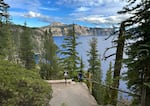
FILE - A child stands at the edge of the Cleetwood Cove trail in Crater Lake National Park on Aug. 15, 2025. The trail will be closed for rehabilitation from the summer of 2026 to the summer of 2029.
Claudia Johnson / OPB
The U.S. Forest Service is responsible for over 370,000 miles of roads and around 160,000 miles of trails, much of which are on federal lands. But a government report from 2013 found that only about a quarter of these trails met safety or maintenance standards. Even more recently, in November, an internal report from the agency showed a 100% loss of trail staff and widespread declining morale.
What do we lose when we don’t maintain our trails? What do these trails across the country, and in Oregon, tell us about our history? And what challenges do staff and volunteers maintaining these routes face today? Dillon Osleger is a writer and public lands analyst. His forthcoming book “Trail Works” will be released in May, and he recently had a story in RE:PUBLIC and High Country News. He joins us to answer these questions and more.
Note: The following transcript was transcribed digitally and validated for accuracy, readability and formatting by an OPB volunteer.
Dave Miller: This is Think Out Loud on OPB. I’m Dave Miller. What happens when trails are clogged with burned logs, taken over by brush or washed away by a flood, when the U.S. Forest Service, an agency responsible for maintaining around 160,000 miles of trails, is falling further and further behind on that task? What history, what access, what connection to nature goes away when a trail disappears?
These are some of the questions that the writer and public lands analyst Dillon Osleger has been wrestling with. His forthcoming book is called “Trail Work.” It comes out in May. He has a recent article out now in RE:PUBLIC and High Country News. He joins us to talk about all this. It’s great to have you on the show.
Dillon Osleger: Howdy, thanks for having me.
Miller: How did you first get interested in writing about trails?
Osleger: Oh gosh, probably daily journaling. I was privileged and fortunate enough to grow up in a family of geologists, so I spent a lot of time outside. I just over time recognized that the thing I wrote about most was my time on trails.
Miller: I want to turn immediately to politics, because I think for me and for many people, when they hear a stat like the U.S. Forest Service is falling way behind in maintaining its 160,000 miles of trails, for me one of the first things that came to mind was DOGE. But what was the staffing for trail work at the Forest Service like before the start of the second Trump administration, before DOGE led federal workforce reductions?
Osleger: I think I would start this conversation around politics just with my respect and appreciation for the staff of public land management agencies. They work incredibly hard and they are there because they believe in the missions that were set out when these agencies were established at the turn of the 20th century, largely.
Staffing, especially trails-related staffing for the U.S. Forest Service has been kind of stagnant or in decline since the 1990s, due to a lot of issues around logging and a change in management with the U.S. Forest Service. However, there were trail staff, recreation staff, ecological staff and biodiversity staff in the U.S. Forest Service prior to the second Trump administration, and that has been hamstrung egregiously in the year since.
Miller: What have you heard from reports that have gotten to you about what staffing is like right now?
Osleger: I think people would be shocked to hear that entire districts … and sorry for the nomenclature. In the U.S. Forest Service, there are regions which encompass multiple states. There are forests, which people often know like the Tahoe National Forest or the Uncompahgre. And then those forests are broken up into districts, which are kind of similar to counties. But there are entire districts which represent hundreds of miles of trail and service hundreds of thousands, if not millions of people, with zero trail staff.
Miller: At a time when those trails are facing worsening threats. What are the biggest physical threats to trails right now?
Osleger: They come from two directions. Obviously, during the pandemic we saw a very large increase in usership for outdoor recreation. The increased human usership, which comes in a variety of forms, can obviously cause erosion or be impactful to environments. Human pressures are real. But then also from a climate change perspective, we are seeing more sporadic and intensive wildfires, we’re seeing increased pine bark beetle kill across the West, droughts, storms with atmospheric rivers causing landslides, you name it. The earth moves in a geomorphic way.
Miller: What would it take people, power-wise, to keep up with those threats?
Osleger: I’m sure you could ask a similar question about wildfire. As someone academically trained in the geosciences, I’m not sure that there is a number of man or woman hours that could keep up with erosion and the Earth’s response to these systemic challenges. But, in order to keep up our trail system, we would need about a tripling to a quadrupling of funding for the U.S. Forest Service, specifically for its trails program, to do so.
Miller: You’ve actually done some of this work yourself. Can you give us a sense for what you have physically done in terms of trail restoration?
Osleger: Yeah, I’ve spent over a decade of my life in various aspects of trail stewardship around the Western United States. For six years I was the executive director of one of the largest trail stewardships in California, so I managed about 400 miles of trail on U.S. Forest Service lands in a partnership agreement with the U.S. Forest Service. And then I’m also a licensed contractor, so I’ve designed and built many dozens of miles of trail across several Western states for a variety of land managers, from land trusts to municipalities to federal partners.
Miller: Have you had the experience of going back to a section of trail that you personally worked on months or years later and seeing how it was holding up?
Osleger: Oh yeah, revisitation is certainly a part of the job. Maintenance is such this critical aspect of trail stewardship and appreciation in the outdoors. I’ve been back to trails after normal environmental conditions and after wildfire, you name it. Things change.
Miller: How has doing that work affected the way you think about this issue overall?
Osleger: I think like any valuable resource under threat, you begin to think about, if you can only keep so much, where does the value of a trail come from? So in my eyes, if we can’t maintain everything, if we can’t protect or restore everything, how do we start to create a value system for trails, old dirt roads and public access?
Miller: Can you tell us about one part of Oregon that you mentioned in that article? It’s a big swath of southwestern Oregon, from Oakridge down to Ashland.
Osleger: Yeah, absolutely. For the article for RE:PUBLIC and High Country News – which also includes geospatial analysis, so there’s an interactive map for those interested in playing along – I focused on the Oregon Timber Trail in Oregon, which is a nonprofit that does trail stewardship across the whole state. One of their primary sections is, as you mentioned, from Oakridge down to Ashland. And it’s largely impacted by pine bark beetle kill.
Bark beetles, for those who don’t know, have a long standing, largely somewhat symbiotic relationship with a variety of tree species, wherein the bark beetle will come in and burrow into those trees and cause something called girdling in some trees as it lays its eggs. And those trees will die. However, the trees push back on the beetle with their sap and the beetle is killed by the early frosts of winter.
As climate change has changed that early frost and has changed average temperatures in forests across Oregon, we’re starting to see that balance tip where more trees are being killed by bark beetle. And those trees eventually fall down, hundreds if not thousands at a time, during windstorm events or under natural conditions, and they cover trails. And those trails eventually become largely impassable to hikers, bikers or equestrians.
Miller: One of the points that you come back to in a couple of different ways in your writing is that increasingly we can’t trust the maps that we have access to: the digital maps, the online maps, or even if you go to an outdoor store and buy a physical map. We can’t necessarily believe the lines that are printed on those. Why not?
Osleger: This largely comes back to the initial question of funding for federal agencies and for their staff, mapping for the federal government, which manages all public lands, which are kind of the majority of outdoor recreation. If you live in the West, almost 50% of land is federally owned, and that is where the majority of hiking or other outdoor recreational pursuits occurs. When funding isn’t adequate for surveying, for mapping of trails, that information stays stagnant in a non-stagnant world.
So the way I like to think about it here is that people go oftentimes to public land for recreation to create memories with their family or with their friends, to connect with the environment or with history and culture. If you move across to another place where people do that, you could think of something like Disneyland or a theme park. And if you paid for your entry fee and you took your time to take your family there, and when you got in the map that you’d been promised was full of broken rides and long lines, you would no longer have trust in that institution and you would no longer support it. So that lack of trust in public lands is where we’re seeing this faltering of lack of trust in the institutions, and where that comes back to policy and privatization.
Miller: Lawmakers did attempt to address part of this four years ago with a bill that they passed. Can you explain what the MAPLand Act was supposed to do?
Osleger: So the MAPLand Act was largely in response to something called corner crossing, which goes back to some history in public lands across the West, wherein logging companies and railroads were awarded kind of alternating squares of public lands that, if you look at it down from vertically on a map, it would look like a checkerboard: private land, public land, private land, public land. And that’s created this difficulty in access to public lands, which we all own as a common public good. The MAPLand Act was essentially created to digitize easements, trails and public land from way back in time, including documents that have sat in drawers and basements for a century of easements through private or public land, in order to help the general public get access to their public lands and to their history. That progress in updating the national map has been slow and has proved, in many ways, impossible with the current staffing levels and the current funding levels.
Miller: I forget your wonderful language because I didn’t write it down, but the gist of it is that you think we may end up getting a clean map, an elegant looking map, but one that’s not representative of the actual of the land and trails it’s meant to capture. Why not?
Osleger: So as part of the foundation of the U.S. Forest Service, and especially as they turned to something called Multiple-Use Sustained Yield in the 1960s … Really quickly, Multiple-Use Sustained Yield is the act that incorporated outdoor recreation into a purpose of the U.S. Forest Service. Before that, it was for logging, mining and grazing. So it’s equal in its purpose there. And part of that act was that the U.S. Forest Service was required to survey all of its trails annually. And the way that they would do that when they realized the task at hand is they would survey 1% of the trails on the ground using humans in the field, and they would extrapolate statistically to understand the backlog or the maintenance that they had to do and the funding that they needed to ask Congress for in order to maintain trails on public lands.
That 1% survey has not been completed in more than a decade or two. The U.S. Forest Service has repeatedly failed to actually put people out in the field and hire the folks necessary to keep track of the health of public lands.
Miller: I think that for a lot of people, the first use that comes to mind if you say, “imagine a trail in a national forest somewhere,” and especially if we’re talking about a trail as opposed to a logging road, is recreation. But what are the various reasons that these trails were created in the first place?
Osleger: I love that question. Dirt roads and trails or pathways through public lands, I think there’s a really important differentiation between the term “road” and the term “trail.” Roads, at least to me in this ethics sense, are bridges across a landscape from point A to point B. And trails are more so this physical representation of a relationship between people and a landscape.
What I think about is what’s beneath the dirt. So even those old dirt roads, they are often in very convenient places on public lands. But beneath them, if you look at old maps, you can see language that talks about the folks who traveled those routes previously, which are often Indigenous tribes. If you’re down in Southern California or the Southwest, you’ll see a lot of Spanish infrastructure being built by the Spanish incursion into California. And the East Coast, Highway 1, the first postal route in the U.S., is a well documented Indigenous trade route that has since been paved over.
And all trails themselves often come from our forebears, whether that’s the Civilian Conservation Corps in the 1930s, and this seeding of immigration across the West and diversifying of the West by bringing in folks to work on public lands. You think about Indigenous tribes, you think about Russian settlers in the U.S. There’s so many layers of history that happened that trails become, equally so, this palimpsest, this overwriting on the landscape by all those who have come before and interacted with these environments. And when you think about trails in that capacity, they take on a new level of becoming a public good.
Miller: Given all that, what’s lost when a trail disappears?
Osleger: It’s our connection to our past. It’s this connection to what America is and what makes us great, and that is the sum of all of our parts. So remembering the past is key to looking towards our future.
Miller: Dillon, thanks very much.
Osleger: Thank you.
Miller: Dillon Osleger is a writer and a public lands analyst. His new book, which comes out in May, is called “Trail Work.” You can read some of his writing about trails right now. He has a recent article in the RE:PUBLIC and High Country News.
“Think Out Loud®” broadcasts live at noon every day and rebroadcasts at 8 p.m.
If you’d like to comment on any of the topics in this show or suggest a topic of your own, please get in touch with us on Facebook, send an email to thinkoutloud@opb.org, or you can leave a voicemail for us at 503-293-1983.