Oregon farmers are divided over a proposal that would lift some limits on the type of business they can conduct on agricultural land.
Some are pushing to change state law so they can make more money from sources other than agriculture, saying it’s necessary to stay in business. Others worry that changing the rules – and inviting more tourism to rural areas – could harm working farms and transform farming communities.
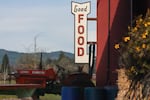
The market store at Topaz Farm in Sauvie Island, Ore., Feb. 4, 2026. The farm owners, Kat Topaz and Jim Abeles, have been at the forefront of the agritourism debate in Oregon.
Alejandro Figueroa / OPB
Land conservation watchdogs say it could put farming communities at risk of losing their primary function: to grow crops and raise livestock. Property rights advocates say the state should update its land-use rules to reflect the needs of modern farm businesses.
At issue is Oregon House Bill 4153, sponsored by state Rep. Vikki Breese Iverson, R-Prineville.
The legislation would rename what’s called a “farm stand” permit to a “farm store,” and would clarify how farm owners can operate retail space on their land and host events – think a rural farm market selling farm-grown goods and snacks, offering farm-to-table dinners or hosting music events.
Gov. Tina Kotek has expressed support for the bill, as have the Oregon Farm Bureau and property rights advocates.
A debate fueled by social media
The bill’s introduction follows a very public backlash last summer. The Oregon Department of Land Conservation and Development, the state agency in charge of land use policy, published a draft of proposed rules meant to clarify a permitting system that some county planners and farmers say is unclear and vague.
But some farmers said the proposal did the opposite, and took to social media to argue it would complicate a process that is already hard enough to navigate and could put them out of business. As online posts spread, so did misinformation, and some people thought Oregon was trying to shut down small family farms.
The outcry that resulted, including thousands of calls and emails to Kotek’s office, led the governor to direct the department to shelve the rules.
Jim Abeles and Kat Topaz, the owners of Topaz Farm in Sauvie Island, were at the forefront of the debate.
They grow fruit and vegetables at their 130-acre farm, but they also host live music events, jam and pickling workshops and educational tours in the summer. They also have a small farm market, a corn maze and a pumpkin patch in the fall.
“This is what the public wants. Farms have become more popular. Sauvie Island has become more popular and Hood River,” said Abeles. “Particularly near urban areas, people want to get connected to the food source.”
Topaz said traditional farm income models have changed. People don’t buy large amounts of beets or strawberries to jam or pickle, they want smaller portions and to still be able to enjoy rural farm spaces outside the city.
“Do you want to save the farmers to keep farming?” Topaz said. “Our state should be proud of all these things that we’ve done to get us to this point. But if we want farms to survive, then we need to make it so we’re looking out for farmers, not just farmland.”

A pickup truck at the entrance of Topaz Farm in Sauvie Island, Ore., Feb. 4, 2026.
Alejandro Figueroa / OPB
Farms across Oregon and the country are indeed struggling. They’ve had to deal with rising costs for gas, fertilizer, equipment and labor – and shrinking federal support too.
Land conservation policy watchdog groups, however, say these types of farms bring with them large crowds and traffic that disrupts working farms. They argue that a growing tourism industry encroaching into scenic rural areas would devastate small farming communities, price out younger farmers, and deepen the pockets of developers.
At a hearing Wednesday, Mike McCarthy, an orchard grower from Hood River, called the changes the bill is proposing deceptive, unenforceable and harmful to local farms.
“The principal problem of the bill is that farm stores can sell, exclusively, products with no connection to products grown on the farm,” McCarthy said.
The bill would allow loopholes for “farm stores,” allowing 95% or more of their store products to be retail merchandise or snacks and drinks with no connection to the farm, according to land watchdog groups. It would also get rid of a limit on annual sales of non-agricultural goods.
That’s a significant reversal of present rules.
Currently, farmers on land zoned exclusively for agriculture need to show that at least 75% of their annual sales come from products grown at the farm or nearby farms. No more than 25% of their revenue may come from events they charge a fee for, or from selling snacks and bottled drinks or branded products, such as mugs and sweaters.
Samantha Bayer, the general counsel at the Oregon Property Owners Association – a property rights group – said several guardrails in the bill would prevent a farm from turning into a full-blown grocery store or amusement park.
“This is not a free for all, there’s lots of limitations,” Bayer said at the hearing.
More than half of the property still needs to be dedicated to farming, according to Bayer. Farm stores are capped at 10,000 square feet and they cannot be used as hotels, full-service cafes or drive-thru fast food restaurants. Counties also have the ability to regulate traffic, noise and store hours, but it wasn’t clear how exactly it would be enforced at the Wednesday meeting.
Legislators were unable to get through a long list of submitted public testimony Wednesday. They will revisit the bill Monday.