In a unanimous vote Monday, OHSU’s board gave the green light to explore a plan to transition the Oregon National Primate Research Center to a monkey sanctuary.
Last week, OHSU officials announced the National Institutes of Health’s offer to help determine if federal funding could transition the research facility. The board said it did not intend for the resolution to predetermine the future of the primate center and set no timeline for a proposed transition.
During the negotiations with federal officials, OHSU has agreed to a six-month pause on most breeding of the monkeys in its colony — one of the largest in the U.S. But OHSU’s leadership dropped another proposed condition of the talks, allowing researchers at the center to continue to seek grant funding for new work.
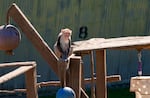
A Japanese macaque at OHSU’s Oregon National Primate Research Center in Beaverton, Ore., April 17, 2025.
Kristyna Wentz-Graff / OPB
The campaign to close the monkey research facility is a rare example of an issue that has cut across partisan lines, pushing OHSU to look for a way to adapt to federal policy instead of opposing it.
The Trump administration is dramatically accelerating efforts to reduce the use of animals in scientific research. Meanwhile, Oregon Democrats, allied with animal rights groups, have signaled they oppose spending state tax dollars to support the primate center if it loses federal funding.
In comments Monday before the board vote, OHSU President Shreef Elnahal called the decision to proceed with the talks the most difficult of his career. He said it was necessary in light of recent policy changes - and more that are likely to come in the near future.
“It was important to answer this call for a conversation in order for OHSU to retain agency on the outcomes for our university in this environment,” he said.
National animal welfare groups immediately hailed OHSU’s decision and the possibility of a new monkey sanctuary, saying that monkeys at the facility have suffered for decades.
“This is a glorious day for monkeys and for science,” PETA Senior Vice President Kathy Guillermo said in a prepared statement.

Monkeys in the sheltered housing units at OHSU’s Oregon National Primate Research Center in Beaverton, Ore., April 17, 2025.
Kristyna Wentz-Graff / OPB
The talks over the center’s future will take place over the objections of many of the scientists and employees at OHSU, including the faculty senate, the labor union AFSCME 530, and the primate center’s director, Dr. Skip Bohm.
Bohm told the board Monday that simply announcing the resolution had harmed OHSU’s reputation as an institution committed to science, and would impair the university’s effort to recruit faculty and compete for grants. Other faculty members accused OHSU’s leaders of violating the university’s academic freedom policy by allowing political interference in the conduct of their research.
Amy Miller Juve testified on behalf of the faculty senate, which represents some 3,000 faculty members. Juve said the overwhelming majority believe closing the primate center will cause irreparable harm to OHSU. A small number of the faculty hold principled objections to animal research, she said.
Members of the board voted unanimously to move forward with talks with the NIH. Several board members praised primate research for its contributions to science, from flu vaccines to the effort to cure HIV.
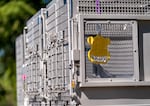
Cages at OHSU’s Oregon National Primate Research Center in Beaverton, Ore., April 17, 2025. Cages may accomodate single occupants or multiple monkeys. Enrichments such as the plastic toy and mirror are often utilized.
Kristyna Wentz-Graff / OPB
But they also said they could not ignore the risk posed by the federal government cooling on primate research, or the potential shifts toward newer methodologies. As part of any deal with the federal government, the board is seeking continued funding for research that’s currently underway.
The talks, said Dr. Maria Rodriguez, a board member and professor of obstetrics and gynecology, will help clarify OHSU’s options and their costs.
“One of the major concerns I have is that running a primate sanctuary is completely outside the scope of what we do at OHSU,” Rodriguez said. “So part of the reason to have these conversations is to understand what it would mean.”
Any deal between OHSU and the NIH regarding the center’s future would return to the board for a debate and vote, Elnahal said.
The Oregon National Primate Research Center is among the largest primate research centers in the country that serves scientists working on federally funded medical and basic science research. It houses more than 5,000 monkeys, primarily rhesus macaques.
It has become a flashpoint in the national debate over whether scientists should be moving more quickly to adopt new approaches, and whether the orthodoxy that primates offer the most accurate model of human diseases still holds.
More than 7,000 people submitted testimony on the OHSU board’s resolution on opening talks with the NIH. Supporters of closing the center said Monday that newer methods are faster to test, more ethical and more likely to translate into clinical breakthroughs for human patients.
Dr. Melissa Lee, a pathologist and graduate of OHSU medical school, said monkeys are a poor model for humans, and scientists have an obligation to look past the impulse to preserve tradition.
“Humans have 46 chromosomes, rhesus monkeys have 42. Those differences are not abstract,” she said. “Too often, studies that appear promising in animals fail when applied to humans.”
But many faculty members argued that closing the center will interrupt promising science and diminish OHSU’s ability to advance medicine.
Monica Hinds, a professor of bioengineering, said her work in primates had supported the development of popular drugs to prevent strokes.
“In my lab, we rely on just four animals a year, and this work has directly informed therapies annually prescribed to more than 8 million people in the U.S. alone,” Hinds told the board. “There are no alternative methods at this time that can fully replicate the complexity of primate coagulation biology.”
Researchers and staff working for primate research centers elsewhere in the U.S. gave some of the most biting testimony, with one accusing OHSU of “bending the knee” to the Trump administration, and another suggesting that without the primate center, Oregon would be a scientific backwater.
Editor’s note: An earlier version of this story misstated the comparative size of the Oregon National Primate Research Center. It is among the nation’s largest federal primate research facilities, along with the Tulane National Biomedical Research Center and the California National Primate Research Center. OPB regrets the error.