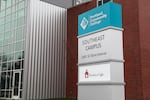
Portland Community College and its two unions are at odds over wages, health benefits and how much the institution has to spend on employees.
Bryan M. Vance / OPB
After 10 months of bargaining, Portland Community College’s two unions are turning up the heat on the institution.
PCC’s Federation of Faculty and Academic Professionals and the Federation of Classified Employees declared an impasse in negotiations with the college on Jan. 30. That notice, filed with Oregon’s Employment Relations Board, kicked off a strike timeline in which hundreds of represented workers could walk off the job next month.
Salaries and healthcare benefit costs are the central sticking points for both the unions and college. They’re also at odds over how much money PCC has in its coffers to spend on employees.
Union representatives say the tenor of negotiations over the past few months has been frustrating.
“Our main goal at this point is just to get a cost of living adjustment that’s not a pay cut and something that helps people pay for the increased premium cost of health insurance,” said PCCFCE President Jeff Grider.
PCCFCE represents close to 700 administrative assistants, front desk clerks, IT staff, custodians, public safety officers and other college support workers.
The unions are seeking between a 6.5% and 8.75% increase in wages over two years. PCC has offered a less than one percent increase over the same time span to the two unions. The college’s last, best and final offers on salaries included upping wages by .35% in year one and then up to a half percent in the second year.
Ben Cushing, who leads PCCFFAP, said the institution’s offer barely moves the needle.
“Budgets are moral documents and they reflect the priorities of the college,” Cushing said. PCCFFAP represents about 1,600 faculty and other academic staff at the college.
“What we’ve seen is the college prioritizing management at the expense of workers and students,” he said.
But PCC leaders say the college, Oregon’s largest higher education institution, is in an unpredictable financial situation and it must consider the needs of its workforce with long term sustainability.
Like most other colleges and universities across the country, PCC is faced with future proofing itself from a forecasted decline in student enrollment and increased operational costs. Post-secondary schools in Oregon are also bracing for state budget cuts.
“We know cuts are coming to this current budget cycle and this is happening within the broader context of rising costs, whether it’s healthcare, facilities, technology - lots of costs are rising,” said Howard Croom, associate vice president of people strategy, equity and culture at PCC.
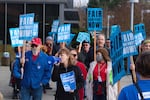
Portland Community College Federation of Classified Employees members rallied at the Rock Creek Campus in Northwest Portland on February 13, 2024. Two years later, the union is at the bargaining table again.
Christian Martinez Guzman
The college slashed more than $14 million to balance its ledger for PCC’s current two year 2025 - 27 budget cycle. Reductions were mostly derived through a combination of layoffs and a pause in filling vacant jobs.
Looking ahead, PCC is predicting it could be nearly $21 million in the red in its next biennium, according to Croom. That’s if state budget cuts to colleges go through this year.
Croom said PCC leaders are weighing these financial pressures as it negotiates with the unions.
“We’re here for all employees. We want the best for the students,” Croom said. “We have to continue to be the community’s college and part of that involves financial responsibility and balancing that with taking care of employees and serving students.”
PCC’s union representatives say they understand the bind the institution is in. But they say the college isn’t looking into other alternatives, like reducing the percentage of the college’s reserve fund in order to support employees more.
PCC’s board mandates that at least 9% of its general operating funds be in reserve. For this biennium, the college hopes to increase reserves to 12%. Reserve funds cannot be used to pay for employee wages or benefits.
Cushing said both unions are ready to negotiate in good faith with PCC, but they have yet to see any offers that will realistically satisfy their members.
“We need a stable workforce both for faculty and academic professionals and also for classified staff to be able to serve our students,” Cushing said. “We don’t think what we’re asking for is at all unreasonable.”
A strike could occur as early as March 10. But it is not imminent. The unions and PCC have scheduled three negotiation sessions with a state mediator during the mandated 30-day cooling off period. The first session is set for this Friday.