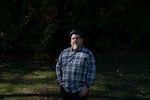
Chuck Sams, former National Park Service director, stands for a portrait at Willamette Park in Portland, Ore., on Feb. 11, 2026.
Eli Imadali / OPB
When Chuck Sams was sworn in as director of the National Park Service in 2021, he became the first Native American to lead the agency. Sams previously served as a member of the Northwest Power and Conservation Council and as executive director of the Confederated Tribes of the Umatilla Indian Reservation.
Not long after Sams returned to Oregon after leaving the agency last year, the Trump administration fired nearly 1,000 park service employees without warning. The agency lost nearly a quarter of its permanent staff in the following months.
Sams has denounced the loss of institutional knowledge within the National Park Service. He joins us to share his thoughts.
Note: The following transcript was transcribed digitally and validated for accuracy, readability and formatting by an OPB volunteer.
Dave Miller: From the Gert Boyle Studio at OPB, this is Think Out Loud. I’m Dave Miller. Chuck Sams is Cayuse and Walla Walla, and an enrolled member of the Confederated Tribes of the Umatilla Indian Reservation. In 2021, under the Biden administration, he became the first Native American director of the National Park Service. He moved back to Oregon when Donald Trump began his second presidency. Within months, thousands of Park Service employees, a quarter of the agency’s staff by one reckoning, had been fired or had taken buyouts. The remaining staff have been asked to remove signage that’s not appropriately booster-ish about our country.
Chuck Sams is now the co-chair of the Oregon Environmental Restoration Fund and a member of the Northwest Power and Conservation Council. He joins me now to talk about the future of national parks. It’s great to have you back on the show.
Chuck Sams: Thanks, Dave. It’s been a while.
Miller: How were you feeling when you left the Park Service last year as the second Trump administration was just ramping up?
Sams: When I came in as the 19th director of the National Park Service, we spent a lot of time just trying to fix and repair, and establish a better, stronger relationship between the politicals and the civil servants across the National Park Service. And so we worked very hard on that in the four years of the Biden-Harris administration. I was very concerned when leaving because Trump 2.0 looked very ominous. And while the plans hadn’t really called out anything for the National Park Service, I did want the rank and file to be prepared for changes that would be coming.
Miller: What did you find when you arrived there, in terms of the relationship between the political appointees and the lifelong staffers?
Sams: Many of the civil servants had a lot of psychological damage done during the Trump administration. Many of them were forced to work during COVID and therefore exposed to the virus in ways that other people hadn’t. The parks were forced to stay open during COVID. And while that was great for the American people to get outside, it placed those staff at risk. They were constantly worried about who was going to take care of them. And so I wanted to reestablish that my primary job as the director of the National Park Service was to ensure that not only did they have the resources necessary to do their job, by my going up and asking Congress for the appropriate amount of funding, but to also ensure that their well-being was protected.
Miller: How has the second Trump administration been different from the first in terms of management of the Park Service?
Sams: Well, first, as you opened with, they let go nearly 25% of the staff. And now, while there have been some gains back, and there’s a current saying that they’re about 16% below where they were at the end of the last administration – I think that number’s probably higher – that has dramatically affected the ability to do the work that the National Park Service does under its mandate: protection of natural resources and protection of cultural resources.
Miller: Can you give us a sense for the kinds of jobs that have been lost?
Sams: There have been stripping of the science directorate within the National Park Service. So you have biologists, hydrologists, botanists, climatologists – all have been let go, many of them senior in the staff – who either have taken the buyout or have been pushed out for one way or another. That type of long-term memory, which is crucial to the understanding of how we combat climate change, how we manage these places in situ, has a dramatic effect on each and every property of the National Park Service.
Miller: How long do you think it would take to build back that knowledge base?
Sams: It will take quite a while. The only silver lining I see out of this is that a lot of the younger staffers … I’ve been able to go out and start visiting national parks and sites since I’m no longer director, just to go and talk with staff out there …
Miller: So in the last year, since you departed as director, you have taken it upon yourself, just as a citizen, to …
Sams: To go to parks, to head up to Glacier, to go to Whitman, go out and see the parks. Because when you’re a director, you don’t get to see them as everybody else does.
Miller: But you did visit 100+ as director as well, right? Except you were a director and so it was different?
Sams: That’s right. 133.
Miller: You were never CEO undercover?
Sams: No, I didn’t get to do the CEO undercover. That would have been fun.
Miller: So what did you hear or learn about morale in the last year, post your time as director?
Sams: I heard from many members of the National Park Service family all across the United States talking about how they’ve lost their supervisors, their institutional knowledge. They’re worried about their own ability to continue on, to serve. These folks took an oath of office. They are public servants and civil servants. They do this job not because of the money, but because of their passion that they have to be of service to the American people. And it’s hard to hear those calls and those discussions.
But as I said, I think that if there is a silver lining, this younger generation of stewards, who are now having to do two, three, four, five different jobs, are learning a lot. And as I remind some of them who have been thrust into the supervisory or the superintendent role, when we come out of this, you will be well positioned to start building out your career and teaching others the lessons that you learned. While hard learned and hard fought for, you will build a much stronger organization, is my hope in the coming years.
Miller: So as you said, your first priority was the people who actually worked for the Park Service. But obviously, you were also focused on the experience of people visiting these parks. What have you heard about how the cuts translated to visitor experiences and park maintenance?
Sams: So for visitor experiences, what was interesting is Secretary Burgum had ensured that the backend staff – the folks that usually work in finance and administration – were thrust to go work in the public sector of it, in interpretation and supportive visitor resources and services. And so to the American public for the most part over this last year, you didn’t really see anything wrong in your experience in the park. You wouldn’t know that, but on the backend, where maintenance is supposed to happen, where cultural resources and natural resource protection is supposed to be taking place, those things were suffering in the park. And we’re going to see the accumulative effects over the next few years of that being neglected.
Miller: The National Park Service has long been one of America’s most popular federal agencies. You weren’t the head of the IRS, for example. This is a service that people go to to see some of the most extraordinary places in the world. Do you, at this point, see the cuts that we’re talking about as just a part of the overall decimation of the federal government, or as more specific and intentional, as something about parks themselves?
Sams: I did read Project 2025 and I noticed that parks were absent of that. I think as this administration began to implement what they wanted in a wholesale change of the federal government, they saw that the National Park Service is an icon of America, and that it was trying to hold fast and hold strong in its authorities under the 1916 Organic Act, and that you had a strong civil workforce there. They decided to pivot and start going after one of America’s most popular bureaus in the United States government. And that was to start demonstrating to the other bureaus that we can come and get you also. That’s just me, that’s my thought process in that. I own that as my own opinion.
But as I watched this happening and the dismantling that was taking place in the National Park Service, I thought not only was it an attack on a federal agency and its staff, but it was also an attack on the American people. These lands that we’ve set aside for ourselves for over 100 years, to ensure that we not only protect them for today, but for future generations down the road, were being attacked. Our relationship that we have to not only our history but also to the natural world was being attacked. The way we interpret and that we use scholarship to better understand who we are as an American people and the diversity that we have in the stories that we have all across this nation was being attacked and being put into a single narrative. The natural resources and our connection, that once you get outside and experience the natural world, be able to go on trails, and hiking and interpretation by the staff, was being attacked.
So the American people are being restricted by having to show ID when you come into the national park. We’ve increased the fees for foreign visitors ...
Miller: $100 a person as of January 1 this year.
Sams: I think that is an attack on our relationship to the natural world, trying to put up some type of barriers.
Miller: To what end?
Sams: I think that there’s been this push by this administration and some members of Congress, as we’ve seen, to sell off public lands. And that is a very sad thing, because we worked very, very hard over the last 100-plus years in the National Park Service, and Congresses before this, to set these particular lands aside for ourselves because of their natural resources, because of their cultural resources. So that we can tell America’s story fully, and have a better education of who we are as Americans, to tell the trials and tribulations, the challenges, but also our successes.
Miller: You talked a little bit about national parks not just teaching us about the natural world, but about the human history on this land as well. I thought we could explore just one personal version of this in your own life. Can you tell us about a trip that you took to the Whitman Mission National Historic Site when you were a fourth grader?
Sams: I remember going to the site. It’s a historic site that talks about the Whitmans, Doctor Whitman and his wife Narcissa, their invitation by the Cayuse – my own people – in the 1830s to come out to the West and teach us not only about the Bible – as we called it the Black Book – but also to teach us English. We wanted to know who the new people were that were coming into the territories. The story that they told there was that, as Dr. Whitman was attempting to help the Cayuse, Umatilla, Walla Walla people come over from the ravages of diseases, measles and other diseases that were coming into the West, he also was helping forge the Oregon Trail.
Now the agreement that we had with him, as I grew up and understood it, is that we did invite him out here. We provided land within Cayuse’s territory. Then he started to move away from his primary focus of both teaching religion and English. And because he wasn’t making any money, [he brought] out folks on the Oregon Trail and attempted to open the lands up for settlement.
Miller: But none of that was explained in the interpretive signs?
Sams: Other than, on the good part, that it was Manifest Destiny in 1978, 1979, this is what’s coming to you, the word of God for the American people that they must overcome these Indians and the savages to take these lands. That was the message that I was told, but not what I was told at home. And then coupled with the fact that he couldn’t cure the Natives. Well, we have our own laws and we have our own doctors too. And under our own laws, when somebody couldn’t cure someone else, if you were an acclaimed doctor, then you had to pay some type of tribute to that family, for either their loss or for your inability to do so. And he’d been warned about this over and over again as he was practicing medicine. And that wasn’t his value system. But the fact of the matter is, he was living within our territory, within our land, within our laws and structure. That’s what he agreed to.
Miller: New interpretive signs at the Mission went up during your tenure as Park Service director. One says this: “One-sided representations that portray the Whitmans as martyrs and depict a Native ‘massacre’ of non-Indians have further marginalized the associated Native peoples. Addressing the Mission’s complex historical context, including the complicated legacy of Manifest Destiny and its continued impacts on Native populations, will promote healing and understanding.”
Do you know if that sign is still up?
Sams: It was when I last was there, just about three weeks ago. I don’t know if it’s still up today. But I will be back to go and see if it’s still up.
Miller: I ask because many signs – as you know, but I want to make sure listeners know – have been removed because of an executive order that says that parks have to “focus on the greatness of achievements and progress of the American people.” And any signs that “inappropriately disparage Americans” had to be taken down. What has that order meant in practice?
Sams: It has meant changing the narrative. Again, really just pulling back from the diverse stories that we were telling in the parks. I credit former director Bob Stanton in the 1990s. He was the first African American to become director of the National Park Service under the Clinton administration. And he took a hard look at how America’s story was being told across the country, and said we needed to look at additional scholarship and tell a much broader story of who we are as Americans, and the strength of that diversity.
Miller: That’s an important point, that timeline. You’re saying that work went on through the George W. Bush years and even during Trump 1.0?
Sams: That’s correct. So the interpretive science at the Whitman National Park, by example, had been worked on since the late 1980s, early 1990s by several of our tribal members. The late Cecilia Bearcham was one of them, who was my grandmother’s roommate at boarding school here at Chemawa. [She] went and volunteered, and became a park ranger during season, and was starting to help build and talk about our side of the story.
That took nearly 35 years before that story finally got changed. There’s a lot of points saying it happened under the Biden-Harris administration. The National Park Service takes its job very seriously about vetting the scholarship and works very hard with external historians, community members to tell that story right and make sure that it’s correct to the best of their ability. And they’re willing to change it when necessary when the new scholarship comes about.
Miller: But it seems like what you’re talking about is a painstaking process that involved, if I understand you correctly, sort of a best case scenario of cooperation and partnership between the federal government and Native tribes. That took decades. But in a number of cases, it took weeks or days for signs that had been in the works for decades to just be torn down.
Sams: That’s correct. You look at Independence Hall, where they took down President Washington’s whole story about the slaves that he had brought with him when that was our first Capitol at the president’s house. That was worked out decades ago between the city of Philadelphia and the National Park Service. I applaud the city of Philadelphia taking this to court to point out that this was a long-standing relationship, that the scholarship was right on point and that it tells a broader story of who we are as Americans. And to take it down arbitrarily really just denigrates who we are as American people.
Miller: Do you think that the American people are such, the word that comes to mind is snowflakes, that they can’t handle the truth?
Sams: I don’t believe that we are. We are stronger as a country by the struggles that we have gone through. Because on the other end, we’ve been able to form a more perfect union. It’s an experiment. Our democracy is an experiment and it’s an ongoing experiment. And whether it was us overcoming slavery or whether it was women getting their rights, whether it was the passing of the American Disabilities Act in 1990, whether it is fulfilling the full trust responsibilities to Native people all across America, those struggles are real, a part of our democracy. To ensure that all men and women are created equal, that everyone has a right to dignity and a right to a just government. But we have to fight for it. Nobody’s going to just give it to you. And those struggles are extremely important.
When I was sworn in as the 19th director, Secretary Haaland said, “I want you to go out there and tell America’s story fiercely. Find those stories yet untold.” And I told my staff I wanted to ensure that we saw a reflection of America in our parks. I want every American to go into the parks and see a reflection of themselves. I don’t care if you’ve been here since my people have been here since time immemorial or you were sworn in yesterday. The story of who we are is a melting pot. The story of our diversity just strengthens our union. Because we have folks who bring us their talents, their skills, their thoughts to work towards not only a stronger democracy, but a stronger nation as a whole, economically, socially, education-wise.
Miller: We could have spent the entire conversation talking about your time right now in the Northwest Power and Conservation Council. But in the minute-and-a-half I have left, let me just ask you at least one question about it. I’m just curious how the Trump administration’s opposition to clean energy projects is affecting what’s happening right now in terms of our power grid and the future of energy in the Northwest?
Sams: We’re beginning our modeling practices as we develop the energy plan coming up. We’ve just finished the fish and wildlife amendments and the program is out there for comment now. Matter of fact, I’m heading to Bend after this for a public hearing that will happen tomorrow at OSU’s campus to talk about what we want to do with fish and wildlife mitigation for BPA.
What this administration does on renewables, what it’s doing on conservation, the conservation STAR program to ensure that we’re using less energy, will have a direct effect. It will most likely, in my opinion, move our costs up. And we are charged with trying to keep those costs down for everyone in the Pacific Northwest. But it is a challenge that we are going to face in the modeling and what comes out of that as we see these policies being rolled back, that go back clear to the Nixon era – the protection of good clean water and air – all of these contribute to the production of energy and how we’re able to ensure to keep those lowest costs.
We are very fortunate in the Pacific Northwest. I’ve lived in Southern California, I’ve lived in Washington DC, I’ve lived in New York City. Everywhere else I’ve paid an exorbitant amount of money for energy. And to me, that’s the cost of living in those places. We here are able to do it through a renewable resource such as the Columbia River system. But we need wind, we need solar, we need geothermal. We need those things in effect so that we can continue to meet the energy demands, both residential and industrial.
Miller: Chuck Sams, thanks very much.
Sams: Thank you. It’s been a pleasure.
Miller: Chuck Sams is former director of the National Park Service. He’s current co-chair of the Oregon Environmental Restoration Fund and a member of the Northwest Power and Conservation Council.
“Think Out Loud®” broadcasts live at noon every day and rebroadcasts at 8 p.m.
If you’d like to comment on any of the topics in this show or suggest a topic of your own, please get in touch with us on Facebook, send an email to thinkoutloud@opb.org, or you can leave a voicemail for us at 503-293-1983.