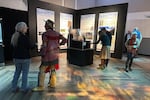
In this provided photo, visitors explore the exhibit "Heads & Hearts: Seeing the Landscape through Nez Perce Eyes" at the Oregon Museum of Science and Industry on Saturday, Jan. 10, 2026.
Courtesy of OMSI
Much of our understanding about the earthquakes, volcanic eruptions and floods that shaped the geology of the Pacific Northwest comes from Western scientists. But those records almost always overlook the oral traditions of Native American tribes who witnessed those events.
An exhibit at the Oregon Museum of Science and Industry in Portland looks at the eruption of Mount Mazama, the Ice Age floods and other geological events through the perspective of the Nez Perce and other Columbia Basin tribes. “Heads & Hearts: Seeing the Landscape through Nez Perce Eyes” is on display through Feb. 16.
Geologists Roger Amerman and Ellen Bishop created the exhibit, which originally appeared at the Josephy Center for Arts & Culture in Joseph, Oregon. They join us to talk about how Native oral traditions can — and should — inform modern science.
Note: The following transcript was transcribed digitally and validated for accuracy, readability and formatting by an OPB volunteer.
Dave Miller: From the Gert Boyle Studio at OPB, this is Think Out Loud. I’m Dave Miller. The oral traditions of Native American tribes in the Northwest often include mentions of earthquakes, volcanic eruptions and floods. But Western scientists have traditionally ignored this form of passed-down knowledge as they’ve pieced together the story of what shaped the geology of the region.
That is slowly starting to change. An exhibition at OMSI in Portland looks at the eruption of Mount Mazama, the Ice Age floods and other geological events through the perspectives of the Nez Perce and other Columbia Basin tribes. It’s called “Heads & Hearts: Seeing the Landscape Through Nez Perce Eyes.” It’s on display through this coming Monday.
Geologists Roger Amerman and Ellen Bishop created the exhibit. They both join me now to talk about how Native oral traditions can and should inform modern science. It’s great to have both of you on the show.
Ellen Bishop: It’s a pleasure to be here, Dave.
Miller: Roger, first – you worked a lot of “traditional geological geology jobs” in government agencies and natural resource companies. What did you feel was missing in that work?
Roger Amerman: I felt my perspective of Native peoples all around the nation, all around this continent, was not involved in mainstream science. I worked for Mobil, ARCO, exploiting resources, oil and gas – same thing with the government. And the thing is, Dave, I knew that my people had a perspective growing up around the Hopi Reservation, around the Umatilla Reservation of Oregon, that they had uses of soil. They had uses of how they explained how they defined geography in their own mannerisms. And they had ways, through their oral tradition, oral testimony and oral literature – what I call it, I don’t call it legends, I don’t call it myths – to convey what happened for the past 18,000 years. And when that story is not told, Dave, it takes away my people’s humanity. And that’s unacceptable.
Miller: Were there times when you would bring this up and your bosses or colleagues would denigrate it or ignore it? I’m curious how that actually showed up in your work.
Amerman: I brought it up in grad school as well as undergraduate that there was another perspective and that these oral traditions offered a window, offered a portal, to a people that survived apocalyptic activity. This is like someone surviving Pompeii, yet there was this covey of people that survived it, and they passed down the information like, what did you see before, during and after Pompeii? The same thing happened with what Dr. Bishop and myself are sharing. This is a window that archaeology and geology haven’t presented, to my knowledge, in any great depth or legacy. I did bring it up quite a bit politely and it was dead silence from my professors going back into the ‘70s, ‘80s and ‘90s.
Miller: Ellen Bishop, in your career as a geologist, as a white geologist, it’s worth saying, how were Native American oral histories – I like what Roger said, oral literature – how were they perceived?
Bishop: Well, they pretty much weren’t perceived. I think, in general, geologists tend to look at sciences as facts determined by the data they’ve accumulated. And as a culture, we’ve tended to look at Indigenous stories as stories, as myths, as some funny thing that a coyote did. But as I looked at and listened to those stories, there were many of them that included geologic events. For example, the tsunamis and earthquakes – the Cascadia earthquakes, which are a very strong oral tradition of coastal tribes, which describe quite accurately the shaking of the earth, the run-up areas of tsunamis, the devastation of villages. [They] accurately describe these events as happening at night – at least for the last one, the January 6, 1700 quake. So I began to think more and more that if we wanted to understand some portions of Pleistocene geology, we should talk to the people who are actually here.
Miller: How did the two of you meet up?
Bishop: Well, we both work with the Josephy Center in Joseph, Oregon. It’s a Josephy Center for Arts & Culture. Roger is an artist. He does beadwork and other really outstanding art. I’m a photographer and writer. So we basically got to know one another and began to share our interest in how Indigenous culture and stories, or oral traditions, kind of matched with the geology. And Roger basically utilized the term ethnogeology, which I think is great.
Miller: Roger, what does it mean to be an ethnogeologist? What is ethnogeology?
Amerman: Simply put, I would say ethnogeology is the science of geology with the soul, and that meaning, how did the people engage the landscape? How did they use the lithic resources? How did they use the soils? How did they use the volcanic ash? How did they explain drastic apocalyptic volcanism as well as Ice Age floods at 60 miles an hour, a mile high. How did they explain those? So, it’s the marriage.
We just had an excellent talk last night at OMSI and the public, many of them were not science oriented. A few of them, but even them said, no one’s presenting this. It’s a human element, the “ethno” adds a human element. These guys in the late Pleistocene were here 18,000 years. They got a story. No one else has that story. Why hasn’t it been included? So we had a lot of very non-earth science people, an extremely diverse demographic last night. I wish you could have seen it, Dave.
Miller: There’s a lot of diversity from tribe to tribe, but if you can speak broadly, how are Native American oral histories, oral literatures, structured and passed down from generation to generation going back thousands of years?
Amerman: That’s a pretty loaded question …
Miller: It’s a huge question.
Amerman: … because oral tradition has a lot of protocols and context to explain it in great depth and fullness. So the public might be able to guess that we have to have a pretty dynamic speaker; he or she, in the oral tradition of Native peoples, persons is probably pretty theatrical. They’re gonna bust out a song or two.
Miller: To keep people’s attention?
Amerman: To keep their attention. That’s the whole idea. So in the longhouse, three months of winter when these things happen, this information download takes place traditionally. And I’m gonna say even in modern times, because I was just in a ceremony after that, the longhouse is the best learning environment. You’re in a very comfortable setting and you’ve just had your services. You’re with all your loved ones. You’re with all your family.
I don’t know how to explain it. It’s like, my identity is here. I have this very theatrical he or she in front of me. And when they talk about a story, any given story that follows a whole trend going upriver, they might have a song that goes with it. They might have the narrative that goes with it. When they point out a visual landform in the landscape that I know of, that person, that student, whether 10 years old, 30 years old or 50 years old, not only is that a good teacher, but that’s my identity.
Miller: One of the things that came to mind as you were describing that just now – talking about the landscape feature that people would recognize, that the storyteller-teacher is talking about – what happens when people were severed forcefully from the land? What happens to those stories?
Amerman: I’ll tell you exactly what happens. I come from a tribe in Oklahoma. We were definitely severed from our Mississippi Basin area. And what happens, we have the story, but we can’t put our hands on the landscape that facilitated that story. We’re impoverished as a Choctaw people; I can’t put my hand out there and look at a visual, because in oral tradition, all these senses have to be stimulated. For us reading something, something that can’t answer your questions, reading something’s very one dimensional to oral people. All the senses have to be energized. All the neurons have to be sparking.
Miller: Ellen, can you give us a sense for, let’s say, one of the particular stories that folks can see in the exhibit at OMSI right now.
Bishop: Sure, I’d be happy to do that. I’d like to add one important thing, I think, to Roger’s explanation of the passage of these stories, that science often neglects or doesn’t understand, and that is that often the storytellers come from the same lineage. And so the storytellers are charged with making sure that their stories are accurate and replicate that information to people. And those stories are important because they convey not only information about landscape, but information about sort of devastating events that this new generation of people should know about and should know what to do.
Miller: This is safety and survival information …
Bishop: Correct.
Miller: Embedded in culture.
Bishop: Well, and embedded in story. I mean, we know that neurologically humans are preprogrammed to listen to stories and to pay attention to characters. So that part of how to pass these stories down and ensuring that they’re kept the same is really important.
One of the stories that we have in the OMSI exhibit is basically a story that goes back to – it’s not quite in Oregon, it’s on the Oregon border – a story of two women who are out picking berries. And a man who was a white man came riding up to them. And this man was known as a person who was not necessarily a friend to Native Americans and particularly women. So one woman told the other to go hide. She began to run and the man on horseback chased her. And just before he caught her, there was a huge earthquake. This earthquake basically frightened the horse, the horse reared, the man fell off, the horse trampled him. So the two women were safe.
The important part about this story is this occurred in the valley of the Tutshi River in Washington, just north of the Oregon border near Walla Walla. And along that valley, there’s a fault known as the Hite Fault. And the Hite Fault has been considered to be generally inactive, not very active, not a particularly dangerous fault. And yet this story, which given that it was a white man, we could probably date as post-1800, pre-1840 when the Whitman Mission was going.
Miller: Relatively recent in relatively geologic time.
Bishop: Yes, exactly. It is a story about a quake and my experience with Indigenous stories is that the events in those stories, the geologic events, are real events. They’re not just something that was made up. And so that would suggest that the Hite Fault has, within the very recent geologic past, been a very active fault.
Miller: Is that something that geologists have investigated?
Bishop: Well, they’ve investigated the fault enough so that there is, in an older Washington Department of Natural Resources report, a suggestion that the Hite Fault might be capable of a magnitude 7.0 earthquake. But as far as I know there’s no knowledge of any earthquakes that actually have been severe enough to spook a running horse, make it buck and just have a hissy fit.
Miller: You know, Roger, this makes me wonder … To me, there’s something very Western about the idea of “verifying” Indigenous oral traditions or knowledge using scientific sensors. And I’m wondering if you’ve heard elders or tribal leaders say something like, “We don’t want your validation. Our forms of knowledge exist in their own realm. They’re ours, and we don’t need you to come along and say, ‘you know what, turns out you’re right.’” Have you heard that?
Amerman: Oh, I’ve heard that several times. So a good example is, Native Americans came from across the Bering Strait. Hey, tell you what, Dave, there’s no Bering Strait in any Native oral tradition I’ve ever heard.
Miller: A land crossing.
Amerman: A land crossing. There’s a lot of tribes, not so much the Plateau, but my tribe has a lot of migration and establishing ourselves throughout South and North America, but we don’t have no land bridge story. So that’s not a deep seated pillar of our oral tradition. Our oral tradition, going back to the value, the role of those storytellers is so paramount that I would put their role equivalent to the greatest warriors, to the greatest cooks, to the greatest harvesters. I mean, that’s how valued they were.
They have an editing board, Dave. So their editing board, subtly placed in the longhouse, is other elders that are listening to them. And those elders have the authority. They have the right to stop the elder telling the story, “Back it up. You didn’t complete this part.” And that’s a big move for another elder to do, to stop, interrupt someone. But if it’s important enough, you’re telling our identity, you’re telling our legacy and you’re gonna repeat it every year. And we’re the editing board to let you know that we’re listening and you better tell it right. And that storyteller, he or she has to abide by that traditionally.
In modern times, it’s really hard to get into that context and format for our younger people. I hope there’s a way we can go back to that. And then those storytellers will tell you what are the landforms, what are the pillars, what are the concrete parts of the culture. The Bering Strait usually don’t come up, so it’s not a big topic.
Miller: Ellen, what are you hoping that people will take from this exhibit?
Bishop: I hope, first of all, they understand that Indigenous stories or myths are not myths, that they serve multiple purposes to convey information that is accurate in terms of those events happening, and sometimes the sequence of those events; and that we should listen more to these stories, and honor them and understand them. And secondly, to understand the Nez Perce’s way of thinking about their landscape, which Roger has described really quite well, that there’s a very, very deep connection that oftentimes we don’t have.
Miller: Where might this exhibition go next? As I mentioned, it’s at OMSI through Monday. What about after that?
Bishop: We don’t have any particular location for it, but we are talking with and negotiating with a number of other venues. They include the Museum of the Rockies, a museum in Lewiston, potentially the High Desert Museum. So this will grow and it will have a life in the future.
Miller: Ellen Bishop and Roger Amerman, thanks very much to both of you.
Bishop: Thank you.
Amerman: Thank you very much, Dave.
Miller: Ellen Bishop is a geologist, writer and photographer. Roger Amerman is the co-instructor of earth sciences at Northwest Indian College and a consulting field ethnogeologist for Washington State University.
“Think Out Loud®” broadcasts live at noon every day and rebroadcasts at 8 p.m.
If you’d like to comment on any of the topics in this show or suggest a topic of your own, please get in touch with us on Facebook, send an email to thinkoutloud@opb.org, or you can leave a voicemail for us at 503-293-1983.