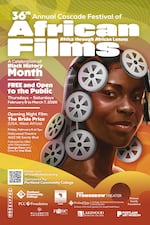
A poster of the 36th Annual Cascade Festival of African Films hosted by Portland Community College.
Cascade Festival of African Films
Portland Community College is hosting its 36th Annual Cascade Festival of African Films. The festival was founded by faculty members in the 1990s. It’s the longest-running African Film festival in the United States. It’s also a celebration of Black History Month at PCC.
OPB’s Paul Marshall II sat down to talk with co-director Eugénie Jolivett Fontana about the festival.
The festival runs through March 7.
The following interview has been edited for clarity.
Paul Marshall II: What elements do you look for when choosing films to showcase?
Eugénie Jolivett Fontana: It’s a committee of us that chooses the films. We look for the uniqueness of the film and the country. If it’s a country we’ve shown before, is it a unique story that hasn’t been told before? That’s one of the things that we look for. The other piece is making sure we get multiple voices from both seasoned, established filmmakers and emerging filmmakers.
Marshall II: Americans think of Hollywood and maybe Bollywood, but there’s also a big film production industry across Africa. What do people get wrong about the African film production industry?
Fontana: That’s a great question. There’s a little bit of Western adaptation in saying Hollywood, Bollywood and also Nollywood, which is the Nigerian film industry. The unique thing I’ve noticed about the African films is the technology that’s used and how it varies. There could be filmmakers filming on a phone, and there could be filmmakers showing high-end digital production to a television style of filmmaking. What we get wrong is that we think with the Western lens that there’s a particular, stylized way filmmaking should be. The African continent of filmmakers is reminding Western filmmakers and Western lenses that it’s about storytelling, and everything we use to make that story is a tool. The film style and the quality are going to look so much different than our expectations of what films we see in mainstream America, and in other Western countries.
Marshall II: I noticed that the festival is not just a film festival. There are other activities like the family fest and marketplace day. What are some of the other parts of the festival this year, and why is it important to have other components as well?
Fontana: One of the things about the African diaspora is community, and that throughline is in everything. It’s in the films we show. It’s also in the way we’re engaging with partners and community members. Having the festival at Portland Community College is a big part of that. The films we show reflect community, so how can we bring what we see on the screen or what we end up feeling from an experience of a film into a live moment? I think that’s really important to show that art is not just a singular category. Film is in one category. Theater is in one category. Music is another category. This festival shows that it embraces all of the categories.
Marshall II: On the website, I noticed there was a line that emphasizes viewing and experiencing these films through African lenses. Why is that distinction important to make?
Fontana: It’s important because it’s not coming from a Western lens. A Western lens has a way of skewing how we see things. There’s a bit of editing that happens, and it’s important that folks see what’s really happening through the eyes of the filmmakers making it. It’s important that our festival leans into Africa through African lenses and provides a platform so that we are showing what these filmmakers are talking about, experiencing and creating.
Marshall II: The festival has been going on now for 36 years. What are the goals for the festival in the future?
Fontana: We want to continue to build community and meet people where they are because that’s really important. The festival has been able to continue in the long term, and there are people who have been working with the festival for 36 years. We’ve had people come to the festival, and they were visiting from out of town. I think that’s beautiful because the reach is going outside of the state of Oregon. Whether it’s year by year or it’s just one time, we want to broaden the festival’s reach to more people within our state and beyond.