Rep. Paul Evans, D-Monmouth, in the Oregon House of Representatives, Feb. 5, 2024, at the Oregon state Capitol in Salem, Ore.
Kristyna Wentz-Graff / OPB
Oregon lawmakers grappling with the financial fallout of a blocked gas tax hike recently considered a notable idea for funding the state’s deteriorating roads: Letting cities and counties more easily raise gas taxes on their own.
An amendment to House Bill 4007, a wide-ranging “omnibus” transportation bill, would have rolled back a 17-year-old law that requires local governments to ask voters before raising fuel taxes.
Had the proposal moved forward, cities and counties could have passed the taxes on their own, avoiding a hurdle that has repeatedly sunk road-funding measures around the state in recent years.
But the idea ran into opposition. Between the amendment’s emergence on Friday afternoon and a work session on the bill Monday morning, the proposal’s author, state Rep. Paul Evans, D-Monmouth, said he concluded it was not politically viable.
“I was truly entertained by the scale and scope of the communicated threats and observations sent to my office over the weekend,” Evans said Monday. “Especially [those] suggesting things that I’m pretty sure I physically cannot do to myself.”
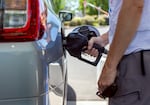
FILE - A person pumps gas into a car at a Mobil gas station on Friday, July 5, 2024 in Bend, Ore.
Kathryn Styer Martínez / OPB
The furor over the gas-tax proposal illustrates the difficult balancing act lawmakers have in front of them this year. With a road-funding proposal passed last year on hold until voters get a say, the Legislature is working to close a roughly $300 million budget hole for the Oregon Department of Transportation.
Evans’ idea was viewed as a consolation prize to local governments for another change the lawmaker proposed. A separate amendment would have ensured that $15 million that flows to the state’s Safe Routes to School program every year was paid for out of money that goes to cities and counties – not the state’s cut of road funds.
“It would be unfair to deny local leadership the tools required for greater flexibility as we confront coming budgetary challenges,” Evans wrote in a text message to OPB on Friday.
The amendments were discussed in a meeting of House Democrats last week. But they immediately prompted pushback from local governments and the Oregon Fuels Association, which represents gas stations around the state.
“You don’t rebuild trust in government by taking decisions away from voters — especially when polling shows more than 70% of Oregonians want to keep their right to vote on local gas taxes,” said Mike Freese, a lobbyist for the fuels group. “Doing so also seems politically shortsighted, given that the central fight of this session revolves around a transportation package being referred to voters.”
State lawmakers have considered removing voters from local gas tax decisions before. Last year, state Sen. Khanh Pham, D-Portland, and Rep. Mark Gamba, D-Milwaukie, put forward a bill that would have accomplished what Evans now proposes.
They argued that local governments are increasingly unable to pay for basic services because of constraints on how quickly Oregon property taxes can grow. Allowing cities and counties to more easily tap gas taxes to pay for road upkeep made sense, Pham and Gamba said.
Local governments were allowed to pass gas taxes on their own until 2009, when lawmakers passed a law requiring citizen approval for local gas taxes as part of a larger transportation package.
“Right now we’re tying cities and counties’ hands and taking out one tool,” Pham said last year. “I want to make sure that we’re untying their hands as much as we can.”
The 2025 bill, introduced as lawmakers were working on an ambitious proposal to fund roads into the next decade, never received a hearing.
More than 30 cities and counties have implemented local gas taxes, according to the Oregon Department of Transportation. That includes Portland, where voters in 2024 opted to renew a 10-cent-per-gallon gas tax.
In other cities, gas tax hikes have met backlash. Nearly 75% of voters in Cottage Grove shot down a proposed six-cent-per-gallon gas tax increase.
Evans’ decision not to move forward with his amendments likely ends the discussion this year. That doesn’t mean it won’t crop up in the 2027 legislative session, when lawmakers are once again expected to take up the massive question of how to fund road upkeep in the decades to come.
As it currently stands, HB 4007 would make a wide variety of changes to state transportation laws – from tightening up regulations on electric mobility devices, to allowing larger, heavier milk trucks to operate on some state highways. The bill moved out of the House Transportation Committee on Monday.