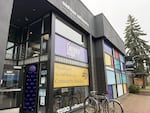
An undated, provided photo of The Lavender Network's new building at 1590 Willamette St., Eugene, Ore. The building now houses Eugene's only permanent LGBTQ+ resource center.
Courtesy of The Lavender Network
According to its website, The Lavender Network is Eugene’s only LGBTQ+ service and community center. The coalition of five nonprofits offers health care, counseling, a free clothing closet and more to queer communities in Lane County. After renting different spaces around Eugene, the network opened its first permanent space near downtown on Feb. 10.
Laura Henry is the manager of The Lavender Network. She joins us to talk about the importance of creating permanent spaces for LGBTQ+ communities.
Note: The following transcript was transcribed digitally and validated for accuracy, readability and formatting by an OPB volunteer.
Dave Miller: From the Gert Boyle Studio at OPB, this is Think Out Loud. I’m Dave Miller. Eugene’s only LGBTQ+ community and service center just got its first permanent home. The Lavender Network formed a few years ago as a coalition of local nonprofits. It offers health care, counseling, a free clothing closet and other services to queer communities in Lane County. The network opened its first permanent space last week.
Laura Henry is the manager of The Lavender Network, and she joins me now. It’s great to have you on Think Out Loud.
Laura Henry: Yes, thank you for having me.
Miller: How did The Lavender Network first get started?
Henry: It actually started as a collaboration, to provide LGBTQ and queer services to folks in Eugene, between HIV Alliance and TransPonder sometime in 2021. We just called it the Queer Resource Center. It was out of a small former chiropractor’s office that was not a great space to see a lot of people at once, but we were doing what we could.
Miller: What partner organizations at this point make up the network?
Henry: So The Lavender Network now has five partners. It is HIV Alliance and TransPonder, as well as Eugene Pride, Queer Eugene and Authentic Movement Project.
Miller: And what kinds of services or supports can folks get all in this one place?
Henry: We’ve got a variety of things. Authentic Movement Project does dance and movement classes. They’ve got four to six classes a week on a sliding scale just so people can feel comfortable moving, getting out there, being themselves in a public space. TransPonder provides behavioral health counseling, resource navigation and peer support services. HIV Alliance provides HIV testing, STI testing, and we provide hormone needle exchange services. So if folks need bandages, syringes or such to inject hormones, we can provide those to them for free. Queer Eugene has their permanent clothing closet on site, as well as hosting a number of social events, meetups and such for different groups of folks in the community. And Eugene Pride is primarily hosting their Pride planning meetings with us here on site. But they are hoping to do more sort of social events than just the big Pride festival each year.
Miller: I was surprised to read on your website that you’re Eugene’s only LGBTQ+ community and service center. How is that possible?
Henry: I was surprised when I got the job as the manager too. I went searching around to try and find examples, people who I could meet with to see how their organization works and what we needed to do. I found the Westside Queer Resource Center over in Hillsboro and the Q Center in Portland, and not much else. There are of course tons of LGBTQ-focused nonprofits, smaller organizations, less official groups that are doing the work out in their communities. But there hasn’t been an official permanent, long-term, “this is a space where people can go” sort of place.
Miller: So you were hired specifically to manage and maybe grow this partnership. What were your own personal biggest goals when you started?
Henry: Honestly, one of the first things I heard is there have been community members in Eugene trying to make this happen for years and years and years, but all essentially on a volunteer basis. They’ve got their full-time jobs or whatever else, and they’re spending extra time to put something like this together, with no funding, nothing else happening. All of those eventually fell apart for one reason or another. So my big thing was, I’m hired to do this 40 hours a week, I’m going to make it happen. If you need a bad guy in a situation because we all hate the compromise we have to make to make it happen, I can be the bad guy. I’m fine with that.
Miller: Did you have to actually do that? When you’re talking about five different nonprofits who all, I imagine, are well-meaning but may not always have the exact same goals about how to use the space or how to operate, were there challenges in the partnership?
Henry: Very luckily there have not been. Everyone has been largely on the same page of the types of values that we want to emulate. Obviously, we sometimes have conversations that have to go on for a while to make sure that we are presenting a uniform direction and that we are on the same page about how we’re doing things. But there really haven’t been any problems like I was told to expect. So I was very happy about that.
Miller: Where’d the name Lavender Network come from?
Henry: So like I said, we originally were just the Queer Resource Center, and that’s what the name was when we essentially got a grant to allow us to expand. But because we were expanding, I thought, “Great time to rebrand. Let’s get us a new name.” So I searched around for a bunch of stuff. I was considering something related to Marie Equi right before the Marie Equi Center opened in Portland. I was like, “Good thing I didn’t pick that name. We would have had the same thing.”
But we looked around and we actually found, I think it was like an archival website related to a donation at Oregon State, about The Lavender Network, which was a queer news magazine published in Eugene, I want to say from 1986 to 1994, self-published LGBTQ news. We were able to reach out to one of the folks who published that to get their permission to sort of revive that name.
Miller: How were you able to acquire this new building?
Henry: That is a great story. I mentioned a grant that allowed us to expand, that only allowed us to rent a space. We had a great space for about a year that we ended up renting. And as part of that process, we connected with Helen Shepard, a community member who at first offered us their building that they owned, but it wasn’t really the right fit, and eventually just decided, “hey, I’m just going to donate enough money to buy you a building.”
Miller: Nothing better if you’re a nonprofit than just plain old cash. [Laughter]
Henry: Exactly, yeah. It was an amazing opportunity and we thank them all the time. They actually ended up donating a total of $2.5 million for us to buy the building and have some money for repairs if we need. Everything to be in good repair, to keep this place running long term.
Miller: What does it mean to have created this permanent space for queer communities in Eugene and in Lane County at this particular moment in history?
Henry: I think it means a lot. There are basically always times that people feel like everything is the worst. But being an employee of HIV Alliance for the last seven-and-a-half years, everyone’s really looking, like, “the AIDS crisis, that’s something that you always have to be reflecting back on.” We know that things could be worse. And we are here to continually make things better as much as we can. I’ve heard amazing community feedback from folks, folks that are so happy just to have a space that they can walk into and use the name they want to use, use the pronouns they want to use, wear the clothes they want to wear, without having to be afraid of someone looking at them sideways or making a rude comment, or something worse.
Miller: Well, I am curious ... Along those lines, a permanent address, it seems like it could also mean more visibility, which could be maybe a double-edged sword. Are you at all worried about vandalism or being targeted at this new building?
Henry: That’s always something that we have to consider, the balancing act between visibility and little too much visibility for kind of the wrong people, in a way. We even considered that when we were considering the name. We ended up settling for The Lavender Network because of the historical connection, but also because “lavender,” if you know, you know it’s associated. But without putting the word queer in there or without putting LGBTQ front and center or even rainbow, maybe we fly under the radar a little bit with just this name.
But obviously yes, permanent location, we are right in Midtown Eugene just south of downtown. It’s something that we’re always paying attention to, and keeping an eye out, and trying our best to keep our community safe. Luckily, there have been no situations. We’ve been in the building since November and everything’s been great. There haven’t been any safety concerns. But it’s not something that we let ourselves forget.
Miller: What kind of community are you hoping to foster in this new building?
Henry: Ultimately, I think the best sort of community we could foster is one that’s resilient, that will stick together and find ways to keep going, beyond just the convenience of it. Because sometimes to make communities work, it isn’t convenient. You have to go out of your way to help someone. You can’t say, “I don’t owe you anything,” because we need to support each other. The best way to build strong communities and make them last long term is having the people in the community who will make the effort to make it work.
Miller: How do you do that? Because it seems like what you’re talking about is bigger than a building. You’re talking about dedication and people actually stepping up. I’m wondering how you foster that.
Henry: Honestly, I think the best we can is just support it. With this building, if we can provide the space for folks to have meetups, make friends, build these sort of groups, Eugene is full of self-made social, political, activist groups that folks don’t have a place to meet, or they don’t know how to make things happen. The easiest first step is just having a space to meet that you feel safe.
Miller: Laura, thanks very much.
Henry: Thank you.
Miller: Laura Henry is the manager of The Lavender Network. It’s Eugene’s only LGBTQ+ resource center. They recently moved into the first permanent home.
“Think Out Loud®” broadcasts live at noon every day and rebroadcasts at 8 p.m.
If you’d like to comment on any of the topics in this show or suggest a topic of your own, please get in touch with us on Facebook, send an email to thinkoutloud@opb.org, or you can leave a voicemail for us at 503-293-1983.