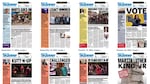
An array of front pages from The Skanner, one of Oregon’s only Black-owned news outlets, that ended operations on Jan. 30, 2026, after 50 years of publication.
Screenshot via Historic Oregon Newspapers / OPB
The Black newspaper The Skanner was founded more than 50 years ago by Bernie and Bobbie Foster. It became something of an institution and community organization for Black communities in Portland. The paper went entirely online in 2020 but continued to play a critical role in the lives of many Black Oregonians. Recently, the Fosters announced the paper had shut down as of Jan. 30. We sit down with former reporters for the paper, writers Donovan Scribes and Bruce Poinsette, along with Margaret Carter, the first Black woman elected to the Oregon Legislature in 1984. We hear about their personal connections to The Skanner and get more details about the paper’s importance to members of the community.

Margaret Carter poses for a portrait at Oregon Public Broadcasting in Portland, Ore., on Feb 19, 2026.
Saskia Hatvany / OPB
Note: The following transcript was transcribed digitally and validated for accuracy, readability and formatting by an OPB volunteer.
Dave Miller: From the Gert Boyle Studio at OPB, this is Think Out Loud. I’m Dave Miller. The Skanner was founded more than 50 years ago by Bernie and Bobbie Foster. Over time, the newspaper became an institution for Black communities in Portland. It went entirely online in 2020, but continued to play a critical role in the lives of many Black Oregonians, but the paper is no more. The Fosters announced that they were shutting it down as of January 30. We’re going to hear three perspectives now on the legacy and the impact of The Skanner. Bruce Poinsette, Donovan Scribes, and Margaret Carter all wrote for the paper. Poinsette and Scribes were reporters. Carter, who was the first Black woman elected to the Oregon State Legislature, wrote a column for the paper. All three of them join me now. It’s great to have all three of you on the show.
Margaret Carter: Thank you.
Bruce Poinsette: Thank you.
Donovan Scribes: Thank you for having us.
Miller: Margaret Carter, before we get to the newspaper itself, can you tell us a little bit about Bernie and Bobbie Foster, who started the paper 51 years ago?
Carter: Yes, it was really an amazing time because there was another Black newspaper here, but Bernie and Bobbie brought a kind of an updated view of things because they went out and started talking with politicians and talking with other community people, they were very community-oriented. Sometimes you liked them and sometimes you didn’t, because they did not stray away from controversy that was going on in the community or with me as an elected official.
Miller: Well, I was curious about that because you weren’t just a member of the community. At a certain point you, as an elected leader, were also someone that I imagine they, as newspaper publishers and editors, wanted to hold to account. So what was that like?
Carter: I’m telling you, sometimes Bernie Foster made me so mad, Dave, because he would get on me about things that you had no control over. When you think about it, I was basically the 61st member of the House of Representatives, and…
Miller: Just to put that in perspective for listeners, when you say that, there were 60 members, but you’re saying you felt like the 61st?
Carter: Yes, because I had to bring culture and thoughts that they never had to think about. And so they came off pretty controversial because of what I brought to that place. Jim Hill was already there as a Black person, but his thoughts were totally different from mine and a lot of that had to do with age and other things in terms of how I saw things.
Miller: So what you’re talking about there is the power you had, the responsibility you had, and what you saw as your role, but it seems like you’re also saying that Bernie Foster, or the Fosters more broadly, they would give you a hard time because they would say, nevertheless, you’re a state lawmaker, this is what we want you to do?
Carter: That’s exactly right. Bernie was very clear about things that he wanted to see happen, because, as you know, he started the Dr. King program that made history. It was so good over the years that he and Bobbie established the Martin Luther King holiday and the Martin Luther King program that they had, but he was especially, I think, hard on me because he wanted me to be successful. There is a difference between just being hard on a person or being hard on a person because you want them successful. So we became friends, and in becoming friends that did not alleviate any criticism or any correction or…
Miller: In other words, he still felt comfortable even as you became friends to hold you to account.
Carter: Hold me accountable.
Miller: But it seems like you respect him for that.
Carter: I did.
Miller: You wouldn’t have wanted something different from a journalist, or am I putting words in your mouth?
Carter: No, you’re not. I wanted to say there were times when we disagreed, but we disagreed to agree, which means that our friendship was always left intact because we separated it from my role as an elected leader. And so that was quite complimentary to me, that he could look at me and still respect me as a leader, but also hold dearly the relationship that we had.
Miller: I should note that we did reach out to the Fosters to see if they would like to come on to the show to talk about the legacy of the paper that they created. They thanked us very kindly for our interest, but they also very politely declined to join us today. Bruce Poinsette, how did you get started at The Skanner?
Poinsette: I was just coming out of the University of Oregon journalism schools, the summer of 2011. I was just looking for an opportunity to kind of get my foot in the news world. So I pitched a story to the editor at the time, Lisa Loving, and I was also blogging and she gave me a shot. I think it was a great opportunity when you’re at a community newspaper to one, be on the ground level, but also you get to meet a lot of people early in their journeys.
One of the things I’m really proud of my time is just being in the right place at the right time to do some of the first profiles on artists like Mike Capes or children’s performers like Nikki Brown Clown or Intisar Abioto’s Black Portlanders Project, and then seeing time after that where it’s like, oh, she’s doing the largest takeover of Black art in the Portland Art Museum with the Black Artists of Oregon exhibit a couple of years ago.
It’s exciting, it’s a fun thing to like look back on and also recognize that when you’re at this place that’s very accessible to the community, it’s right down the street from PCC and Jeff, and people feel comfortable just walking in, pitching you stories and knowing that they may not be able to get to The Oregonian or to these bigger outlets, but they’re gonna get to you.
Miller: Would that literally happen? People would walk in the door and say, hey, you work here right here, I have an idea for you?
Poinsette: Well, I was upstairs, so…
Miller: But there was enough of a sense of, maybe ownership is the wrong word, but comfort that they could come in and pitch things or talk to the folks who are putting the paper together?
Poinsette: Yeah, you just get used to being out everywhere and people know you, so they’re gonna reach out whether it’s walking in, whether it’s shooting you an email. But they know that again, like in this media ecosystem where they’re gonna get a story to you and that might be the first coverage and then it gets picked up by a bigger outlet and then it spreads. Whereas it can be hard to reach a reporter who, oh, I’m on deadline, I need to get like, pump out five stories today or something like that. But with The Skanner, you just had more space to really work and you’re really incentivized to be among the people.
Miller: Donovan, when you think back about the stories that you wrote for The Skanner, what are one or two that stand out now?
Scribes: Yeah, there’s a lot. One that immediately comes to mind is when my cousin had sent me this picture one day, she was in the Tualatin School District and it was the front page of her school’s website. And it had a bunch of derogatory terms that I can’t say on air about Jewish people, Black people, primarily.
Miller: On the actual school’s website?
Scribes: Yes, and so I was like, whoa. And she was like, yes, the people are retweeting this and laughing about it. And I went online and I saw all of these comments and things that people were just having a great time with this image. And so I pitched it to my editor at the time and told her, this feels like a pretty significant story that this happened to Tualatin School District’s website.
And so I reached out, after I got greenlit to move forward with the story, to the school district to ask them about it and then they quickly corrected me and said, well, the school website was not actually hacked, which is important, right? But I was like, OK, the school website was not hacked, but this image is going viral in your student body right now, how are you all addressing it? And they’re like, we don’t really want to talk about this. This is not something that needs to be elevated more. And what I knew, because my cousin was one of the few Black students at that school and we talked a lot about her experiences, that this was not a one-off of racist activities that were happening with a lot of fanfare.
So I was like, this is still a story. So while they encouraged me to not do anything, I continued to charge forth with the story. I talked to the Southern Poverty Law Center about the school’s response to it all, and they’re like, that’s kind of like having a swastika that’s spray painted on the side of your school and saying, well, we just won’t talk about that.
Once I published the story, what ended up happening is there were a number of the few Black parents there that were commenting and saying, I had no idea and we’ve been having issues too at this school. In that story being out, what ended up happening too is that the school ended up putting a statement out on their actual website that they condemn this behavior, da da da, and they’re going to move forward and address it. They pinpointed the students who were responsible for the image and they had their own internal dealing with them, but what they recognize is this is part of a wider problem than just the two students.
So they ended up actually changing their school policies around bullying and online harassment and all of those things and there were some other cultural aspects that I won’t get into, that they ended up standing up. But that was like, I think if I had listened to that first phone call that said, there’s no story here. And so being able to do that.
Another one that stands out to me is, in journalism, I didn’t come from J school. I was also one of those people who got a shot because Lisa and Helen Silvas had seen me out at the Portland Observer where I got my start and then when I left there, they kind of plucked me up and they gave me a shot alongside Bernie and Bobbie. But in journalism, there’s this mantra of objectivity and you’re just a reporter of the truth. And for Black folks, not to sound too Kellyanne Conway-ish, but there is a different relationship to the truth. There’s a different relationship to facts that are often reported as the standard facts.
So inside of that, one of the things that has been a popularized term within media is “gang related.” So a shooting happens, for example, and they say, this was gang related, possibly gang related, not gang related. All of those things get put out there. What a lot of people know is that is a heavily color-coded set of words to put out there in any case, and we know which colors we’re talking about. I remember being, just pitching to my editor, I want to talk to the police department about why they say that. What is their rationale when they put that out into the media to then be parroted by the media?
Miller: How do they decide that they can even say gang related?
Scribes: That part. What I ended up doing a Q&A with the Gresham public information officers, Gresham Police Department PIO, and just kind of asking them, what is your rationale here? And we ping-pong back and forth, back and forth, back and forth, and then it kind of reveals itself through his own words. Like there is no actual rubric here for what this is based around.
I remember when that story got published, so many people in the community just reacting to that and being like, thank you, because it was a thing that is again reported just as a standard truth. Like it was or it wasn’t gang related, but there’s something more in that parroting and there’s a lot of things like that. That was the kind of platform that I had through The Skanner to be able to tell those types of stories.
Miller: Margaret Carter, what do you think The Skanner ended up meaning to Black communities in Portland and outside of Portland? I mean, some of the examples that we’ve just heard, it’s not just simply within the city lines of Portland. We heard about Tualatin, about Gresham, about places further out.
Carter: They’re the most prolific voice that got to many more people than a voice. Like if I was talking to Bruce, was talking to Donovan, was talking, has died. We don’t have – we being the African American community at large – you don’t know what we as a community think anymore because we don’t have The Skanner or replacement at this moment in time. The Skanner has taken away a voice that for 51 years was very prolific, and I’m just delighted to be here with these young people today. Young people, because I’m 90 years old, I can refer to you as being young people and in a loving, grandmotherly kind of way.
Miller: And I think I can speak for the three of us saying that I pray that I’m half as vibrant as you are when I’m 90. Holy moly.
Carter: But I think that voice dying means more to the state as well as for our community, because sometimes people need to hear what this community thinks, and you won’t have that anymore.
Miller: I wonder, so Bruce, how much do you think, in addition to talking about the loss of this one newspaper, are we also talking about the end of the centrality of newspapers in general, in 2026. And if so, what replaces that?
Poinsette: I mean, yeah, it is a thing that even though it’s shocking – well, I shouldn’t say shocking, it’s actually not shocking, just what’s happening with newspapers. I recently, a couple of years ago, did some survey work with Uplift Local that kind of confirmed where a lot of people, they still go to the larger news platforms, TV news, to get information the most, but in terms of trust, there’s just a lack of trust in consumers and it leads people more to individual reporters and media personalities rather than outlets.
More than likely we’re still gonna see the contraction of news, the shuttering of community newspapers, but what you see is a lot of individuals, I mean, I’ll just shout out Donovan next to me, partnering with the Portland Mercury to do a Black changemakers innovators issue. You see people who do have that trust, that standing in the community. And there’s more opportunity to lift that up, to spotlight that work and drive people to that work. And it’s harder, obviously, because there’s just more voices, there’s more options, there’s more noise, frankly.
But there’s still a lot of people at the end of the day doing great work, putting the information out there and it’s just a matter of, I think, the business of it is helping consumers find them. Sort of like that middle person, that curator, that can bring people out to, like, there’s just a lot of, for lack of better terms, amazing Black free agents in the media space in Portland and throughout the state.
As mentioned before, the real importance is not just in, people go to Facebook community groups to talk to each other and learn about community events, but when it comes to getting the information, letting people know outside of these spaces what’s happening and contextualizing and fact checking, there’s always still gonna be demand for that.
Miller: Bruce Poinsette, Donovan Scribes, and Margaret Carter, thanks very much to all three of you.
Scribes: Thank you.
Carter: Thank you.
Miller: Margaret Carter was the first Black woman elected to the Oregon State Legislature. She served in both the state House and the State Senate, former director of community engagement for the Oregon Department of Human Services. Bruce Poinsette is a freelance writer, a former reporter for The Skanner. Donovan Scribes wrote for The Skanner as well. He is now a writer, a producer, an artist, and a communications consultant.
“Think Out Loud®” broadcasts live at noon every day and rebroadcasts at 8 p.m.
If you’d like to comment on any of the topics in this show or suggest a topic of your own, please get in touch with us on Facebook, send an email to thinkoutloud@opb.org, or you can leave a voicemail for us at 503-293-1983.