
Portland Public Schools district headquarters, Portland, Ore., Dec. 15, 2018.
Bradley W. Parks / OPB
Portland Public Schools is under a federal civil rights investigation for moving forward on a voter-approved effort to better support the district’s historically marginalized Black students.
The U.S. Department of Education’s Office for Civil Rights announced this week that it’s looking into allegations of race-based discrimination at PPS. The investigation is specifically tied to a complaint over the district’s effort to create a new learning facility formerly known as the Center for Black Student Excellence.
The complaint, filed by the conservative education advocacy group Defending Education in December, alleges that the PPS initiative violates Title VI of the Civil Rights Act and equal protection granted under the U.S. Constitution through what the group calls “racially discriminatory programming.”
The PPS center targeted in the new investigation is still in its development stages. Programming for district students has yet to be finalized.
A PPS spokesperson said the district cannot comment on the pending investigation.
Related: Coalition calls for immediate action on Portland’s delayed Center for Black Student Excellence
The inquiry is the latest federal examination of Oregon educational institutions for possible civil rights violations.
Title VI is a section of civil rights law that protects students from discrimination based on race, color or national origin. Schools, universities and colleges must comply with the law to be eligible to receive federal funding.
The law was originally developed as a mechanism to dismantle long-standing inequities in U.S. schools. That’s also the goal of the yet-to-open PPS facility.
The district project has already seen its fair share of controversy locally.
In 2020, nearly 75% of Portland voters approved a $1.2 billion bond that included $60 million for a center to support the city’s Black students. But the funds sat unused for years until a coalition of education and community organizations called on the district last summer to make good on its promise to Black students and families.
That pressure helped PPS move forward on the purchase of a building in the Albina district, a historically Black neighborhood in Portland, that would house the center. District board members approved that move in early December, about two weeks before the civil rights complaint was filed.
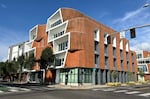
The One North property, located at the corner of North Vancouver Avenue and North Fremont in Portland, Sept. 9, 2025. Portland Public Schools bought the building in December 2025 with the intention of using it as the home of the Center for Black Student Excellence.
Rob Manning / OPB
At the time, the building purchase appeared to breathe new life into the initiative.
“This vote honors a promise our Black community can experience for generations, and it’s long overdue,” PPS Board Vice Chair Michelle DePass said in a Dec. 2 statement from the district. “I am humbled to serve as a steward of this moment, and I want to thank the community whose courage and persistence brought us here.”
DePass declined to comment on the investigation, citing PPS policy. She denied that the still-developing center would discriminate against students.
This new federal inquiry could snuff out the project’s recent momentum. And that could be the intention of the Trump administration.
Education advocates note that the Trump administration has tried multiple strategies to force schools to abandon policies that support diversity, equity and inclusion goals — including federal investigations based on a broad interpretation of the Supreme Court’s 2023 decision to end race-based admissions at colleges.
Just over a year ago the Education Department issued a “Dear Colleague” letter with updated guidance on DEI initiatives at K-12 schools and higher education institutions, directing them to drop such efforts or risk losing federal funding.
Related: Portland Public Schools voters approve $1.2 billion borrowing plan
Some schools reacted by scrambling to update, change or scrub equity policies and programs from their institutions.
But those responses were premature, said Kayleigh Baker, a senior consultant with the education risk management group TNG Consulting. She cited a federal ruling from last month that blocked the directive. The Education Department is not appealing the ruling.
“Those were requirements that schools didn’t need to adhere to,” Baker said. “Those may have been lawful programs that were ended or funds reallocated when we could have continued serving those students.”
PPS has already made a change to the project now under investigation, removing the word “Black” from the center and renaming it the Adair-Grice Center of Excellence. The new name honors two of the district’s prominent Black educators.
Education advocacy groups, like the American Association of University Professors, have accused the Trump administration of misusing and weaponizing federal law to further the administration’s anti-DEI agenda.
Portland State University and the University of Oregon received Title VI investigations notices from the Education Department last year, alleging race-based discrimination. PSU’s case is ongoing. A UO spokesperson said the university signed an agreement to resolve its case last September.
Title VI cases typically take months to investigate and rarely result in federal dollars being revoked from a school district or college. A more likely outcome, Baker said, is a settlement in which schools agree to make policy changes or provide training, while federal authorities maintain funding.
But she warned institutions and districts against censoring equity-related programs that align with institutional missions and state law. Instead, Baker recommends school leaders audit their Title VI policies and procedures.
“The federal law is still the same law that it was five years ago, three years ago and yesterday,” Baker said. “Title VI has not changed. So if schools were complying with the law then, they likely comply with the law now.”