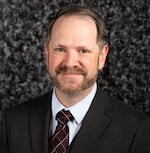
As of February 2026, Ken Sanchagrin is the new head of the Oregon Public Defense Commission. Undated file photo provided by OPDC.
Kelvin_Watkins_Photography
The Oregon public defense system has been in crisis for many years. The number of defendants who need representation has far outstripped the number of available public defenders.
Previous reports found the state’s system violated Oregonians’ constitutional rights. Earlier this month the Oregon Supreme Court ruled unanimously that criminal charges against defendants must be dropped if an attorney cannot be found. Oregon lawmakers have passed legislation aimed at alleviating the crisis.
We sit down with Ken Sanchagrin, the new head of the Oregon Public Defense Commission, to talk about the progress that’s been made in turning the crisis around and the future of the system.
Note: The following transcript was transcribed digitally and validated for accuracy, readability and formatting by an OPB volunteer.
Dave Miller: This is Think Out Loud on OPB. I’m Dave Miller. We start this week with an update on Oregon’s ongoing public defender system crisis. Earlier this month, the Oregon Supreme Court ruled unanimously that defendants accused of a crime who do not have access to an attorney within a certain window must have their cases dismissed. The Oregon Judicial Department estimated the ruling could lead to the dismissal of 1,400 cases across the state. More than 600 have already been dismissed in Multnomah County alone. Meanwhile, on Friday in a separate case, a judge in Clackamas County ruled that attorneys at two nonprofit public defense organizations do not need to take cases that would stretch them beyond their capacity. Ken Sanchagrin has been the interim executive director of the Oregon Public Defense Commission since last April. He was appointed the official head of the agency by the governor last month, and he joins us now. It’s great to have you back on the show.
Ken Sanchagrin: Thank you, Dave.
Miller: I want to start with this recent Oregon Supreme Court ruling. Can you give us the basics of the timelines that judges and prosecutors and defense attorneys and the accused, that they all now have to reckon with?
Sanchagrin: Sure, and there is some devil in the details that still needs to be worked out, but in the most basic sense, if an individual who has been charged with a misdemeanor is unrepresented for 60 consecutive days then that would lead to a dismissal without prejudice. It would be 90 consecutive days for an individual charged with a felony.
Miller: And is the idea that if there are people in the system who already have been dealing with that time period already, whether it was for a misdemeanor or a felony, that they automatically have to be released? Or is it sort of going forward? What did the judge rule in terms of people who’ve already been past those time periods?
Sanchagrin: I would clarify, for the idea of there being a release, real briefly, most of these folks are out of custody. And I know that there’s been a lot of worry about folks actually being released from being in pretrial detention or something like that. But that’s a very small percentage of the folks we’re talking about.
Miller: Because most people don’t actually spend time in a lockup, pretrial.
Sanchagrin: They may initially, but folks may be able to be released on bail, or they may be released after a release hearing on their own recognizance or with certain monitoring conditions. That’s pretty standard.
Miller: OK, that’s helpful. So in terms of my language, we’re talking here about charges being dropped, in general, as opposed to people who had been locked up in a county lockup being released.
Sanchagrin: That’s correct. Yes.
Miller: But to go back to that question, is the idea that people who were already past that period, their charges will be dropped, or is it going forward?
Sanchagrin: Well, that would apply to folks who are currently on the unrepresented list right now, and the figure that you cited just a few minutes ago, about upwards of 1,400 folks being affected. Those are the folks who, as of February 5, would have already been past either the 60 or 90-day deadline. That number certainly has changed since that date, both because some of the cases have been dismissed, but then too, as time goes on, some other folks will have fallen into that bucket.
But the entire idea is based on this notion that those folks, their case may be affected by this time without an attorney. Investigation hasn’t happened, interviews with witnesses and case prep hasn’t happened, so there might be prejudice for those individuals charged with crimes attached to it. So the only remedy the court felt that they could really craft was this idea of dismissal – but again, it’s without prejudice so the prosecutor could bring charges back in many of those cases.
Miller: I do want to hear more about what that would take. Were you surprised by any aspect of this ruling?
Sanchagrin: I think that we all expected there to be a timeline, if the justices found in favor of the case, that there’d be timelines put on. I think that nobody really knew what those timelines would look like, and the fact that they would be separate between misdemeanors and felonies, so if there was a surprising aspect, it was probably just the real specifics there.
Miller: As I noted briefly in my intro, Multnomah County alone is going to release more than 600 defendants, according to legislative testimony that District Attorney Nathan Vasquez gave last Thursday to lawmakers. He said this: “We talk about these in terms of misdemeanors and felonies, but the reality for victims is these are real incidents. These are assaults, an individual with a broken nose, someone’s home broken into, a business door kicked in. These have real world effects on Oregonians.” What do you see as the real-world effects of this ruling?
Sanchagrin: I guess from my vantage point, the real-world effects that I’m focused on are more the logistical issues that we have to go through to make sure that we can address the crisis. Because what you described is exactly correct. Each of these cases represents a victim. It represents something, a wrong that has occurred. But then it also represents, when you have an unrepresented crisis or when you have an individual who’s been unrepresented for a period of time, as the court has found, prejudice against that defendant as well.
What we really see, our role at OPDC, is trying to meet that moment of making sure that wherever we can we find representation within those guidelines moving forward. That’s not something we’ve been able to do effectively over the past several years. We’ve been getting a lot better at it, but that’s really the real-world effect for me, sitting behind my desk, is making sure that, because of all of those impacted parties and impacted individuals, we’re actually able to try to solve that issue.
Miller: You said that, because these are going to be released without prejudice, these cases, these felony cases could be brought again. What would it take for someone whose felony case was dismissed to be charged again?
Sanchagrin: Well, there are certainly some challenges there.
Miller: For some of the same reasons on the flip side though, that you were saying that the time makes it hard on the defense side, are those same time pressures a challenge for prosecutors?
Sanchagrin: Yeah, it certainly could. Witnesses may move away, evidence may be lost or deteriorate. There’s all kinds of things that could impact the other side as well.
Miller: Because you can’t just take the original charging documents and change the date and bring them back.
Sanchagrin: You may be able to, but in the felony cases, somebody could be brought back into the system, and they could be arraigned on the information, which just means they’re arraigned on those allegations. But there needs to be a grand jury process or a preliminary exam, although most cases have a grand jury process. So that’s where a case being a little bit older could be more of a challenge and that could be a barrier, certainly, to refiling from a strategic standpoint, I would think.
Miller: I want to take a step back. I mentioned in my intro that this has been a years-long public defense crisis. How did we get here?
Sanchagrin: It’s come through several stages, but certainly it’s been an issue that’s been around for several years. I think that really the genesis of it was in moving from a tried and true yet problematic system that operated within public defense for many, many years; that after some folks came in and evaluated our system from the Sixth Amendment Center, it was found that the approach that the state was taking was not really serving the rights of defendants very well. Public defenders were motivated to just take as many cases as they could, irrespective of maybe the quality, in many cases, that was being delivered.
And so there was a change in the contracting approach. We’ve tried our best over time to lower caseloads to be more consistent with what folks should be able to take, as far as the public defenders are concerned, but then that can cause moments of crisis where the work is not necessarily getting done.
I think a good illustration from a contracting standpoint, in some ways it’s very boring, but at one point when new caseload standards were passed, nobody thought about what would happen as those cases were taken and as lawyers reached their capacity. So at one point we had many of our providers several years ago reach their capacity only partway through the contract period. And then you saw a huge uptick in the number of unrepresented folks because we didn’t have any more capacity. It had already been used.
Miller: When you say nobody thought of this, there weren’t public defenders who were saying in advance, “Wait, this is something you should think about?”
Sanchagrin: It’s before my time and so I don’t know the exact conversations that were happening at the time. But I think that a lot of times when you’re moving quickly and trying to create a new system, you may make assumptions as to how people are going to take cases. And I think under the old system, especially, there wasn’t much thought into how you dole out cases within a jurisdiction.
Now we have to be really careful because we do want to make sure that folks are taking the right amount of cases at the right time. I’d like lawyers to be able to focus on providing services to their clients as opposed to being bean counters. And that’s something that I think the agency didn’t quite see at the time, but then we’ve certainly come into that being the routine now, trying to make sure that things are balanced, in a sense.
Miller: In a joint statement after the state Supreme Court ruling I mentioned earlier, the DAs of Multnomah and Washington Counties – Nathan Vasquez and Kevin Barton – wrote this: “Excuses claiming too little money, too few attorneys, or too many criminal cases, do not hold up.” Do you agree? Do you agree that this is not a question of state resources, or the number of attorneys?
Sanchagrin: I guess I would say that I agree in part and disagree in part. I think that there are certainly jurisdictions where more attorneys are needed, and I think that there are very valid questions that we’re talking through right now about what are the appropriate caseloads for those public defenders, to make sure that they can provide constitutionally adequate representation for folks.
But I do think that some of the complaints that we’ve heard over the years about funding – you know, the legislature’s been very generous in the amount of funding that is provided to the agency; and one thing that I’ve looked at a lot since I’ve come into the agency is not so much the amount of funding, but where is that funding dedicated and is it at the most efficient spot?
And so I think that while I would agree in part, I disagree in part as well. I think that we can get to a workable solution, but it definitely takes a lot of tinkering under the hood, which is what I’ve been trying to do internally at the agency.
Miller: Where do you think money may have been if not poorly spent, where do you think money has gone in the past, that could be better spent in other ways?
Sanchagrin: I think that one thing you could point to is, there’s a request that we have in front of the legislature now for some additional trial team attorneys, and the proposal that we’ve put out would be to shift some money from our hourly attorney program, which funds external hourly attorneys, into hiring some folks.
What we’ve been able to see, at least through some analyses internally, is that whether you devoted that to more lawyers at OPDC or to our providers, essentially to have somebody who’s full time working on these cases can be a more efficient usage than to fund attorneys to take those cases hourly, for example.
Miller: Why is that, do you think?
Sanchagrin: Most of it is merely because, when you have somebody who is on an hourly case, there’s very little to determine how much time is taken on that case, whereas when you have a full-time employee, it’s a little bit easier to oversee that work.
I do want to be clear though, that hourly cases are something that’s really an important part of the system, especially when we have conflicts, and for sometimes cases that are particularly complex – so what I’m talking about is more maybe like that misdemeanor level, or low felony level, that it might be more efficient to have full-time individuals take those cases.
Miller: Lawmakers have put more money towards the public defense system. My understanding is something like a 15% increase last year. What difference has that made?
Sanchagrin: I think it has given us a lot of flexibility and the ability to really respond to the crisis. In most of the crisis counties that we have been monitoring since I arrived, we’ve been able to increase the number of attorneys within those jurisdictions, both through additions to the trial team, but then also additions to providers. It also allowed us to have the flexibility, we’ve created a program that allows attorneys who are sufficiently experienced and meet other criteria, to go over the maximum caseload limit that we’ve sent by up to 15%, to provide additional capacity in those crisis jurisdictions as well. Having that funding is really important to getting those programs off the ground.
They’ve also continued to fund a program that is at law schools, to make sure that we are trying to build a pipeline from our local law schools up into public defense. So when you think about the legislative investments that are being made, they’re going toward, I think, what we see as some of these essential programs to address the issues that we have. We have a high turnover rate. We do have concerns about getting people into the profession and keeping them there. So whether it’s at that front end, or whether it’s at the end of actually getting the cases handled, that’s what the funding has really given us the ability to do.
Miller: With the improvements you’re talking about, how would you characterize the system right now?
Sanchagrin: Some days when I come into work, I like to say that we’re halfway there. We may not be exactly halfway there. Roberts certainly makes that a bit more complex than it was before.
Miller: The case we were just talking about.
Sanchagrin:Yes, the most recent Supreme Court case. Immediately before the release of that case, I’d say that we were down around 37% year-over-year, in the number of unrepresented individuals. After Roberts was released, we were already 49% down, but that’s maybe partially artificial, because we’ve already talked about the issues with, you know, Robert’s dismissals could be brought back, and that adds a level of complexity we hadn’t faced before. So maybe my mantra of, “We’re halfway there,” isn’t quite correct now that we have a little bit of a hiccup that we have to figure out how to address.
Miller: So the percentage there is one way to think about this. The other is a date or a year when you think everybody who’s accused of a crime in Oregon has ready access to representation, regardless of their ability to pay. Do you have a day that you can tell us?
Sanchagrin: I’ve tried my best to be as non-committal as possible on dates, but I think we can make really, serious progress by the end of this year.
Miller: Why do you not want to give a date?
Sanchagrin: Maybe it’s the empirical kind of approach that just drives my thinking, is that anytime you put a date on it, then whether you’re a day early or a day late, to me, that still is effectively doing the same job. But then it usually turns into more of a thing, for lack of a better way to describe it.
Miller: I understand, but it also gives the possibility of accountability in a very specific way, and a goal to work towards.
Sanchagrin: Right, when I released, well, in the response that we had at OPDC to the governor, our initial goal was to look at where we stood in 12 months. And so we call it our 12-month plan. That would be looking from May to May. I think by this May we’ll be making significant progress. I don’t think that we’ll be able to kick the ball through the goalposts in that period of time, but that’s where, like I said, with the complications that come with Roberts, I think that looking toward the end of the year maybe is our new goal, if we’re trying to set something that’s a little bit amorphous.
But more than just saying it’s coming, I think we can make really good progress there, but it’s something that, especially once I came in, you realize the complexities of the system, it’s a little bit difficult. And I think, too, we have to define what it really means to say the crisis is over. There are always going to be some folks who at least go through a relatively short period of being unrepresented, and I mentioned conflict cases, for example. That’s where you might have all of the attorneys within a jurisdiction maybe have a connection to a defendant in the past.
That means that you have to find somebody either out of county or from a totally different area to take that case. So I think it depends on even, what do we count as being zero in a sense; and does that mean we go back to, in the pre-crisis days of the system, what was a reasonable number of folks there, or is it truly zero? I think there’s a little bit of questions there too.
Miller: I want to turn to a more recent development, I mentioned this briefly in my intro. Last week, two public defense agencies argued that their caseload requirements are so large that they’re not able to provide adequate counsel to their clients, violating the Sixth Amendment rights of Oregonians who are accused of crimes, and a Clackamas County judge has agreed. What’s that going to mean?
Sanchagrin: I’ll just note that I think that both OPDC and the plaintiffs may be appealing different aspects of that case, and I’d keep my thoughts brief, but the main takeaway from the case on Friday was that the preliminary injunction that had been filed was made permanent going forward. We were already operating under this notion that, at least with the first plaintiff, we weren’t able to do anything to require them to go above and beyond what they thought their ethical capacity was.
And so, on some level it’s a continuation of what we had before. But I think that, really, the biggest question that comes out of this case, and a lot of this was litigated during the trial over the past few days, is, how do we adequately define what that ethical level is? I think that if there’s a challenge going forward for us at OPDC, even thinking more broadly, even beyond those two entities, is, how do we all as a community try to define what that ethical number of cases is to take?
Because we have, right now under our system, the maximum attorney caseload standard that’s certainly much higher than what the plaintiffs were arguing for in their pleadings and the evidence that they offered. But then, too, we have the sticky situation of, if we were to move to some of the national standards that the plaintiff was advocating for, we talked about funding and everything else, that would be something that, from a funding perspective, I know that we could not at OPDC support at this period. We just wouldn’t have the funding to do so. And so, there’s certainly some challenges there too.
Miller: Why did you want this job?
Sanchagrin: Well, you know, I’ve sat on the periphery of these discussions for several years. There were some work groups that were put together while I was director at CJC. I was often brought in just from a data perspective to help provide support to those work groups. Sitting on the periphery and seeing that this issue has gone on and on, and even with different reforms has not gotten fixed, when the governor’s office reached out to me to see if I’d be willing to come over and try to fix it, I really felt that motivation of public service.
And if nobody else has been able to do it, it wasn’t that I felt that I would be the only one who could, but I thought I could give it the best try that I could. I really wanted to see the system get fixed as well as possible, so it was really just that type of motivation that led me here. Certainly, if you’d asked me 10 months ago if I’d be sitting in this position, I would have called you crazy.
Miller: Ken Sanchagrin, thanks very much.
Sanchagrin: Thank you.
Miller: Ken Sanchagrin is the executive director of the Oregon Public Defense Commission.
“Think Out Loud®” broadcasts live at noon every day and rebroadcasts at 8 p.m.
If you’d like to comment on any of the topics in this show or suggest a topic of your own, please get in touch with us on Facebook, send an email to thinkoutloud@opb.org, or you can leave a voicemail for us at 503-293-1983.