The Oregon State Capitol building in Salem, Ore., photographed on Feb. 25, 2026 during the short legislative session.
Julie Sabatier / OPB
Oregon lawmakers approved a campaign finance bill on Thursday that critics fear will allow the politically powerful to continue flooding elections with cash.
House Bill 4018 passed through both chambers of the Oregon Legislature, all while some lawmakers acknowledged in floor testimony that the bill was highly complicated, flawed and required more work.
“I do not want to vote yes,” said Sen. Lew Frederick, D-Portland, who added: “But the alternative of doing nothing is much worse. That is not the position I want to be in, but it is the reality of where we are.”
Frederick’s sentiment was shared by more than a few lawmakers who voted in support of the bill, which seeks to stand up a law passed in 2024 that set contribution limits for unions, businesses, candidates and more, which are set to go into effect next year. For years, Oregon has not capped political giving.
The bill has become one of this session’s most contentious. Good government groups say they were not consulted as it was crafted with the help of big spenders who have long held sway in Oregon politics. Proponents — including unions, business groups and leaders of both parties — say the bill takes Oregon one step closer to fulfilling voters’ demands of changing the campaign finance system.
“Oregonians want and deserve fair elections where the voices of everyday people are not drowned out by wealthy and powerful interests making unlimited political contributions,” said House Majority Leader Ben Bowman, who disputed many critiques of the bill.
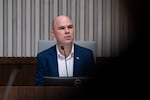
Rep. Benjamin Bowman (D-Tigard) speaks to reporters at a legislative preview on Wednesday, Jan. 28, 2026 in Salem, Ore.
Saskia Hatvany / OPB
The bill comes two years after lawmakers passed a historic campaign finance law in the 2024 short legislative session. Ever since, state leaders have acknowledged that the law needed extensive work. Without revisions, both lawmakers and other state officials warned the state is barreling toward a botched implementation, potentially placing the integrity of Oregon’s elections at risk.
“The result could be a campaign finance framework so complex that only candidates and donors with access to legal counsel or seasoned campaign teams will be able to safely participate,” Bowman said. “The bill before us provides clarity for those ambiguities and eases those structural challenges.”
The Oregon Secretary of State’s office, which manages the state’s elections, said it needed more time and money to build up a required system to track spending. The bill allocates more than $1.5 million in general fund money to do that. Secretary of State Tobias Read supports it.
Proponents characterize it as a “technical fix” bill that aims to address a dizzying array of definitions while keeping promised limits on donations by businesses, political committees, interest groups, labor unions and other citizens in place by 2027. The bill would also push back the start date for a donation tracking system from 2028 to 2032.
“There are a lot of details to figure out,” House Minority Leader Lucetta Elmer, a Republican from McMinnville, said Thursday in testimony supporting the bill. “So with that being said, we’re moving forward in good faith, knowing that we’ll also be coming back next year to make sure that those details and those kinks are all worked out.”
But advocates like Honest Elections Oregon and the League of Women Voters are crying foul, pointing to a number of changes they believe will allow excessive political giving to remain unchecked. These advocates have warned they will seek to refer new campaign finance regulations to Oregonians’ ballots in 2028, as they did before dropping the effort when lawmakers reached a deal in 2024.

Rep. Lucetta Elmer (R-McMinnville) pictured in a pre-session media briefing in 2026.
Saskia Hatvany / OPB
“The big money groups want loopholes, and that’s what these are,” said Dan Meek, a longtime campaign finance expert and vocal critic of the bill, who decried the bill as “a complete betrayal, and extremely dishonest.”
In a letter to a state senator this week, the Campaign Legal Center, a Washington D.C.-based nonprofit focused on fair elections, said at least two of the bill’s provisions “stand out for their effect of substantively weakening Oregon campaign finance law.”
One change would allow donors to create multiple entities to contribute to a candidate, so long as their creation was not for the “sole purpose” of skirting the limits. While critics expect big spenders to abuse that change and others, proponents argue that’s unlikely to happen.
Critics also argue the bill removes a provision in the law that clarifies that a coordinated expenditure is a contribution, raising concerns that this would allow for unlimited spending. Proponents dispute that.
“We’re relying mostly on what the most powerful organizations in the current finance system — those with the least interest in significant reform – are telling us,” said Sen. Jeff Golden, D-Ashland, who opposed the bill. “Colleagues, I do not understand why we’d repeat the same frenzied process that got us into this mess. We don’t have to.”
The back-and-forth had lawmakers openly acknowledging the bill’s flaws prior to chamber votes Thursday. Rep. Paul Evans, D-Monmouth, said: “Nobody on this floor today loves this bill.”
But Evans and other lawmakers said they needed to cast yes votes to prevent a disastrous rollout. Senate Minority Leader Bruce Starr, R-Dundee, said in testimony supporting the bill: “If we don’t pass this bill, the law from two years ago stands, and the secretary of state will attempt to implement current existing law. I would suggest that that is near impossible.”
“We have work to do,” Starr said. “This isn’t the end of the conversation.”
The bill awaits Gov. Tina Kotek’s signature.