A federal judge has ruled that the Bonneville Power Administration intentionally destroyed evidence that could have tied it to a 2020 wildfire, in a lawsuit brought by more than 200 people and businesses affected by that fire.
The Holiday Farm Fire burned about 173,000 acres in Lane and Linn counties, destroyed more than 500 homes and killed one person. It was among a dozen fires that burned across the state over the 2020 Labor Day weekend.
The judge’s order reprimands Bonneville, a federal agency that supplies about a third of the electricity in the Pacific Northwest, for destroying evidence, skirting attorneys’ questions and not providing key records.
It’s a significant blow against Bonneville, one of three utilities accused of failing to maintain electrical equipment that may have sparked the Holiday Farm Fire.
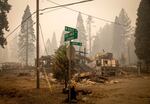
Street signs stand in front of buildings destroyed in the Holiday Farm Fire in Blue River, Ore., in this 2020 file photo. Almost 200 people have sued three electric utilities, including the Bonneville Power Administration, accusing them of failing to maintain their equipment.
Andy Nelson / Register-Guard/Pool
U.S. District Judge Mustafa Kasubhai’s order — issued late last month and first reported by Lookout Eugene-Springfield — requires Bonneville to pay plaintiffs’ attorneys’ fees associated with this particular motion in the lawsuit. It also includes sanctions that will affect Bonneville when the case goes to trial, which will allow the judge to infer that the evidence Bonneville destroyed likely made the agency look bad.
Bonneville officials declined a request for comment.
In his order, Kasubhai wrote that Bonneville crews moved multiple trees, including two that had fallen across power lines, even though wildfire investigators had asked the agency to stay out of the area until those investigators could document evidence.
Bonneville had warned its crews: “There is a significant liability concern for BPA if any of our actions or equipment can be associated with the cause of any of these devastating fires.”
But when U.S. Forest Service investigators arrived, they found trees that had once been lying across power lines had been moved. They also found tracks from heavy machinery.
“BPA willfully spoiled evidence because it moved trees of interest and allowed its contractors to materially disturb the ignition site without preserving evidence it knew it should, and could, preserve in reasonable anticipation of litigation,” Kasubhai wrote.
Bonneville also failed to cooperate with the lawsuit’s discovery process, according to Kasubhai’s order. When opposing attorneys requested records, Bonneville provided 16,000 that included invoices for hand wipes and hand sanitizer, but it omitted some of the documents they had requested.
Bonneville also failed to tell its contractors to preserve electronic records. Those crews have deleted records associated with the work they did at the ignition site.
Bonneville didn’t explain why it didn’t tell its contractors to preserve this evidence.
“Its complete failure to offer any explanation, and its general recalcitrance in complying with this Court’s discovery management orders, taken as whole, lead the Court to conclude BPA’s conduct is in bad faith and the spoliation of critical evidence is willful,” Kasubhai wrote.
Then, when attorneys for the people and businesses affected by the fire brought a Bonneville representative in for questioning, she couldn’t answer even basic questions about Bonneville’s recordkeeping policies.
Kasubhai reprimanded Boneville for not preparing its witness to answer questions on topics approved by the court, calling this failure “abuse of the judicial process,” and adding, “this Court will not tolerate such insolence.”
This lawsuit initially involved just two smaller, nonprofit electric utilities: the Eugene Water Electric Board and Lane County Cooperative. Lawyers for the people suing over the fire alleged the utilities failed to adequately maintain their equipment.
As that lawsuit progressed, those attorneys found evidence suggesting Bonneville’s equipment also could have sparked the wildfire. They roped Bonneville into the suit and moved it to federal court.
Since a federal agency is involved, this lawsuit won’t end with a jury trial. Instead, Kasubhai will ultimately decide if the three electrical utilities need to pay damages associated with the fire.