If you grew up in the United States, chances are the folk stories you read in school featured mostly white heroes, like Johnny Appleseed and Paul Bunyan. But what if you had grown up with a folk tale featuring an Asian character — a perfect hybrid of man and myth, a farmer with a larger-than-life presence?
Enter Ah Bing, a horticulturalist who immigrated to Milwaukie, Oregon, from China around 1855. About 20 years later, a dark, cross-bred cherry was named after him by his employer, Seth Lewelling, giving rise to the famous Bing cherry.

A page from the new children's picture book "Bing's Cherries" by author Livia Blackburne and illustrator Julia Kuo. The story reimagines the life of Chinese horticulturist Ah Bing into a classic American tall tale.
Courtesy of Random House Children’s Books
According to accounts from the Lewelling family, Ah Bing had a Manchurian cultural background and stood 6 feet 2 inches tall, distinguishing him from many other Chinese immigrants at the time, most of whom came from southern China.
Like many Chinese immigrants of that era, Ah Bing faced racism in this country, especially after the Chinese Exclusion Act was adopted in 1882. Lewelling family accounts say that after he traveled back to China to visit his family in 1889, he was barred from re-entering the United States.
In addition to being honored each year at the “Bing in the New Year” celebration in Milwaukie, Ah Bing has recently become the subject of a children’s book called “Bing’s Cherries,” written by Los Angeles–based Livia Blackburne and illustrated by Seattle–based Julia Kuo. This is their second collaboration, following “I Dream of Popo” published in 2021.
Blackburne and Kuo, both Taiwanese American, spoke with “All Things Considered” host Crystal Ligori about why they placed a Chinese immigrant figure within the tradition of classic American tall tales, why they believe AAPI representation matters in children’s literature and what that representation means for their own careers.
The following transcript has been edited for clarity and length.
Crystal Ligori: Your book, “Bing’s Cherries,” unfolds through a conversation between a father and his daughter. Ah Bing, as we know, was a real person just like John Chapman, who’s better known as Johnny Appleseed. But in this story, Ah Bing has kind of a larger-than-life feeling of Paul Bunyan. Can you talk about the decision to tell this story as folklore?
Julia Kuo: I was reading Erika Lee’s book, “The Making of Asian America, A History,” and it had a paragraph that said that there were two Chinese people in agriculture who helped to transform the industry. There was a single line on him and it went, “One was Ah Bing who bred the famous Bing cherry in Oregon.” I looked him up. I initially read that Ah Bing was over 7 feet tall and was noted as singing this sad mournful song, and it just sounded like the perfect ingredients for a folk hero.
Ligori: Is there a connection for either of you between Chinese mythology and American folklore?
Livia Blackburne: I feel like legends and myths have a unique power in shaping identity and purpose for groups of people. So, when we were growing up, we heard Chinese legends at home and American folktales at school. What was missing was something that brought the two cultures together, which is what we wanted to create with Bing.
When we started shopping the story to publishers, one Chinese American editor told us that she’d never felt more American than when she read [“Bing’s Cherries”]. And to me, that’s the best compliment she could have given us.
Ligori: Do either of you draw from your own lives or your family’s stories while working on “Bing’s cherries”? How did those personal experiences shape the book?
Kuo: As an illustrator, I draw on different styles for different books — it’s kinda part of the job — and I often consciously decide that my illustrations are going to look a certain way, whether they’re more academic or more naive, more Asian or more western, whatever the story needs.
The illustrations for “Bing’s Cheries” needed to be simple in a charming way, but also Asian American. And there’s this beautiful moment where I realized that I can just draw how I draw naturally. I myself am already a product of these two cultures, and so what is more Asian American than the art I intuitively make? So it was this wonderful moment where I could just let myself produce art without trying to move it in any particular other direction.
Blackburne: Definitely my memories about eating cherries growing up went into the writing of the story. As I went through writing it, it just made me more proud of my heritage and more proud to be Chinese American.
Because my own family immigrated in the late 20th century, I tend to think about Chinese immigration in recent terms, but Ah Bing reminded me that Chinese immigrants have been woven into the fabric of our country for a much longer time and have been contributing to it.
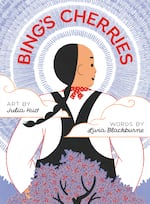
"Bing's Cherries" is a new children's book from author Livia Blackburne and illustrator Julia Kuo which reimagines the life of Chinese horticulturalist Ah Bing into a classic American tall tale.
Courtesy of Random House Children’s Books
Ligori: Livia, I know that you started out your career with a Ph.D. in neuroscience from MIT then became a fantasy fiction writer, and it’s more in recent years that you’ve been focusing on telling AAPI stories. What led you in that direction?
Blackburne: The main thing leading me into that direction has been having kids. Once I started having a family, had my own daughter, I started thinking more about family and roots and where we come from, the people who came before us and how to pass on that heritage to the next generation. And that has been a big inspiration for me.
Ligori: Julia, you’ve illustrated for lots of different outlets like The New York Times and The Economist, as well as for fiction pieces like “Bing’s Cherries,” and a lot of your work does explore Asian politics and AAPI experience. How does it feel to create work that reflects your own community compared to work aimed at a broader, frankly whiter, audience?
Kuo: These two different types of work were something I had to reconcile for editorial illustrations. It can be an article about travel, something that has nothing to do with Asian American identity, but I’m also making these books that speak directly to my community.
I remember that once when I was doing editorial years ago, having to draw what I consider a default character; it was just a person and I drew that person with blonde hair and blue eyes. I later questioned: Why does that person look like that? Why can my default character look like me or my family? It’s been really fulfilling to tackle these questions and these identities through various different stories and ways of relating to them.
Ligori: “Bing’s Cherries” is a children’s storybook, but within it are real depictions of racism and potential violence during an era of U.S. history that included the Chinese Exclusion Act. How did you think about including this information in a way that was child-friendly?
Blackburne: That’s always a balancing act, and it comes down to getting to the heart of the matter without getting too graphic. I think children are able to understand things like exclusion and prejudice and hate, because even from the time we’re in elementary school and growing up, they have their own experiences of these things. So being able to relay it in a way that they can understand, but not making the details so sharp and graphic would be unhealthy for them.
Related: ‘Bing in the New Year’ with Milwaukie’s Bing cherry, and the Chinese American history behind it
Ligori: Your book is coming out at a time when immigration and diversity policies are under a lot of intense debate. Given Ah Bing leaving the U.S. just years after the Chinese Exclusion Act became law and his decision to not return to the States, what do you guys hope readers will take away from the book in today’s climate?
Kuo: I really hope that this book challenges what gets to be remembered as a part of American history and what doesn’t. Reading American folk tales as a child often made me feel like an outsider, so I hope this book can help immigrant children to feel as American as they truly are. We need these stories that educate us and celebrate how American culture has been built and shaped by immigrants often in these larger-than-life ways.
Blackburne: I hope people come away from the story with a reminder that we are a country of immigrants and there is beauty in that. In the story, Ah Bing, as an immigrant, worked with the orchard owner, Seth, to create something truly delicious, and that has enriched many people’s lives. Our country has had our share of strife regarding how immigrants are viewed and treated, and I hope that this book will inspire readers to accept and celebrate people of all backgrounds and origins.
“Bing’s Cherries” is out March 10, 2026. Illustrator Julia Kuo will host an all-ages reading of the picture book at the Ledding Library in Milwaukie, Oregon, in May.
This story was written, with its transcript edited, by Winston Szeto