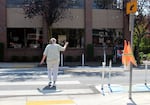
A pedestrian waves to oncoming traffic while crossing Northeast Fremont Street, Sept. 1, 2025. Pedestrian safety flags have been attached to several crosswalks, like this one, to alert drivers when people are crossing.
Riley Martinez / OPB
The city of Hoboken, New Jersey, has had no traffic deaths for nine years straight. This streak is no fluke. It’s the result of focused efforts by the city’s planners and concerted leadership from elected representatives.
Portland and other cities in Oregon are making some progress in their efforts to reduce these same kinds of deaths, which transportation planners like Lake McTighe say are largely preventable.
McTighe is the principle transportation planner for Portland’s regional government, Metro. She also manages the Safe Streets for All program, which aims to reduce deaths and serious injuries from traffic crashes.
We sit down with McTighe to hear about the best practices that Hoboken and some other cities in the U.S. and other countries have used to eliminate traffic deaths — and get an update on the region’s progress toward that goal.
Note: The following transcript was transcribed digitally and validated for accuracy, readability and formatting by an OPB volunteer.
Dave Miller: This is Think Out Loud on OPB, I’m Dave Miller. Hoboken, New Jersey has had no traffic deaths for nine years straight. That streak is no fluke. It is the result of focused efforts by the city’s planners and leaders. Hoboken’s counterparts in the Portland area are paying attention. I’m joined now by one of them. Lake McTighe is a principal transportation planner at Metro and the head of its Safe Streets for All program. It’s great to have you on the show.
Lake McTighe: Happy to be here.
Miller: So let’s start with Hoboken. What are they doing right?
McTighe: They are doing everything right. They are focusing on safe speeds, they have a 20 mile-per-hour speed limit in the entire city, which is a survivable speed.
Miller: When you say the entire city, the first thing that came to mind is, Portland did that too, and then I realized right outside our windows here is a street in the city, Macadam, that is also a state highway, and that’s not 20. So it’s everywhere in the city of Hoboken, you can’t go over 20 miles an hour?
McTighe: That’s my understanding, yes, and Portland is moving in that direction. They’ve been very proactively reducing speeds on city streets, but Hoboken is two square miles. Portland is 145 square miles, 620,000 people vs 60,000 people. Different contexts.
Miller: And that’s just Portland, and you’re from Metro, so it’s way bigger than just Portland.
McTighe: Yes, I work for the Metropolitan Planning Organization, so for the three-county metro area.
Miller: Every piece of this is important and interesting, but you started with speed. So, reducing speed, what are the other big components?
McTighe: They also are focusing on high-injury segments of streets. So it’s a data-driven approach, and we do that here as well. But they are looking at, where are the highest number of injuries occurring? And then addressing those. They found intersections, and that is true. Here in this region, 50% of all crashes and 50% of serious crashes are at intersections.
And so they focused on intersections, making them safer for people walking. They really focused on vulnerable users. So, if you make it safe for people walking, safe for people biking, you make it safe for everyone. That’s a very important approach. They’re also really involving the community, making sure that people are understanding traffic safety, and what works. They have a Vision Zero plan and a Vision Zero target. So yeah, I think they’re really doing the right things.
Miller: You didn’t mention public transit usage. For people who aren’t familiar with Hoboken, it’s essentially a bedroom community of New York City, and way, way denser than Portland, I think eight times more dense than one of the most densely populated parts of Oregon – Portland, but what role does public transit usage play in reducing traffic injuries and traffic fatalities?
McTighe: I’d say transit is one of our number one safety strategies. When you see dense urban areas that have high transit use, they almost always have a very low traffic death rate per 100,000 people per capita. So if you can increase transit, you’re going to have a safer city overall.
And yeah, Hoboken is extremely dense. They are well served by transit, and New York City, Boston – they have very low traffic death rates. And so does Portland. We have one of the lowest traffic death rates in the country in this region.
Miller: It’s striking to hear that, because those rates have also been on the rise, and each one is a tragedy for somebody or somebodies, and it seems high. So to hear that we’re actually lower than the national average, to me that says maybe more about how bad we are as a country than how good we are in the region, or is that not a fair way to put it?
McTighe: I think that is a fair way to put it. Really one of the important things about Vision Zero is that no traffic death or serious injury is acceptable. So we focus on the numbers, not just the rates. And any one person dying, we don’t want that to happen. So, yes, other places, for example, Oslo, Norway – same size, or a little bit bigger than the city of Portland – had only one traffic death in 2019, and no bike and pedestrian deaths. So it is achievable. You can get there, but the context here is very different.
Miller: What are proven ways to keep people away from vehicles or keep vehicles away from people, to separate them?
McTighe: Separating people in time and space. A very effective intervention is called a leading pedestrian interval. You just turn on the walk sign a little bit sooner so that people can get out into the intersection and be visible to cars, drivers that are turning.
Miller: Does that work as well in places where you can turn right on red?
McTighe: Yes, it does. Ideally, you would limit right on red, and Portland is doing that as well. That’s also a really good safety intervention, other cities in the region are doing it. But just getting any kind of lead time for pedestrians really helps. Making intersections smaller with curb extensions. You can do that with a quick build by painting the curb out and putting up lawns or with concrete. Adding medians, huge safety countermeasure.
Miller: In what way? What does a median do?
McTighe: It’s good for both people that are driving, it separates, reduces head on crashes, for example, reduces turning crashes, and then it also gives people that are crossing the street, walking and biking, a place of refuge as they’re crossing a larger street.
Miller: You know, a lot of what you’re talking about there is the permanent or the fixed infrastructure. I’ve also, in recent years, seen reporting, and I’ve seen with my own eyes, the steroidally-enhanced versions of vehicles. It feels like almost no passenger vehicle anymore is a sedan. Sedans turned into SUVs, SUVs turned into huge ones, and trucks turned into monster trucks.
And one of the things that seems to be a given in all of this, is that the grills are higher, and from what I’ve read, they’re more likely now to hit you in your chest, in your heart, in your lungs, or even in your head than in your knees. Is there science behind this? Are there studies to show that the seeming increase in the size of vehicles has led to more serious injuries?
McTighe: Yes, there are studies showing that, and showing the link between the increase in height especially, as you point out, and weight, and now vehicles can also get up to speed faster. So there is, yes, there are studies linking that.
Miller: Oh, with EVs in particular… just going zero to 60 in the blink of an eye.
McTighe: Yeah, there was some recent research from MIT that was also showing that just the heaviness of the EVs and some of them have worse braking power. Pedestrian deaths are our main focus because they’re disproportionately impacted, but deaths of people in vehicles have actually been increasing the fastest in the region.
Miller: And in your mind that’s at least in part attributable to changes in the engineering of cars, themselves.
McTighe: Yeah, it’s a big part of it. I mean, we saw a huge reduction in traffic deaths in the country as technology got better, since the 70s.
Miller: Airbags, better brakes…
McTighe: Exactly. And it really reduced traffic deaths. And now the size and speed of vehicles is contributing to less safe streets.
Miller: What role does Metro play in this? Metro, the forever weird governmental stepchild of the Portland area, as opposed to PBOT or ODOT on state highways or county transportation systems. What do you do at Metro in terms of traffic safety?
McTighe: Well, we work with all those partners. So yes, the cities and the counties and ODOT and Tri-Met, they’re all working on the streets. We set policy. So we do a lot of planning, and we coordinate with these partners, and we elevate best practices. We adopted the Vision Zero and Safe Streets for All policies.
Our policies that we’re adopting region-wide go into criteria to make sure that we’re funding more safety projects, and that’s been working. Over the two decades that I’ve been at Metro, safety has been increasingly elevated, and we’re putting more money towards Safe Streets projects, towards Safe Routes to School. We elevate best practices in complete and sustainable and livable streets. So it’s funding, it’s policy, it’s planning.
Miller: You know, there’s a tendency, I think, to focus on cities when we talk about traffic fatalities. We’ve been doing that already, at least in my mind. Portland or Hoboken, obviously on the other side of the country, or Gresham or Beaverton, but there are a ton of rural areas and true farmland within the tri-county boundaries. How do you think about traffic safety specifically in exurban, suburban or truly rural land?
McTighe: There are differences for those areas. I mean, in an urban area, you’re going to have a lot more complex movements, a lot of different users, people walking, biking, accessing transit...
Miller: Perhaps lower speeds too.
McTighe: Hopefully, yes. Hopefully lower speeds. And in a more exurban, suburban, rural, we’ve been seeing more roundabouts, for example. Roundabouts, I love them. They really improve safety. And you’ll see them out in Forest Grove, out in Washington County, Clackamas County. You know, that’s a treatment at the intersection of two big rural-type roads that can really, really improve safety.
Miller: Why? What is the mechanism that actually makes an intersection safer?
McTighe: It just slows people coming into the intersection, and it’s all about physics, really. It’s about reducing those speeds. And it’s another layer, one of the safe systems approach principles is that redundancy is crucial. You want these layers of safety so that if one fails, another one is there, so that we don’t have crashes resulting in deaths or serious injuries. But roundabouts can reduce the seriousness of crashes by like 90%.
Miller: I’d be surprised if large numbers of people said that they were against the general idea of traffic safety. But in practice, all kinds of infrastructure projects or infrastructure changes, they’re often seen as privileging pedestrians, or giving cyclists something special over cars, and in general making it harder “for drivers of cars to get around,” which a lot of drivers, all of us, when we get behind the wheel, can feel is our God-given right. How do you build political will for these policies?
McTighe: Well, I think you’re right. I think most people do really care about traffic safety, and they want everyone to be safe. So I think always starting there is really important. And it’s a shared culture of responsibility. I think that change is hard. People are never going to like something changing their neighborhood, and having conversations about it, talking about why it is important, using pilot projects and demonstration projects to test things out and show people how it’ll work; and I do feel that traffic safety is a reflection of the well-being of our society overall. And the more that we can just express our care for each other and can make change, I really do believe that. It’s not easy in this day and age, but I think it’s imperative.
Miller: You mentioned funding earlier. At the state level, transportation cuts seem like they’re going to disproportionately affect basically everything you’re talking about, with safe routes to school, or bike and pedestrian infrastructure in this cuts world. And with transportation at the state level being affected more than most state agencies right now, it’s kind of the bread and butter of ODOT that’s going to get limited money, meaning roads and bridges and car infrastructure, and everything else, it seems, is going to suffer. First of all, is my read accurate?
McTighe: Well, programs like Safe Routes to School were cut, and the Community Paths Program, and others. And it’s really hard to see those cuts, and I think we just need to continue to focus on the tools that we do have and continue to do what we can with what we have right now. Those programs do need to come back. It took a long time to get to the place of those programs.
And we all, the kids walking and biking safely to school, it’s really important. The safety of everyone driving, it’s really important. Hopefully this is a short stretch and it won’t be the new norm, but I think we can continue those programs, they were a huge impact for low dollars. And ideally they’re going to come back in the next legislative session. In the meantime, I think we just continue to do what we can with what we have.
Miller: What would you most want transportation planners in the Portland area and around the state to focus on right now, with their limited dollars? Where do you see the biggest bang for the buck when it comes to traffic safety?
McTighe: I think it’s a two-part thing. It’s a multi-pronged solution, but I’ll say two things. One is that there are things that we can do that don’t cost a lot, but as you said, do take some political will: Daylighting intersections, removing parking to make it easier to see, prohibiting right on red, changing some speeds on streets. These are things that may not cost a lot of money, but that do take a lot of conversations with neighborhoods.
Miller: And perhaps enforcement if they’re going to be successful, as well.
McTighe: Absolutely. Enforcement is a really important part of it. And then we do need to continue to look at major projects that emphasize safety for all users.
Miller: Lake McTighe, thanks very much.
McTighe: Thank you.
Miller: Lake McTighe is a principal transportation planner at Metro, and the head of its Safe Streets for All program.
“Think Out Loud®” broadcasts live at noon every day and rebroadcasts at 8 p.m.
If you’d like to comment on any of the topics in this show or suggest a topic of your own, please get in touch with us on Facebook, send an email to thinkoutloud@opb.org, or you can leave a voicemail for us at 503-293-1983.