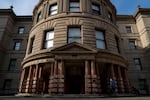
A man walks into Portland City Hall on Nov. 12, 2025 in Portland, Ore.
Eli Imadali / OPB
Late last year, arts organizations across Portland raised alarm after seeing reports of a significant amount of arts tax dollars appearing to be sitting untapped in city coffers. But the city says there’s no reason for concern.
The Arts Education and Access Tax, commonly called the arts tax, is an annual $35 tax on any Portlander who earns over $1,000 yearly. It generates roughly $12 million each year, which funds arts teachers at public schools and nonprofit art grants.
Last fall, arts nonprofit leaders stumbled upon a reference to $8.5 million sitting in the tax’s reserves. This was included in an annual arts tax report published in October and in city revenue documents.
The city did not dispute the characterization of these funds at the time. Nearly a month after OPB published a Feb. 9 story on these funds, the city said the number had been misinterpreted.
According to city spokesperson Alison Perkins, the $8.5 million was only a “snapshot” of money in the fund at the end of the fiscal year, in June. That pot of money is not sitting untouched year-round. According to city revenue data the fund is spent down to roughly $2 million annually.
“Because the City’s financial reporting captures the fund at a point in time, a year-over-year snapshot can give the impression that the balance is unchanged or sitting idle, when in fact funds are committed and distributed over the course of the year,” wrote Carrie Belding, another city spokesperson, in a March 20 email to OPB.
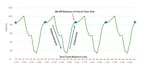
A chart provided by the city March 6 after OPB's initial reporting on the arts tax fund shows how the fund balance fluctuates over the course of a year.
City of Portland
OPB has confirmed with city finance leaders that this information is accurate.
It’s not immediately clear why this information wasn’t shared with OPB before publication Feb. 9.
Perkins offered this explanation to OPB this week: “With staff juggling multiple inquiries alongside their regular work, it can take time to respond and provide support, such as a detailed model explaining how the fund actually works.”
Public still calls for changes
Subsequent reporting and conversations with arts organizations, city councilors and members of the public make clear that many are still advocating for a change in the way the arts tax is dispersed — and more transparency around how much money is in the fund.
In the past year, arts nonprofits saw a 44% dip in the amount of arts tax dollars being shared with them via grants. Earlier this month, a group of 50 arts organizations sent a letter to city leaders calling on them to hand over any leftover arts tax dollars to make their programs whole.
It’s something Portland City Council President Jamie Dunphy is open to. Dunphy has proposed using arts tax dollars to restore that 44% cut, which would amount to $1.5 million annually. It’s one of several changes he’s proposed to overhaul the tax.
Last week, the city auditor’s office published a report that highlighted longstanding management issues involving the arts tax. According to City Auditor Simone Rede, the city has “not measured quality arts education nor ensured that grants improve access for students and underserved communities, as it promised Arts Tax funds would do. These conditions increase the risk that Arts Tax funds are not used as intended.”
How OPB reported and updated this story
The city took the rare step March 20 of issuing a press release about how unnamed media outlets have contributed to “inaccurate reporting” on the arts tax funds.
In December, OPB started making calls and reporting on this story. A key facet of our journalism is checking information with the principal sources, in this case, the city.
OPB asked to speak with officials overseeing the arts tax program about the $8.5 million in reserves. Instead of allowing OPB an interview with an arts tax official, city spokesperson Elliott Kozuch issued a response in a Feb. 3 email. In that email, Kozuch did not dispute the characterization of the $8.5 million as a reserve, nor did they dispute the dollar amount. They said that the fund appeared high because the city did not distribute any of the revenue collected in 2013, the first year of its collection. Public records obtained by OPB show this explanation was also used in an internal email from Revenue Division Director Thomas Lannom last year.
After interviewing six people knowledgeable of the fund, sifting through city revenue documents and reviewing more than 60 emails between arts tax officials about the reserves, OPB published a story Feb. 9 highlighting the $8.5 million in reserves.
Nearly a month later, city spokesperson Perkins said this interpretation of the arts tax funds was wrong. In the March 6 email, Perkins shared a chart with information showing the $8.5 million was drawn down annually. This had never been disclosed to OPB by the city at the time of our reporting.
OPB was slow to respond with an updated story after the city reached out post-publication, but has since confirmed the new numbers.
The city followed up two weeks later, informing OPB that they planned to issue a press release based on “inaccurate claims” made in OPB’s reporting.
OPB has since added an editor’s note to its original story to include the city’s updated explanation of the arts tax fund
The arts tax is due April 15.