Each year, the James Beard Foundation nominates chefs from across the U.S. for some of the nation’s highest culinary honors.
It may not come as a surprise that Oregon, a popular foodie destination, is home to a handful of chefs who might walk away with a James Beard award this year — and several 2026 nominees are coming to the table (pun intended) with unique accolades.
JORY Restaurant executive chef Jack Strong, a member of the Confederated Tribes of Siletz Indians, is the first Indigenous chef to be nominated for the award in Oregon. Married chefs Siobhan Speirits and Taylor Manning received a rare dual nomination for their restaurant Cafe Olli in Portland. And Joshua Dorcak, who heads MӒS in Ashland, is looking at his fourth nomination since 2023.
Ahead of the finalists announcement Tuesday, OPB spoke with four Oregon semifinalists vying for “Best Chef: Northwest & Pacific,” which includes nominees from Oregon, Washington, Alaska and Hawaii, about their work and how they’re feeling.
Responses have been edited for clarity and brevity.

Undated photo of JORY Restaurant staff during service at The Allison Inn & Spa in Newberg, Ore.
Courtesy of The Allison Inn & Spa
How did you become a chef?
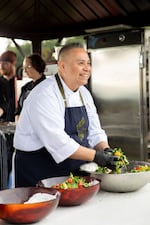
Chef Jack Strong, executive chef of JORY Restaurant in Newberg, Ore., mixes a salad.
Courtesy of The Allison Inn & Spa
Jack Strong: “I say that I didn’t pick being a chef — I feel like being a chef picked me a little bit. I grew up cooking for my grandparents, who raised me, and so I’ve been cooking at a young age. And I just love taking care of others and the hospitality world, so it was kind of ingrained with me as a youth.”
Siobhan Speirits: “I took a culinary arts class in high school … I had a really, really wonderful chef and teacher … He just was so passionate about teaching us the fundamentals of everything… and [that] really was the reason that set me on the path to go to culinary school … It was something that I was good at, and it kind of came naturally to me… When you’re 17 or 18, it can be kind of hard to feel like you know what you’re supposed to do, but as soon as it kind of clicked in my brain, it never occurred to me that I would do anything else.”
Taylor Manning: “I started working in kitchens in North Carolina under my uncle. He owned a few restaurants, and [I] really fell in love with the team and family aspect of everything. And then I really just fell in love with the food, the Italian side of things. But for me, it was more about the people. That really drew me in first.”
Joshua Dorcak: “I really had a family that was into preparing food together. So I think the first insights into what I was gonna do with my career was kind of a family thing: just noticing that good times happen around food. Then after high school, culinary school was kind of a solid option for me, cause I was not academic … Then everything kind of clicked … I was really engaged and participated and really consumed by the overall knowledge base that I was looking at. And then, once I found the actual working environment of restaurants, I was just kind of definitely hooked. It was for me.”
What makes your restaurant unique?
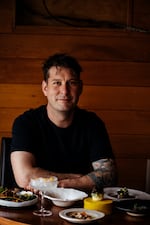
Joshua Dorcak, chef and owner of MÄS in Ashland, Ore., seated in front of assorted dishes.
Photo by Lindsey Bolling, via Mallory Smith, Field Day
Dorcak: “MӒS is very unique for the southern Oregon region. I feel like we’re really just trying to tell a story of where we live through the lens of food. The menu is constantly changing … It just kind of keeps up with the microseasons … And we’re all cooks. I don’t have any front-of-house staff here. So, it’s like we’re pouring the wine, the sake, we’re telling the context of the menu, we’re having conversations with people. I think, bottom line, the most unique thing about MӒS is the connection that diners get to the people that are cooking their food, you know, there is no middle person that’s going to be telling our story for us.”
Strong: “Storytelling is a big part, I think, that separates us a little bit. I love to tell stories through food. You know where you are when you eat at JORY … You know what season it is because we’re serving what’s in season at that moment … You might be having a honey dessert, and it’s telling the story of the 10 beehives that are across the street in our garden. Or it could be sunchokes, which are a native food, and those are also in [our] garden … I like to highlight native foods.”
Manning: “Cafe Olli is an employee-owned restaurant. Siobhan and I own 51% of the company, and anyone who is currently at the restaurant owns 49% … If the restaurant is profitable, that money gets divided equally between staff — so hopefully retaining staff better. We also have a 20% health and wellness fee that allows us to pay staff a higher hourly wage, PTO, sick time, and we cover 100% of health care.”

Chefs Siobhan Speirits and Taylor Manning standing inside their restaurant, Cafe Olli, in Portland, Ore.
Photo courtesy of Siobhan Speirits and Taylor Manning
What does being nominated for a James Beard award mean to you?
Manning: “A dream come true…”
Speirits: “It still feels kind of surreal, to be honest … That’s something that I think most chefs talk about or aspire to … We’re just making food and we’re trying to have a good time, and we’re trying to make sure our staff is OK … Running a restaurant is hard and being married is hard, and running a restaurant with the person that you’re married to can be really hard. And so I think for us this just felt like a real validation of the work that we’ve both put into this place for almost five years now.”
Strong: “It means a lot … One, it celebrates the team. From arrival to departure, we really create a great experience … People celebrate their anniversaries and their birthdays and all these special moments. But to be the first Native chef nominated for the Pacific Northwest, [it] kind of blows my mind a little bit that I’m the first, to be truthful … There isn’t a ton of us out there … There’s more than when I was coming up as a young cook, and so it’s great that there are more chefs that are making their imprint on the scene. But to be the first Native chef coming out of Oregon, [it’s] really special.”
Dorcak: “It’s exciting this time of year because the judges come into the restaurant, and it’s these big city kind of diners … which, for being in a small town, that’s the only time that we really get that kind of attention. I think for me and the staff here — it’s very small staff — all of us are pretty hyped about the opportunity that we have to kind of just showcase and really surprise people — that there is this type of restaurant in a town of 23,000 people.”
The James Beard Foundation is slated to announce award finalists on Tuesday, March 31, with winners crowned during the live awards ceremony on June 15, 2026.