

The Southeast Cesar E Chavez Boulevard sign is covered in graffiti at the intersection of Southeast Lincoln Street in Portland, Ore., on March 27, 2026.
Saskia Hatvany / OPB
Marta Guembes led the successful campaign to rename Portland’s 39th Avenue Southeast after labor leader Cesar Chavez in the late 2000s.
Last week, following revelations that Chavez had allegedly sexually abused women and girls, Guembes took a photograph of Chavez off her kitchen wall and carefully cut it into 39 pieces.
“I haven’t been able to throw it away,” Guembes said Friday, looking at the pile of the fragmented photo scattered on her coffee table. “I can’t rush it. It needs to be intentional. There needs to be a process.”
That’s how Guembes and other activists involved in the 2007 initiative to rename 39th Avenue feel about the current calls to remove Chavez’s name from the north-south thoroughfare on Portland’s east side.
Others want more immediate change, urging a swift renaming, matching the pace of some other efforts to scrub Chavez’s name from public spaces in cities across the country.
While Portlanders may disagree with the approach, they appear united on one thing: The name needs to change.

“For women’s sake everywhere, I feel like it needs to be different,” said Megan Koehler, a Portland therapist who has lived two blocks away from Cesar E Chavez Boulevard for nine years. “Previously, I was really proud to be on a street that represents someone who really made a difference. Now I don’t. There needs to be accountability.”
For years, cities and states across the U.S. celebrated Chavez’s March 31 birthday with parades, proclamations and other events.
In Oregon, like other states, all planned events memorializing the day have been cancelled. Instead of celebrations, Portlanders are calling for a way to acknowledge the pain of Chavez’s legacy.

Marta Guembes poses for a portrait at her home in Portland, Ore., on March 25, 2026. Guembes is the co-chair of the committee that led the effort to rename 39th Avenue in Portland in the late 2000s, and is now involved in discussions to change the name again.
Saskia Hatvany / OPB
The campaign to change a city street name to memorialize Chavez began in 2007. It came on the heels of a city council vote to change Portland Boulevard in North Portland to Rosa Parks Way.
Guembes, a county health worker at the time, said she joined the volunteer organizing group behind the effort, the Chavez Committee, because she thought it would be meaningful and fun.
Guembes saw a chance to recognize Portland’s Latino community through the legacy of a civil rights leader. But her experience as the committee’s co-chair during what became a three-year-long fight was less rosy.
“I saw the ugliest side of Portland, such hatred,” Guembes said, wiping away tears as she spoke at her dining room table on Friday. “I received death threats. I put my family, my children at risk. I saw racism right in my face.”
The group targeted streets on both sides of the Willamette River and faced stiff opposition from people who lived or worked along them.
Guembes said she felt abandoned by elected officials who allowed her committee to take the heat for the proposal.
After attempts to bring Chavez’s name to Interstate Avenue, Broadway Street, Grand Avenue and 4th Avenue failed, the committee finally brought the 39th Avenue renaming proposal to the City Council in 2009.
Despite pushback from neighborhood groups along the eastside thoroughfare, the plan passed unanimously.
“We live in a city with a growing Latino community, yet there is not one single street in our great city that honors their heritage,” said then-City Commissioner Nick Fish, before casting his vote. “Today, we can change that.”
Guembes recalled feeling relieved after the vote.
She framed a news clipping from The Oregonian about the decision, but she and her committee members never really celebrated the change. They were eager to put the stress and pain of the years of advocacy behind them.
For years, it remained there.

A signed photo of Cesar Chavez lay sliced into 39 pieces on the coffee table of Marta Guembes' home in Portland, Ore., on March 25, 2026. Guembes had the portrait hanging in her home for years and removed it once she found out about the allegations of Chavez's sexual abuse against women.
Saskia Hatvany / OPB
On March 18, the New York Times published a five-year investigation that highlighted extensive and shocking allegations that Chavez had assaulted and raped women and girls while leading the United Farm Workers union.
The story included on-the-record comments from UFW co-founder and civil rights leader Dolores Huerta, who said she was raped by Chavez. Chavez died in 1993.
“When I saw that news, I was horrified. I wanted to throw up,” Guembes said. “I felt betrayed and angry. I went through all the stages of grief in one day.”
There are more than 100 streets, schools, libraries and other public spaces in the United States that were hard-fought to be named after Chavez.
Shortly after the news broke, leaders across the country called to remove his name from these places.
Portland City Councilor Candace Avalos, who is a child of Guatemalan immigrants, was quick to weigh in.
“I have begun looking into the process and talking with community leaders about renaming Cesar Chavez blvd to Dolores Huerta blvd,” Avalos wrote on Bluesky that morning. “Per city code, one of the first steps is a petition with 2500 signatures. Stay tuned for ways to be involved in this effort.”
I have begun looking into the process and talking with community leaders about renaming Cesar Chavez blvd to Dolores Huerta blvd. Per city code, one of the first steps is a petition with 2500 signatures. Stay tuned for ways to be involved in this effort. 🫶🏾
— Candace Avalos (@candaceavalos.bsky.social) March 18, 2026 at 10:10 AM
There is no precedent for removing a person’s name from a street in Portland — only renaming a street after a person.
Under city code, changing a street name requires the support of at least 2,500 Portlanders or at least 75% of people living on the street in question.
It also requires a convincing pitch on why the name should be changed, based on historic significance.
The city has not received any applications to rename Chavez Boulevard since the New York Times investigation was published, according to the Portland Bureau of Transportation.
Avalos wants to hold a community meeting where people can discuss the future of this street and consider a way to still commemorate the farmworkers’ rights movement without Chavez.
“This is more than just a renaming of a street,” Avalos told OPB last week. “It’s more about how we honor our movements and the people that make them without idolizing the people that harm our communities like Cesar did.”
She said it’s particularly important to stand up for Portland’s Latino community now, as they’ve faced a surge in scrutiny and arrests by federal immigration authorities.
She said it’s an issue that should be addressed with urgency, as a way to protect Portland’s Latino community from additional harm.
Some who live near Chavez Boulevard agree.
On a sunny Friday afternoon, Matthew Watson waited for the bus on the corner of Chavez Boulevard and Hawthorne Boulevard.
Watson said he grew up in Portland, but has lived in the neighborhood for about a year. He said he wants the name gone, but worries that the process will be hampered by bureaucratic delays.
“I think it’s the kind of situation where the sooner we can fix it, the less painful it will be later on,” Watson said. “The negative impact isn’t going to go away, and there are lots of other civil rights leaders that we could replace the name with to make people feel more comfortable.”
Down the street at Tom’s Bar, a Chavez Boulevard watering hole, fellow neighbor Koehler said that removing the sign swiftly will help other victims of abuse.
“I have lots of friends who have been sexually assaulted, and having that reminder on a daily basis — it’s triggering,” Koehler said. “It’s awful that women still have to experience that.”

Megan Koehler sits at Tom's Bar on Southeast Cesar E Chavez Boulevard on March 27, 2026, in Portland, Ore.
Saskia Hatvany / OPB
Guembes and other advocates for Portland’s Latino community want to see the momentum to rename the street slowed down.
Guembes met with members of the Chavez Committee a week after the news dropped.
They all agreed that the street needed to be renamed — but only after a thoughtful, community-led process.
“Our community needs time to grieve,” wrote Guembes and fellow committee co-chair Jose Romero in a public statement they shared after their meeting. “Time to hold the full complexity of legacy, truth, harm, and history. Rushing to a decision risks deepening harm, rather than healing it.”
Romero and Guembes met with Mayor Keith Wilson on Thursday to share this perspective.
Guembes left with the impression Wilson agreed with their recommendation to slow down. Taylor Zajonc, a spokesperson for Wilson’s office, confirmed this.
“This is a time for patience, for grief, and for listening,” Zajonc wrote. “The temptation to act immediately must be tempered by greater purpose and a commitment to follow the lead of those who have labored for dignity and recognition. Mayor Wilson supports an intentional, community-led path to renaming and an outcome that reflects the humanity and contribution of our Latinx community.”
Cost is top of mind for Wilson, who is working on a plan to fill a nearly $170 million budget gap this year.
The cost to rename 39th Avenue cost the city about $200,000 in staff time and material costs in the five years following the council vote.
It’s not clear how much a second iteration of this work would cost more than a decade later.
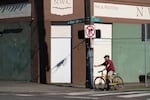
A person waits at the intersection of Southeast Cesar E Chavez Boulevard and Southeast Lincoln Street on March 27, 2026.
Saskia Hatvany / OPB
According to PBOT spokesperson Dylan Rivera, the city stopped processing street renaming requests from the public in 2023, due to budget constraints.
Guembes and the original Chavez Committee members are still waiting to start holding public conversations about a proposal to change the street name again.
In the meantime, they’re talking with Pineros Y Campesinos Unidos del Noroeste, or PCUN, Oregon’s largest farmworker union, and other Latino community groups, to shape their approach.
Guembes has retired. She now spends most of her time volunteering as the Honorary Consul for Guatemala in Oregon, a job where she supports Guatemalan Oregonians threatened with deportation.
She sees a chance to continue to advocate for Portland Latinos in a renewed campaign to change the street name she fought years for.
“I think the city has learned from its past,” Guembes said. “This is not about Cesar Chavez. This is about who we are. This is about the movement. La causa.”
La causa, or “the cause,” is a phrase associated with the farmworker rights movement Chavez helped lead.
The Chavez Committee has already decided to rename itself: Por la Causa.