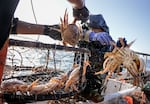
FILE — Crew members pull up a pot of Dungeness crab off of Port Orford, Ore., May 17, 2022. Changes may be on the horizon in 2026 for commercial crab fisheries in Oregon.
Arya Surowidjojo / OPB
Oregon’s valuable commercial Dungeness crab fishery has seen significant changes in recent years as the state looks to minimize and monitor whale entanglements involving gear used in the fishery.
Now more changes are on the horizon. And looming over everything is uncertainty around the details of a federal permit the state is seeking that would allow the fishery to have some degree of impact on endangered humpback populations.
Many of the recent tweaks and additions to Dungeness crab fishery operations are in fact tied to a conservation plan the state is required to complete in order to obtain the incidental take permit under Section 10 of the federal Endangered Species Act. This permit could provide some certainty to fishermen that even if their gear is implicated in humpback whale entanglements, fishing won’t immediately be shut down. The submittal process is underway now, but state fishery managers say it could be several years before a permit is issued.
An industry meeting in Astoria on Thursday hosted by Oregon Department of Fish and Wildlife staff was intended to brief local commercial crabbers and gather input from them ahead of a meeting in August where Oregon Fish and Wildlife commissioners are expected to consider a suite of new regulations connected to the conservation plan, including the possibility of electronic vessel monitoring for the upcoming season, the use of experimental fishing gear and making what had been a temporary rule to close the fishery a month early permanent.
But the main question on crabbers’ minds was the federal take permit and how many whales NOAA Fisheries might allow the state fishery to impact. For them it is the question that nearly everything else revolves around.
“Are we talking about one whale? Are we talking about 10 whales? Are we talking about different varieties of whales?” asked Lance Gray, a crabber who fishes the Columbia River areas in both Oregon and Washington state. “I mean, that is so huge for us and where we’re going with our lives: that somebody’s going to come to us and say, ‘If you entangle one gray whale’ — which I’m sure there are people that feel that way — ‘that you should be closed down.’ That’s what we’re trying to figure out here.”
Many of the humpback whale populations that pass by Oregon are considered threatened or endangered. According to NOAA Fisheries, Oregon Dungeness crab fishing gear entangled three humpback whales in 2024 and four in 2025.
One case late in 2025 drew extensive public and media attention. An entangled juvenile humpback whale was stranded alive near Yachats that November. As word got out, cars lined both sides of the highway as people parked and walked to the beach to get a look. The whale was euthanized after efforts to free it were unsuccessful.
Derelict commercial crabbing gear — gear not being actively used by crabbers and lost in a previous fishery — was implicated. There was no active commercial crabbing at the time of the stranding. ,
State fishery managers say increasing issues between crabbing gear and whales are due to a combination of factors: a growing humpback population, shifting ocean conditions that have resulted in more overlap between whales and crab gear and increased awareness that has led to better reporting and documentation of entangled whales.
Crabbers at the Thursday meeting in Astoria pressed Justin Ainsworth, the Oregon Department of Fish and Wildlife’s Marine Resources Program manager, for a hint at what the state is asking for in terms of how many whales the commercial Dungeness crab fishery might be allowed to impact each year — a ballpark number.
They don’t want to see whales hurt by fishing gear, they said, but the uncertainty around the fishery right now because of the whales is scary.
Ainsworth declined to go into details about what the state is requesting, but referenced the humpback whales entangled last year.
“So last year: four?” he said and shook his head. “Too many.”
Fishery managers said they understood crabbers’ concerns and their interest in wanting more details. But Brittany Harrington, project leader for the Marine Life Entanglement Project with Oregon’s Marine Resources Program, noted that this is the first time NOAA Fisheries has considered a take permit of this kind for an endangered marine mammal. It has been a learning curve for both sides and the process is ongoing, she said.
Shon Landon, who is primarily based out of Westport in Washington state but fishes the river in both Oregon and Washington, told KMUN there’s not as much whale activity off the North Coast. However, crabbers here are often the ones that hit the water later than the rest of the coast. He worries about whale issues farther south affecting fishing operations up north.
“None of us want to see entangled whales,” Landon said, but added that there needs to be more data from aerial surveys and electronic monitoring of fishing vessels to better understand the intersection of fishing activities and whale movement.
“I’m not really sure if the take permit’s good or bad,” Leo Travenshek, an Astoria-based fisherman, told KMUN.
Like Landon and others, Travenshek worries about what will ultimately count against the fishery, particularly in instances where whales might tangle with derelict fishing gear that was lost at sea years ago. Would that kind of entanglement count against fishermen now and potentially shut down a season before it even begins?
With the additional changes to fishery operations happening hand-in-hand with the take permit application process, Travenshek and others say they are also seeing an increase in costs, red tape and time spent on things not directly associated with the work of fishing. And all of this is happening in the context of a shortened season — though much of the crab caught in Oregon is usually landed in the early weeks of the fishery.
Travenshek said the additional regulations make already steep barriers to entry that much higher for new crabbers and he worries about it devaluing the fishery.
“They implement all these rules, could I even get much value out of our investment if I wanted to sell out?” he said.
In December 2025, a group that included the Center for Biological Diversity, Oceana and the Natural Resources Defense Council along with American Cetacean Society and others petitioned the Oregon Fish and Wildlife Commission to modify rules to further reduce the risk of whale entanglement and continue with plans to obtain Endangered Species Act coverage.
The commissioners voted 6-1 to deny the petition at a meeting in February, saying much of the work requested by the petition was already underway or being explored.
Katie Frankowicz is a reporter with KMUN. This story comes to you from the Northwest News Network, a collaboration between public media organizations in Oregon and Washington.
It is part of OPB’s broader effort to ensure that everyone in our region has access to quality journalism that informs, entertains and enriches their lives. To learn more, visit our journalism partnerships page.