
Meals are distributed to seniors at the Asian Health and Service Center in Portland, Ore., on May 21, 2026. The organization distributes free lunches to seniors from Tuesdays to Thursdays.
Saskia Hatvany / OPB
More than 40 years ago, tucked into a 600-square-foot basement space in Portland’s Woodstock neighborhood, the Asian Health and Service Center first opened its doors.
Board chair Dr. Erik Szeto, a retired family physician, founded AHSC — then called the Chinese Social Service Center — in 1983 in response to a major gap in culturally and linguistically appropriate social and mental health services for Asian communities in Portland, especially seniors, women and immigrants.
It was built at a time when broader conversations around mental health, particularly for Asian and Asian American communities, went largely undiscussed.
In the decades since its founding, the center has grown into a three-story, 40,000-square-foot facility that has served more than 24,000 families and expanded its services to include hot meals, recreational activities, workshops, benefits navigation, tax assistance and help accessing medical care — all wraparound services aimed at building rapport and trust with immigrant clients.
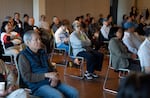
Seniors listen to a presentation on aging and loneliness at the Asian Health and Service Center in Portland, Ore., on May 21, 2026. The center offers daily programming for seniors.
Saskia Hatvany / OPB
Just as the center has grown and changed, so have the concerns of the immigrant and Asian American communities it served. Four decades ago, Portland was welcoming an influx of new arrivals from Vietnam. Today, Asian and Asian American communities are less concerned about far-away conflicts, and more concerned about political rhetoric from Washington, D.C.
Building trust through culturally-specific wraparound care
Located in the Lents neighborhood, the 43-year-old AHSC is one of the few mental health clinics in Portland serving communities of color. Unlike similar organizations across the country that serve only one ethnic community, AHSC serves Chinese-, Korean- and Vietnamese-speaking communities under one roof.
Szeto remembered that while applying for funding under former Congresswoman Edith Green’s mentorship, he was often questioned about whether a mental health clinic focused solely on Asian communities would attract enough clients. The skepticism reflected widespread misconceptions about Asian American mental health at the time.
“The [Multnomah] county and the city didn’t even think those services were necessary,” he said. “Many of them thought Asians had no problem because we took care of our own.”

Supplied profile photo of Dr. Erik Szeto, board chair of Asian Health and Service Center in Portland, Ore., in 2025.
Courtesy of Asian Health and Service Center
Inspired by the image of lanterns rising into the night sky — a symbol of hope in many Asian cultures — the AHSC building is designed to reflect its tiered service model: The top floor hosts a wide range of community activities, the second floor houses staff and volunteers focused on general health services and outreach, and the ground floor provides personal consultation and clinic services.
Born in Hong Kong, Szeto said mental health remains deeply stigmatized in many Asian cultures, making trust, language access and cultural understanding essential to treatment. He said AHSC has spent more than 15 years building those relationships within immigrant communities.
“You cannot counsel a person that you don’t speak to them in their native language,” he said. “When I first wanted to refer my patients to a mental health clinic, they [would] not go for two reasons: They don’t think they understand them, that’s one. No. 2, it’s a small society. How would you just pull your heart out about everything in the family to an interpreter? How do you know the interpreter will keep your secret? So it just doesn’t work.”

Thao Nguyen, left, and Loc Ly sing karaoke at the Asian Health and Service Center in Portland, Ore., on May 21, 2026.
Saskia Hatvany / OPB
Along with building trust through shared language, staff at the AHSC can also recognize the different ways mental health conditions can manifest across cultures.
Dr. Paul Leung, a retired psychiatrist from OHSU, has spent decades providing mental health care to Asian immigrant and refugee communities in Portland. He helped establish mental health services at AHSC in the mid-1980s.
Born in Vietnam and raised in Laos and Hong Kong, Leung said mental health conditions such as depression and anxiety are universal across ethnic groups, but the ways people express symptoms and seek help can vary widely among immigrants.
“If I have an immigrant coming from China within the last six months now experiencing symptoms of not [being] able to sleep, not feeling happy and anxious all the time, feeling helpless, feeling hopeless. Now, we all know that that kind of symptoms are very consistent with people suffering [from] depression or anxiety,” Leung said, adding that many immigrants would not recognize those symptoms as mental health issues and mention them to their family doctor.

People pack meals for seniors at the Asian Health and Service Center in Portland, Ore., on May 21, 2026.
Saskia Hatvany / OPB
Beyond cultural differences in recognizing mental health symptoms, health providers say many immigrant patients are grappling with a new source of anxiety: the Trump administration’s nationwide crackdown on immigration.
Patient concerns amid immigration crackdown
Lately, AHSC staff say patients are raising concerns about social attitudes toward immigrants. Since President Donald Trump took office, he’s made immigration enforcement a centerpiece of his administration, cracking down on immigration policies and challenging established laws, including birthright citizenship, and tightening the application process for permanent resident cards, more commonly called green cards.
“There’s been certain individuals who worry that by signing up for healthcare, it leads to them being put on some kind of list in order for immigration [enforcement authorities] to be on the watch out for them,” said Vinh Tran, a counselor at AHSC for seven years.
Tran said that while immigration-related stress is rarely the primary reason patients seek therapy, the broader political environment often intensifies existing mental health struggles.
“[The current administration’s] views on immigration and views on foreign citizens … definitely it adds a lot of stressors and it creates an atmosphere of uncertainty. And with that uncertainty, there’s just a lot of fear that something might happen to them because of the stories that we hear in the community about people being deported,” he said.
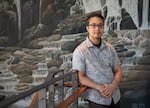
Vinh Quang Tran poses for a portrait at the Asian Health and Service Center in Portland, Ore., on May 21, 2026.
Saskia Hatvany / OPB
To address those fears, Tran said AHSC reassures patients that the Health Insurance Portability and Accountability Act of 1996, or HIPAA, strictly limits the release of medical information. Patient records are confidential and cannot be shared without consent except under very limited legal circumstances. In response to the Trump administration’s transfer last June of Medicaid data from millions of enrollees to deportation officials, Oregon and 13 other Democratic-led states joined a lawsuit citing potential HIPAA violations.
Psychiatrist Dr. Leung said fears surrounding immigration status have become a growing barrier to care under the current political climate. Although he is not aware of cases in which accessing mental health services negatively affected someone’s legal status or future citizenship, he said rumors and misinformation remain widespread and may prevent people from seeking treatment.

Yvonne Li, community health worker at Asian Health and Service Center, works at her desk on May 21, 2026 in Portland, Ore.
Saskia Hatvany / OPB
Other social programs have seen similar impacts. Oregon health officials reported concerns in January when fewer eligible residents enrolled in the state’s Medicaid-like program, citing worries about data privacy and heightened immigration enforcement under the Trump administration.
Tran said the AHSC encourages people to seek help when needed, despite these larger social concerns. Growing up, he watched his grandmother struggle with grief and depression after his grandfather’s death, though those issues were never openly discussed.
“Going to undergrad, learning about psychology, learning about mental health, I saw it as an opportunity to provide a service that my community needed — one that wasn’t really talked about, one that was kind of shoved under the rug and just tiptoed around,” he said.

People chat in the hallway at the Asian Health and Service Center in Portland, Ore., on May 21, 2026.
Saskia Hatvany / OPB
Note: Despite sharing the same last name, this story’s reporter and the AHSC board chair aren’t related.
Correction: This story has been updated with the correct name of the neighborhood where the AHSC was founded.