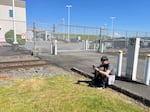
One of Ky Sengdara's sons waits outside a gate at the Northwest ICE Processing Center in Tacoma on May 4.
KUOW Photo / Gustavo Sagrero Álvarez
About a dozen people sit on blankets on a stretch of grass outside the barbed-wire fences that surround the Northwest ICE Processing Center in Tacoma.
They snack on chips and soda and share stories in a mix of Lao and English, talking about how dark their skin gets with the sun, family affairs, and the occasional story that generates some laughs. Mt. Rainier is visible in the distance.
They are hoping for the release of Ky Sengdara, a friend, uncle, dad, and grandfather who was detained and has been held for months at the Tacoma ICE facility.
Nearby, a toddler of the family pushes a key she found into the dirt a few meters from the fence.
“She’s digging a hole into the detention center right now,” her mom said. No one laughs.
Washington state is home to one of the largest communities of Laos refugees in the country. Under the Trump administration, many are facing new scrutiny from Immigration and Customs Enforcement. For decades, people from Laos who got a deportation order were able to stay and work in the U.S. That’s because Laos wouldn’t take them back.
Under pressure from the Trump administration, those deportation flights have picked up.
RELATED: ICE is spending millions of dollars on iris scanners, expanding its arsenal of tech tools
Sengdara is from Raymond, a coastal town in Pacific County. President Trump won that county by a thin margin in the 2024 election partly by campaigning on deporting people he called “migrant criminals.”
Sengdara’s eldest daughter Melissa Ekkaphanh says many people from Laos moved to Pacific County as refugees of the Vietnam War like her parents and grandparents. With abundant cannery and logging jobs, she said it was a good place to start a new life, but there were other reasons, too.
“A lot of people came there, after migrating here. Because it is cheaper, and you are able to provide for your family, especially back then,” she said. “Being able to live off the land, whether it’s fishing or hunting or clam digging. It’s not as hectic as the city, so I think it was a little bit easier for them to adapt.”
Ekkaphanh has learned a lot these past weeks about her family’s history in Laos and their early years in Washington state.
Her dad, Sengdara, has a decades-old deportation order related to a drug charge that was basically put on hold because Laos refused to take most deportees back.
He was still required to check in with ICE once a year and he had done so for 20 years while he built a life.
Then ICE sent a surprise letter, asking him to come in an extra time back in March. Ekkaphanh tried to go with her dad.
“They told me, no, that it was just a check-in. Fifteen minutes later he walked out in handcuffs in front of me and my children,” Ekkaphanh said. “We’ve been navigating since then.”
RELATED: DHS says ICE has ‘no relationship’ with spyware maker Paragon Solutions
Meanwhile, Ekkaphanh was being evicted from her Grays Harbor County home where she was raising her kids. She found herself fighting battles on two fronts — to keep her dad and her house.
Since March, Ekkaphanh said she’s been approached by at least 30 other people in the community asking for help for their family members.
Ekkaphanh found her way through with the help of the Seattle Clemency Project. The group has managed 19 cases of refugees from Laos across the Northwest who are facing deportation in 2026, according to the project’s legal director, Jennie Pasquarella.
Sengdara isn’t the only member of his extended family who is in danger of deportation. Ekkaphanh said her cousin, Chanh Phansisay, received a similar letter from ICE around the same time as her father. Phansisay also received legal help from the Seattle Clemency Project and avoided being deported to Laos — a place he’s never known.
“We all came here as babies, so it’s kinda like... you don’t know anybody over there,” Phansisay said. “People ask me, ‘You have family over there?’ I was like, ‘I have cousins, but I don’t talk to them.’”
His uncle, Sengdara, arrived in the U.S. in 1981 when he was 8. He later got a green card. His family fled Laos when he was 5 because his dad and others worked alongside the U.S. military there in a “secret war” against communism.
After the war, his family was at risk of being persecuted by a government that’s still in power today.
“Laos wasn’t taking us back, so I mean, it was something you weren’t worried about, you know? You didn’t have to look over your shoulder or anything until now,” Phansisay said.
RELATED: Former private prison official to serve as acting ICE chief
When deportees arrive in Laos from the U.S., they’re not considered citizens by the Laos government. They are kept on military bases, according to records shared with KUOW by the Seattle Clemency Project. Deportees are allowed to leave the bases only if they can connect with distant family or a sponsor. Even then, they are not allowed to leave Laos.
Nationwide, nearly 5,000 people from Laos are estimated to have deportation orders. These are people who had a green card, but then committed a crime that was a deportable offense.
Sengdara pleaded guilty in 1999 to a drug offense, possession with intent to deliver methamphetamine, and later got a deportation order. He served time and was released into immigration custody. But for more than 20 years, Laos wouldn’t take him or others back.
In cases like this, the U.S. government would release people if they weren’t considered a flight risk or a threat to the community. Sengdara was soon released from immigration lockup.
That changed last year after the Trump administration issued a travel ban on Laos – putting pressure on the country to take deportees. The administration’s practice of deporting people to a third country also played a role in Laos agreeing to take in U.S. refugees.
“From what I understand, the Laos government didn’t want their people to get deported to some other country that they’re not from, you know? So they’re like, “All right, we’ll take you guys back slowly,” Phansisay said.
RELATED: Sexual abuse investigations mishandled at Tacoma ICE lockup, UW report finds
After Sengdara was detained, ICE presented him with travel documents for Laos, an essential step to send deportees out of the country. But the Seattle Clemency Project said ICE failed to give notice that Sengdara was going to be re-detained, part of refugees’ due-process rights in decades-old deportation orders.
Sengdara’s drug conviction also had been thrown out, because his lawyers discovered he wasn’t told at the time about the immigration consequences of a guilty plea. That overturned conviction restored his green card status.
“Twelve hours later, [I’m] getting a phone call from my dad,” Ekkaphanh said.
“They’re moving me,” he told her.
He was flown out of Tacoma to a facility in Arizona, and then Texas, Ekkaphanh said. That’s where ICE commonly stages flights for people out of the country. But then they flew him back to Tacoma to be in court for his final hearing.
An immigration judge terminated the government’s case to deport Sengdara. But Ekkaphanh had already lost her trust in the federal government, and had been waiting with her family outside the ICE facility with apprehension. They didn’t get confirmation that Sengdara would be released until late in the afternoon on the day of his hearing.
When Sengdara finally walked out of the facility, he was wearing street clothes and freshly showered. The grandkids fought over who got to hug him first.
“Why did it take you forever?” they shouted across the fence as he reached for the small gate where released detainees exit.
“You could’ve climbed the gate,” they said as he opened it to step through.
Sengdara already had plans for the coming days.
“I’m going to go to the beach and enjoy it. I’m not gonna go to work for at least a week, just trying to feel the freedom and get some fresh air first,” he said. “You know, it’s stressful in there, man.”
Sengdara was released just in time to go clamming for the last day of the season. He didn’t take a week off like he planned. Instead he went back to his job as a truck driver. His daughter and her family, post-eviction, planned to move in with him, in Raymond.
Gustavo Sagrero Álvarez is a reporter with KUOW. This story comes to you from the Northwest News Network, a collaboration between public media organizations in Oregon and Washington.
It is part of OPB’s broader effort to ensure that everyone in our region has access to quality journalism that informs, entertains and enriches their lives. To learn more, visit our journalism partnerships page.